After Burner Climax
Mile high club.

After Burner Climax is a hyper-realistic recreation of how it feels to fly a jet fighter plane in every eight-year-old boy's imagination. Forget the multitudinous dials, switches and levers that clutter studious flight simulators; SEGA AM2's latest is a celebration of the economical. You have a machine gun, an unlimited supply of missiles and a plane that barrel rolls in perfect, elegant tumbles at the snap of a single analogue stick.
Wherever realism presents a barrier to joy it has been discarded without second thought, in the way that only a developer who makes arcade games that must grab a player's attention within 10 seconds of an attract mode sequence can truly subscribe to. You may not have a bleached-blonde girlfriend fist-pumping the clouds at every fiery enemy takedown, and the high-speed detail of the open road has been swapped for the blemish-less sweep of the stratosphere, but in spirit and colouring, this is OutRun in the sky.
It is, then, something of an anachronism: the sort of primary-colour explosion of joyful simplicity that SEGA has left behind for Sumo Digital to lovingly reclaim for those who remember the Japanese giant's brightest creative period. After Burner Climax - released this week on Xbox Live Arcade and PlayStation Network - is, after all, a four-year-old game, the fourth in the dog-fighting series, and one that originally came bundled with a servo-equipped chair in arcades.
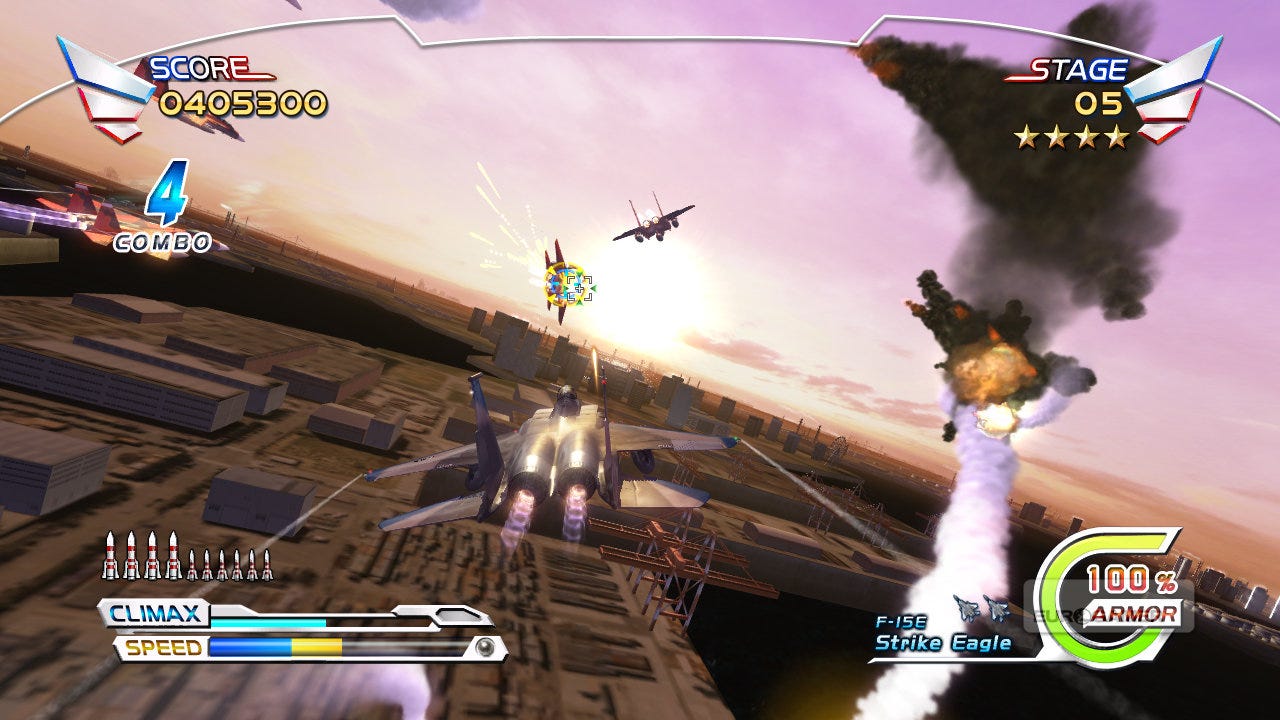
At home, stripped of this prohibitively expensive hardware, some of the attention-grabbing appeal of the package is lost. But as with all AM2 games, there's enough here to sustain you beyond the gimmicks, and while it may not be the division's best work, the bold aesthetic and strong underlying systems make its journey from arcade to home a welcome one.
As with OutRun, you have the choice of a handful of vehicles to pilot - the F/A-18E, F14D Super Tomcat and the F-15E, each of which come with four paint options. The game is then broken into short, sucker-punch stages which run into one another, each themed around different skyscapes whose hues are varied by time of day and proximity to the equator. Lure of the Sky is a twilight dash under the Northern lights, while Vertical Hot Air has you tearing over mustard sand dunes. Innocent Land, by contrast, takes place over patchwork fields framed by an ebullient rainbow, each area as distinct as the next.
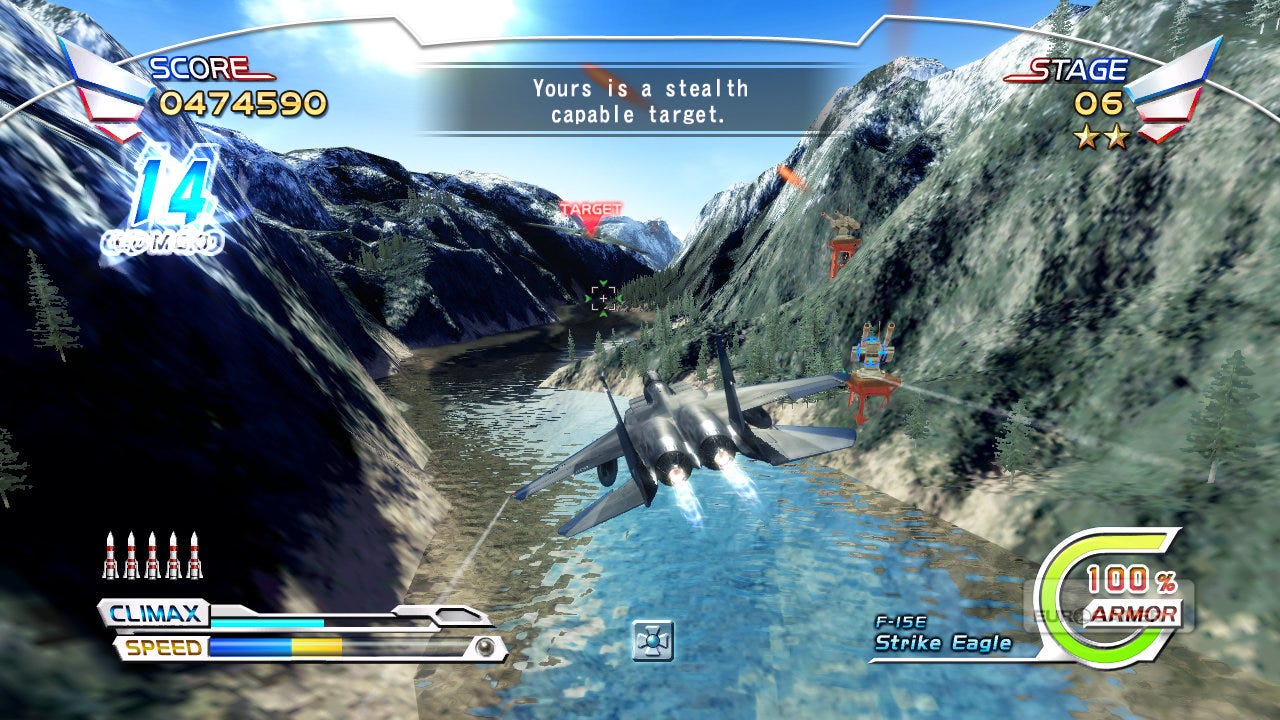
There's little rhyme or reason to the geographical progression of stages: volcano follows jungle follows ice cap. The point is less to recreate a logical flight path than to allow you to fly through a sequence of picture-postcard vistas, a National Geographic flick-book of locations. Twice, the game branches, allowing you an option of which stage to tackle next, and should you meet hidden criteria, you'll also gain access to the occasional secret level. But despite these diversions, the journey is linear and generally short, a single fly-through of the game taking around 20 minutes from start to finish.
The controls are elegant and simple. A machine gun is effective against enemies at close range, as well as Stealth Bombers that are impervious to any other type of attack. Missiles, the only other form of attack available, can be fired after you've 'painted' a target with your lock-on cursor in a similar style to Rez and Panzer Dragoon. While it's possible to have multiple painted targets on screen at once, you'll need to hit the fire button once for each, rather than unleashing a hail of rocket fire. This is where the core of the game is to be found, with many enemy planes darting across the screen in predefined patterns, requiring you to learn their movements and anticipate their positions in order to score a full 100% takedown rating for a stage.