They don't make them like they used to. Apart from, perhaps, when they do - and then they're quite possibly better than ever before.
At the turn of the century the world was in love with the polygon - which isn't the best of news when your best work has traditionally been on two planes. To say Japanese boutique developer Treasure was struggling would be an overstatement - games like 2000's Sin & Punishment and 2001's Freak Out showed the developer of mini-masterpieces such as Gunstar Heroes and Radiant Silvergun was able to port its hyper creativity to three dimensions.
But games like Wario World - a rare home showcase for Nintendo's anti-hero that, while far from a disaster itself, was most definitely average - and the woeful Dragon Drive D, a title that the developer refuses to credit on its own homepage, saw a definite downturn, with a sense of apathy creeping into an output previously renowned for energy.
Nintendo's Game Boy Advance, with its unwillingness to create 3D worlds and its ability to conjure magnificent 2D ones, acted as the perfect tonic. Here, Treasure could return to its most comfortable workspace, but armed this time with better tools.
The partnership between the studio and the handheld started in humble fashion; Hajime no Ippo: The Fighting, a take on the popular manga and anime series that played out like Punch Out after several beef dinners and a month in the gym. Muscular, lean and sure-footed, it was a taut slice of brilliance, a stark contrast to its more bloated and directionless home console games at the time.
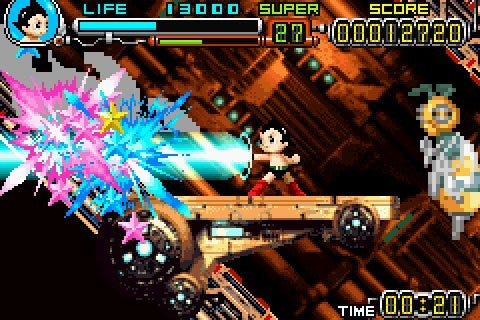
Complete one runthrough and the game starts proper, with old levels repurposed as a time travel mechanic unravels in Omega Factor's plot.
Treasure's next effort on the GBA - developed in tandem with SEGA's Hitmaker studio - would take on another, slightly more revered licence. If Osamu Tezuka really is, as he's often billed, Japan's equivalent of Walt Disney, then Astro Boy is most definitely his Mickey Mouse. The Pinocchio tale told with rocket boots, Tezuka's world has a warmth that transcends its peers, populated by bumbling cigar-nosed detectives working against villains that bumble just as hard.
It's a world dense with characters, and it's one with a touching sadness at its core; created by a grieving doctor in the image of his departed son, Astro Boy's struggle with his existence and his burgeoning humanity creating an affectionate hook.
Both of which are apparent in Omega Factor; no mean feat when you consider that this particular take on Tezuka's world is, in between the abstract action, conjured from static screens, sparse interchanges and a central story that doesn't run much longer than an hour.
The titular Omega Factor fuels this; a sprawling honeycombed grid, it collects every character that Astro Boy encounters throughout the game. Each encounter - and some of them are obvious while others lurk in darker corners of levels - adds a point to spend on Astro's RPG-flavoured progression.
There's a lot of progression to make, thanks to the fact there are a lot of characters to encounter. Like Kingdom Hearts before it, Omega Factor ransacks Tezuka's oeuvre, pulling in appearances not just from Astro Boy itself but also from further afield; from Kimba the White Lion, from Black Jack and from Phoenix.
It's an all-inclusive approach not exactly exclusive to the game; Tezuka often repurposed his characters, casting them in slightly different roles across his various universes - but it does make Omega Factor an engaging interactive encyclopedia.
It's much much more, of course. As a 2D action game by one of the masters of the form, it's also a joy to play, and the confidence with which the world is handled is merely an endearing frame for a canvas splashed with some of Treasure's deftest strokes.
Omega Factor is all-inclusive not just in its extended character roster - as an action game it features cameos from Treasure's rich history; a little of Gunstar, a little of Guardian and there's even enough time to reference lesser knowns with a boss that's crept in from unsung gem Alien Soldier.
Firstly, this is a parallax paradise, a world of aching beauty told in striking 2D vistas. There's Metro City, a futuristic utopia captured under a crisp blue sky, and it's followed up with lush lost civilizations, hulking underwater trains and industrial plants on the surface of the moon.
The real star, quite rightly, is Astro Boy himself, a lead who's had each pixel infused with character. He's lovingly animated, bounding around with a mixture of enthusiasm and menace that gives him the air of a particularly savage toddler.
He's a savage toddler let loose in a playpen packed with vicious toys. Their wide-eyed, boisterous design lends them a charm - the henchmen of Omega Factor seem like the product of a toy factory gone rogue, with killer plushies and snake-headed, bullet-spewing Pez dispensers populating this candy coloured world.
Hitmaker's influence shouldn't go uncredited, with Virtua Tennis creator Mie Kumagi sitting in the producer's chair for Omega Factor.
Vanilla enemies, while not particularly smart, impress in their number as well as their scale. It's a scale that fluctuates wildly: Omega Factor happily repurposes its cast, but enlarges or shrinks them on a whim. One screen you'll be batting away a swarm of wasps that seem to be flitting through Astro's fingers, while the next they'll be blown up to screen-filling proportions.
Astro Boy's been given the perfect vocabulary with which to engage them, and he's in possession of a pleasingly diverse move-set. There are ranged options, with a thin finger laser backed up by a meatier, screen filling laser attack that's an EX move, unlocked by filling a small bar at the top of the screen. Fleeting side-scrolling shooter sections place this front and centre, little Gradius-lite levels that cleanse the palate between Omega Factor's principal brawling arenas.
And it's when fists are flying Omega Factor truly shines. As a beat 'em-up, it's defined by the word kinetic, and like Guardian Heroes before it presents a ruckus that's endlessly entertaining. Straight up punches soften Astro's foes, while a kick pings them around the screen, taking out those in their path and turning crowded fights into violent bouts of bowling.
Omega Factor encourages improvisation and experimentation with a scoring system that is, typically for Treasure, nothing short of genius. Multipliers are awarded for combos, and drilling down into Astro Boy's combat reveals a surprising complexity - command chains are long and varied, strung together with EX moves, dashes and cancels.
Another little slice of perfection from Treasure then, and in some ways the end of an era for the developer. Since Omega Factor was released in 2003, Treasure has pre-occupied itself with sequels and remakes - the very same sequels and remakes which, as legend has it, its founder Masato Maegawa said it'd never do. They've been fantastic, thankfully, but going back to the studio's last original game makes you pine for the team to turn back the clock again, and to create something entirely new once more.
