Once upon a time, the arrival of a new id Software game was like staring into the future. These guys invented the first-person shooter, instituted shareware, legitimised mature content, brought us the first real 3D worlds, and obliged the industry to embrace graphics acceleration against its conservative instincts, catapulting in-game visuals forward by a generation. Every game offered a revolutionary breakthrough that fundamentally altered your expectations forever.
These days, you just don't get individual games pushing things forward like that. Instead you get shared gradual progress across a number of releases, so we see experience systems evolving in RPGs before they break into other genres and eventually help Call of Duty to conquer the world online, and everyone stands on each other's shoulders and learns together. The difference with classic id Software games was that we didn't get to see all that working in-between - you'd just wake up one morning and someone had invented deathmatch.
Now that games have been disarmed of their ability to change the world overnight, then, Rage may be the first id Software title to be judged purely on the merits of game design and content, and in many respects it more than meets the challenge.
It's a first-person shooter set 106 years after a world-shattering meteor strike. You're an Ark survivor - a hardy chap pumped full of nanomachines who slept through the carnage in a subterranean hamster ball - but don't worry too much about the details. id Software's John Carmack once likened stories in games to stories in porn, and a lot of the time in Rage you feel like you're waiting for the TV repair man with the mullet to get down to business. There's a big conspiracy involving the oppressive Authority who rule over the wasteland, but there's nothing to latch onto in the writing.
That's not to say that Rage lacks heart though, because this is a game full of character, most of which can be found in its corridor combat against mutants, bandits and Authority goons. The weapons at your disposal are familiar but they're all wonderful, so the shotgun hits like a wrecking ball, the sniper rifle is a long-distance sledgehammer, and the first time you get a rocket launcher is an event.
id has harnessed the megatexture technology to beautiful effect in Rage.
Each weapon is then transformed by superb ammo types. Most games teach you to regard alternate ammo like wedding china - stupidly expensive and never to be used - but Rage wants you to experiment. You soon earn enough cash to stuff pop rockets into your shotgun to make a grenade launcher out of it, frazzle shields with electrified crossbow bolts, and smash through armour with killbursts - pistol ammo that fires six rounds at once. Everything has a purpose and nothing falls flat.
Not content with that, your bottomless inventory is soon home to a MacGuyver's bounty of homemade off-hand weaponry, engineered from recipes using shiny objects looted from every nook and cranny of the wasteland. The standout is undoubtedly the wing stick - a three-bladed boomerang that decapitates your enemies and often returns to your hand afterward - but there's also much to be said for the spider bot, the sentry turret and the RC bomb car, among others.
Enemy AI is functional - its function is to shoot you a bit and present a target without doing anything too clever - and it suits Rage because this is a game where your weapon and inventory radials are always overflowing with things you actually want to use, and it's more fun thinking about how to kill next than whether you're being flanked. One minute you're headshotting enemies from miles away with your sniper scope, the next you're blowing their legs out with buckshot, and later on you might switch to pop rockets and wing sticks and cruise around gorily vaporising and decapitating people for a bit of refreshment.
Once you have a few different ammo types and gadgets, Rage really arrives.
These encounters usually take place in slick, linear environments that ferry you through carefully arranged arenas before cunningly depositing you back at the start once you've reached your objective, but outside their confines you're free to explore the wasteland in a range of buggies and cars you earn in the hub towns. Rage's isn't quite an open world - it's more like a series of linear FPS levels and fetch-quest locations scattered around dusty highways - but it's a convincing and likeable place.
Nor is it quite as impactful as the wizardry of those first 3D steps into Quake, but id's programmers can still dust off their robes and pointy hats to take a bow for Rage's megatexture technology, because it allows their colleagues to paint miles of landscape with unkempt vegetation, sandy escarpments, smashed masonry, rusting cars, arcane symbols and broken bodies without ever repeating themselves.
It makes artists out of decorators and they live up to that burden, because many of their creations deserve the technology that lets you explore them in an unbroken stream of 60 frames per second. Wellspring, the first of two hub towns that form the backbone of your adventures, is a rusting, leaky patchwork of a community, full of little details that elevate it beyond the functionality that it represents, like cloth-bound steam pipes and settlers playing holographic dice games.
The locations you visit on missions are frequently just as memorable, like the Dead City - a misty, crumbling implosion of fractured concrete and skyscrapers piercing one another to create labyrinthine deathtraps, stalked by mutants and occasionally shaken into further disrepair by the footsteps of god-knows-what in the distance. Even the little shacks and craters you travel to for one-offs in the wasteland are warmingly characterful, like the sheer, iridescent violet chasms of the meteor impact site or the weird underground laboratory of a helpful old hermit.
The technology isn't perfect, mind you. There's a noticeable degree of pop-in as you sprint into new locations, alleviated somewhat by installing to your hard disk but disruptive all the same. This isn't a hugely interactive world either - perhaps the price you pay for so much fidelity - and so that in-jokey photo frame of creative director Tim Willits you found on a desk in Dead City isn't going to fall to the ground when you whack it with the butt of your rifle.
The knee-high piles of rubble at the extremities of your path are often invisible walls and rarely obstacles to be vaulted in search of a bonus, too, but then Rage has plenty of other secrets. There are shrines to old id Software games to uncover, collectable bobble-heads and even a trio of goalposts through which to propel your avatar by crashing your buggy and flying through the windscreen.
The driving side of Rage is at its best in the campaign when you're just tearing through the wasteland shooting bandit buggies and uncovering unique jumps. There are various races to undertake in each hub town, but the AI struggles to keep up or spams you with rockets, which leeches a lot of the fun out of proceedings.
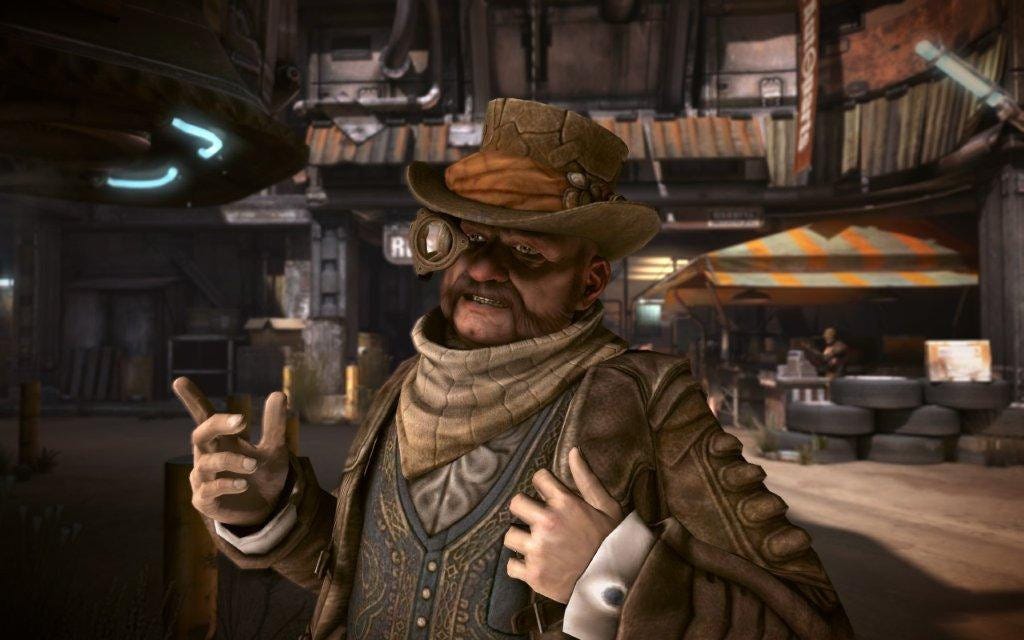
The story is paper-thin but the world is rich and thoroughly likeable.
It's a different matter online, though, where the competitive racing modes should be good for hours of entertainment. Usually built around racing to checkpoints or gathering objects while tussling with machineguns and homing rockets, they're frantic and frequently hilarious battles that make the most of the rugged, intricate terrain and bouncy, playful handling. As you level up through repeated play you can change your loadouts and customise your ride, too.
There's no competitive first-person shooter multiplayer, but elsewhere there are nine Legends of the Wasteland co-operative missions for two people, most of which repurpose locations from the campaign in new configurations, changing a route here or adding a new section there. The balance of play is different to playing alone - there's a preselected arsenal and wider arenas of combat to contend with and less emphasis on looting - but does a good job of complementing it.
Rage is a strange game in many respects, and in contrast to early id games sometimes it makes you feel like you're staring into the past rather than the future. Easily its biggest flaw is the reliance on manual saving, so you have to teach yourself to dive into the menus to record your progress every few minutes or you will probably end up replaying half an hour of content sooner or later. There's a neat defibrillator mini-game to save your life once every six minutes if you get into trouble, but it won't catch you every time.
There are plenty of side missions to pick up, including races.
For some, it will all add up to a strangely shallow experience, where the story never asserts itself enough to feel less than periphery, and where things we take for granted nowadays have been ignored or forgotten. This certainly isn't a video game like the ones we're used to playing in 2011, smothered in celebrity voice actors and shoulder-grabbingly intense expository cut-scenes, and varnished by psychologists so we never look in the wrong direction when we're sprinting away from a set-piece. Instead it's something simpler and more old-fashioned.
Judged on game design and content, then, it's slightly anachronistic, but as a toy box full of things you can only do in games, Rage is warm-hearted and refreshing. It's not going to change the world, but it does serve as a timely reminder of that other thing id Software games always did besides smashing through some new technological barrier. They made shooting things fun, and it's nice to have that back.
8 / 10
