Aliens: Infestation
In space, no one can hear dual screen.

Death has always been a significant part of video games, but in recent years, he's had to settle for a relatively minor role. His mortal enemies, the checkpoint and the regenerating health bar, have relegated him to bit-part status. No longer feared, he's a minor inconvenience, a small bump on an otherwise smooth road to the finish line.
But some developers aren't prepared to let Death shuffle around in the wings, promoting him to a crucial role as both fearmonger and educator. Demon's Souls and its imminent follow-up hark back to a time when games weren't afraid to kill the player. You die, you learn. You take better care. You improve.
There's arguably no finer proponent of this old-fashioned mentality than WayForward, whose most recent game, Bloodrayne: Betrayal, set blood boiling with its brutal difficulty level. WayForward's Aliens: Infestation is slightly easier, but still punishing: reach a save room and you'll exhale deeply. When your life meter is but a single swipe of a xenomorph's tail away from empty and you're a long room full of motion signatures away from safety, the elation and relief as those metal doors slide shut is euphoric.
Infestation takes its cues from Acclaim's Alien 3 and the early Metroid games (which were an Alien tie-in in all but name), but it feels a little slower, mainly thanks to the very deliberate movement of the characters. Yet it's not long before you'll realise why you need to take your time. There's a run button, but you'll only ever use it to flee.
WayForward wastes no time in creating an imposing atmosphere about the USS Sulaco, where your adventure begins. Metallic clanks and hisses are accompanied by an ominous synth-led soundtrack, creating a slow-burn tension through the early stages that is released by one of the cheapest scares in the book. (One which I, playing in the dark with headphones turned up to full volume, was completely suckered by.)
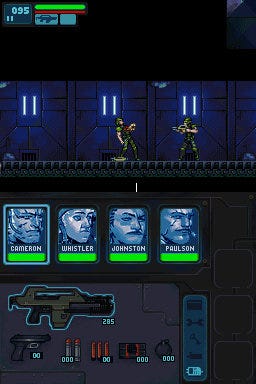
But soon the jolts are for real. The aliens aren't really scary in and of themselves - there are too many of the buggers for that - but it's the knowledge of the harm they can do that makes you enter every room with trepidation. Standard xenomorphs are joined by skittering face-huggers, bursting messily from their ovoid homes while chest-bursters shriek horribly as they hurtle towards you at a rate of knots. If the aim was to match the intensity of James Cameron's sequel, then WayForward can consider it job done.
You begin with a four-strong team of marines, their characters sketched out through brief snatches of dialogue, with exchanges rejigged depending on who you're currently playing as. Mass Effect got you to care about your crew mates through extensive back-stories and lengthy conversations, and while these are little more than efficient caricatures by comparison, their deaths hit equally hard - because one man down means one life down.
It's easy to get attached to those you've kept alive for a while, and some obsessives will struggle to reconcile their inner completist with the need to press on. Gotta save 'em all? If one should fall, you'll have to delete your single save file and start over again.