Version tested: iPhone
I had heard that Kali was good. Heard she was better than Malik and better than Rex, and both Malik and Rex were good too. I'd scoped her out, read the profile, boggled at the Word IQ of 195. Even the name was a giveaway. Kali. I'd seen Indiana Jones and the Temple of Doom.
I thought I knew what to expect, but I didn't. Not even close. Lumbago? Celerity? Vanadium? (It's something to do with metal, apparently.) Kali was pulling open parts of the dictionary that I didn't even know existed. Her words were weapons, and she flung them at me quickly. With great celerity, if you will.
Over at Denki, Quarrel was initially play-tested as a board game, and it still feels like a board game. There are the bright colourful layouts for one thing, and the sprightly rattle of tiles as the anagrams get doled out for another. Even the logo looks like it should be on the front of a dog-eared box that lives at the top of a bookshelf somewhere.
It's Risk mixed with Scrabble, if you want to be brutally reductive, and you can imagine that, played with friends, it would be right up there with either of them. It's tactical and cerebral enough to bring a little depth to kitchen table warfare, yet it's sufficiently swift and nasty to get people yelling at each other nice and quickly too.
So, yes, as an exclusively single-player game - which is what it now is, pending a potential multiplayer patch - Quarrel really shouldn't work. Who wants to play a virtual board game by yourself? Who wants to face off against cold AI, when you could be squabbling with real pals? The funny thing, though, is that Quarrel does work. And it works because of 'people' like Kali.
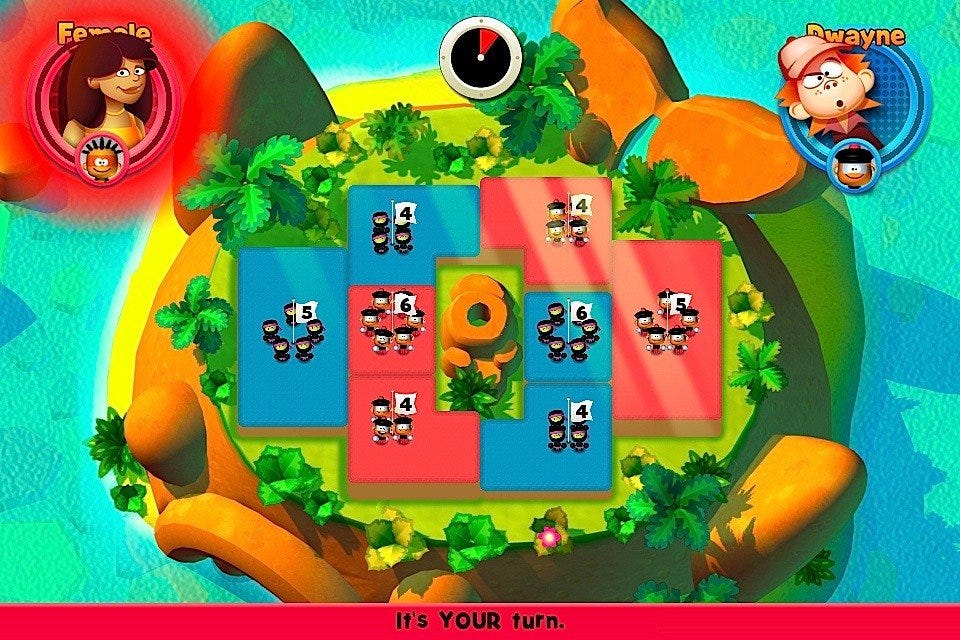
Quarrel was originally slated for release as an XBLA game - Microsoft missed out on a cracker.
The idea is simple: flung out across a segmented map, you fight up to three AI players for ultimate control of the territory. Play is turn-based, and in each round you can move troops between adjoining tiles to shore up your defences, or attack players where your tiles meet theirs, in order to grab more land for yourself.
So far, so Risk - but attacking is where Scrabble comes in. Each battle sees you and your foe given an eight-letter anagram, and the winner comes down to whoever can construct the highest-scoring word before the time-limit runs out. Letters are assigned values on the basis of how awkward they are to use - vowels are low-scoring, weirdoes like J and Z are worth considerably more - and each player is limited by how many troops they've brought to the battle.
If you've got four troops, that's a four-letter word limit, which means you're in trouble if your opponent's heaved up with an army of seven. As with Risk, it ensures a neat tactical link between individual fights and the wider war being waged on the rest of the board.
There are a handful of clever tweaks to the central premise. Capturing enemy treasure, for example, allows you to slowly charge up a meter that eventually lets you chuck a bonus troop into battle, while fights you're not involved in - when the AI is attacking the AI - aren't quite as dull as they should be, as you're free to try to untangle the same anagram they're working on for bonus treasure too.
There's a nice risk/reward mechanic that sees you showered with more troops at the end of a turn if you can keep a chain of successful attacks going (you'll already get an extra troop for each territory you're holding when your go is over), and if you slaughter the enemy, you may even be able to take some of them as prisoners for use in your next fight.
Those enemies take the form of nine different AI players: a selection of lovable, infuriating, grumpy, nasty word-crazy misfits who come complete with freckles, bad haircuts, and turtleneck sweaters. Quarrel's cast is a bit like Hey Arnold! blended with the Royal Tenenbaums, and the line-up is split across three tiers of word skill, from Normal to Expert.
On top of that, the players all have their specific tactical quirks. Peppermint Patty-alike Caprice is quick but possessed of a limited vocabulary, for example, while fusty old Rex knows some great words, but makes weird choices on the map.
For your first few matches, Quarrel can be a bit of a pain in the neck, frankly. The tutorial drags on a little too long - although it is, beneath the simple premise, a surprisingly complex game - while the campaign mode is initially calibrated to be a touch too challenging for newbies. It was for me, anyway, but I am enormously stupid. It's smart stuff, but it's a slog, and for a quarter of an hour I was ready to write Quarrel off as a great idea that didn't quite bring it all together: a designer's game that couldn't come alive for a normal player like me.
But then I had an incredible game during a quick match, and the whole thing clicked.
The setting was Sunburst Chamber: a huge arena set within the caldera of a volcano. It was a pretty dramatic occasion, and a full house, too: I was up against Caprice, Biff, and - ugh - Troy. Caprice and Biff were no problem: they're low-level characters with obvious weaknesses. Caprice rushes everything, while Biff is a bully, but generally flings little more than, y'know, four letter words at you. Troy was a problem, though. He's good-looking for one thing, in a Princeton sort of way, and that put me on the back foot. He's a middle-tier character, too, and I hadn't had much experience with him. What was his deal?
Twitter and Facebook integration are handled pretty smartly. Three days from now, it's still going to be incredibly annoying, though.
His deal, for a while, was steamrolling his way to victory. He came in from the east, I came in from the west, and it was red rushing towards green, with two helpless idiots caught in the middle. Caprice and Biff lost themselves to infighting, and so they effectively softened each other up for Troy and I, and then we took them. I killed off Biff and Troy got Caprice. Five minutes in, and just the two of us left.
I like to strengthen my borders after rounds - a good move, as it turns out, because Troy is a bit of a hero, and tends to attack even when he's outnumbered. We skirmished, almost playfully. I fought back advances, and then I pushed forward - but I pushed forward too far. Stupid mistake. What a balatron! (Unintentional clown, BTW: good for the B but not much else.)
Long story short, Troy had lots of tiles held by three or four units - easyish pickings if you're on a roll and with money in the bank - but I had plenty of ones and twos. No good at all if it came down a Napoleon-fleeing-Moscow situation. The main bulk of our forces, however, were pulled together in an eight-versus-seven face-off right in the middle of the board. Whoever won that would win the game, more or less. There would certainly be little more than mopping up to do afterwards, anyway.
The big battle. The letters were a blur. I couldn't do anything with them. S-B-A? T-N-I? Nobody's going to win this with "TIN" or "STAB". I looked over at Troy's side of the field. He'd come up with a word. I had to do something. I couldn't let all that work slip away. A distant relative of mine went to Cornell, after all. This was personal.
Troy came up with "BEAST", which is pretty good, actually, as that B is a surprise high scorer. Unfortunately for him - and I promise this is true, even though I'll admit it was mainly an accident of my fat fingers - I got "ABSINTH". A classic drink, and a seven-letter neutron bomb. It was all over for Troy. If he could have ragequit, I bet he would have.
After that amazing match, almost all my quick matches have been equally good: dynamic, feisty, and surprising. Quarrel works, then, even in compromised single-player form, because the AIs work. They make things almost as dramatic as it is playing against real friends. They have personality, quirks, and they're fun to clash with even if, at times, you feel that you're reading more into their behaviour than might actually exist.
They're heroes in their own way, because they take a game that should be a disaster and render it deeply satisfying. Ever played Scrabble against an AI? It's horrible. When you win, you know it's holding back. When you lose, you know it's a computer and so it was never a fair match in the first place.
None of that here. When you win, you can believe it's because Dwayne's a big old dummy and you're simply better than him. When you lose, you can console yourself with the fact that bookworm Rex spends too much time in his library. Kali really would know a word like "Vanadium". She's a devilish swot.
It's not always brilliant, of course. In big matches, you still can spend a lot of time waiting while AI plays AI, even if you do get a nice anagram to do for points while they're at it, and the game has no real answer for the fact that, if it's four troops against two, the player with four has to screw up very badly indeed to lose. (Or perhaps the player with two used "QI".)
When both words score the same in a Quarrel, it comes down to who got there first. This is where Caprice can shine.
Elsewhere, there are little presentational issues: I'd like to have a quicker way to get the letters off the playing area again if I've messed up, for example, while if you're Quarreling on an iPhone, the handy text along the bottom of the screen that tells you what the words you're using actually mean can be quite hard to make out.
But mostly, Quarrel's a wonderful package: a decent, if rather grumpy, campaign, lovely quick match options, and, even better, a daily match, which sees players all over the world tackling the same map with the same enemies. It's the meat of the game once you've worked through the main levels, and it'll do as asynchronous Quarrel until the real asynchronous Quarrel comes out - hopefully in a patch.
It shouldn't work, but it does - just as some might say that word games themselves shouldn't be having this period of late summer hipsterism when the industry's meant to be all about space battles and survival horror.
Quarrel is a victory for good ideas and also for clever implementation. I suspect that the game's still waiting for multiplayer in order to really show us what it can do but, until that arrives, this is a smart addition to iOS in its own right.
9 / 10
