Jonathan Blow

"In this game there are hardly any verbs…"

After Braid, Jonathan Blow's latest game, The Witness, seems like quite a departure: it's a 3D exploration experience set in a realistic environment rather than a dreamy watercoloured side-scroller. That said, it's still a dense congregation of ingenious puzzles, and it concerns itself, to a large extent, with a classic Braid preoccupation - the relationship between game themes and game mechanics. With the designer recently visiting London, we caught up with him to ask him a selection of rambling questions and received some surprisingly concise answers.

Eurogamer: None of the puzzles in The Witness have any text associated with them, and yet, as you tackle them, you're always learning how to play the game. How do you make sure you bring the audience with you?

Jonathan Blow: The point of them isn't just to be a puzzle. Every one of them has a little bit of communication in it. It always furthers progress of what you understand. Because that's non-verbal, each statement on its own has to be kind of simple, because if it's too complicated, people won't get it. Once it's kind of simple, it's automatically kind of fair, too.

Eurogamer: The game provides a huge explorative space, and one that's very non-linear. Does your need to communicate things piece-by-piece to the player actually provide you with a structure to guide you when you're creating the game? Does it cut a path of its own through all the possible things you could do with the design?

Jonathan Blow: A little bit. The necessity to introduce ideas like that does end up creating some of the content of the game, right? It's like, Okay, I have this idea for something that could be cool: I need to ramp up to it. That sort of creates the first half of a particular area, then.

Really, though, the bulk of the process is more about just exploring and finding these things. So I start out, and I have this idea that there's going to be a little panel and you can draw in it. Then I have the question: well, what can happen under that constraint? Well, you could have things in the path that you trace, or that you have to cover. You could have things that you have to divide, or you could have multiple things at once. It's really an exploration.

There are two stages. The first thing is finding individual things that at least sound interesting, and then trying them out. There's some things in the game that I tried out but which turned out to not be that good. So that's part one. Part two is seeing how these things then combine with each other. So you've got symmetry lines, say, and then the dots you have to cover, and then those things combine in an interesting way.

Eurogamer: There seems to be three levels of puzzle at work: the puzzles in the frames, then the path-finding puzzles as you reverse-engineer how those puzzles work with the island itself. Then finally there's this puzzle of why you're in the game, and what the game's actually about.

Jonathan Blow: That is the general idea of the game, that the puzzles are reflected thematically within it. There are actually other levels to it that are sort of secret. So if you search through the environment carefully, you might find things that add another layer.

Eurogamer: The Witness also strikes me as being weirdly traditional as well as experimental. A lot of the time, you're driven through areas by the sight of something you want but can't reach yet, for example, which has a very Legend of Zelda feel.

Jonathan Blow: I think that's right. Part of it comes from the fact that I wanted this game to be about, well, it's about a lot of things. But I wanted it to be about what's in the puzzles and what's in the world, and I thought I could do that while keeping the controls as simple as possible.

Games these days have become about using all of the pad. For this game, I guess you need two sticks and maybe two buttons, which is still a lot, but it's less than a lot of other stuff. There aren't a lot of verbs that you have. So a thing that a lot of adventure games used to do, especially graphic adventure games, is they'd give you a lot of verbs, and then that would be part of the puzzle: which verb do I use on which object to make something happen.

But then a lot of the game is just cheap. Anyone can do that, I guess. Because in this game there are hardly any verbs, what is left is something about the purity of the situation, and of the puzzle. Because it's about that now, it's not surprising that you see similarities between this and Zelda and things like that. That's kind of the core reality of what happens when you put things in a game world thoughtfully rather than randomly.

Eurogamer: Is it hard to create a game where there isn't much disconnection between the theme of the game and the mechanics of what you're actually doing?

Jonathan Blow: This is really interesting. What your character is doing in this game is almost exactly the same thing as you're doing as a player. The only difference is that your character is ostensibly in this world and you're on the other side of the screen. You're basically doing the same thing. And then the fiction that's layered through the story of the game, the things the narrator is talking to you about, works on a different level.

One is a very minute-to-minute level, and it's addressing the overall mystery of what's going on in this place, very small bit by very small bit, because this is a ten hour game, and the dawning of understanding is meant to be paced out throughout the whole game. It's also providing a bit of variety in that minute-by-minute stuff: I'm doing a puzzle, now I'm following a cable from one puzzle to the next, now I'm exploring the island, now I'm listening to this voice telling me all these things. It's providing a good pacing of variety. If you do 100 puzzle panels in a row, it can get quite grindy.

That's the bottom level. The middle level is where the story tends to go in individual threads which are spun through individual areas. In the one of the areas, for example, the puzzle theme is about symmetry, and the story is about looking into a mirror - symmetry again - and worrying about facial symmetry and issues of the body. That's all tied together, but that story also serves a point in terms of the larger narrative.

Then there's the highest level, which just gives you some type of dawning understanding that proceeds until you get to the end of the game. At the beginning you know very little, at the end you know a lot more, but this isn't one of those games where every question will be answered at the end in a monologue. [Laughs.] And a consequence of the way the game works is that the story is inherently non-linear. The story has to be engineered so that you can listen to these threads in any order and it should still make sense.

"A lot of my feelings about this are kind of non-verbal: I just kind of do things in a certain way."

Eurogamer: The Witness seems very writeable, too: was it your intention to create a game where the player had leeway to fill in the blanks as they moved through it?

Jonathan Blow: I never thought about it in that term, of being writeable, but it's something I'm definitely interested in. The game itself is about providing a lot of player freedom: it's not about going here, and turning at a certain point so that you see a certain thing. Within that context, it only really made sense to give the player freedom within the narrative as well.

What does that mean exactly? Well, there are a number of things that it could mean. A lot of my feelings about this are kind of non-verbal: I just kind of do things in a certain way. What I will say is I think there's a certain amount of room there in terms of player agency, and in terms of the player deciding what they think about a certain element of the game and the story. There are moments that are referred to but not openly discussed, for example, so there's a lot of freedom for the player to decide what that moment really was. This stuff is hard to talk about, really.

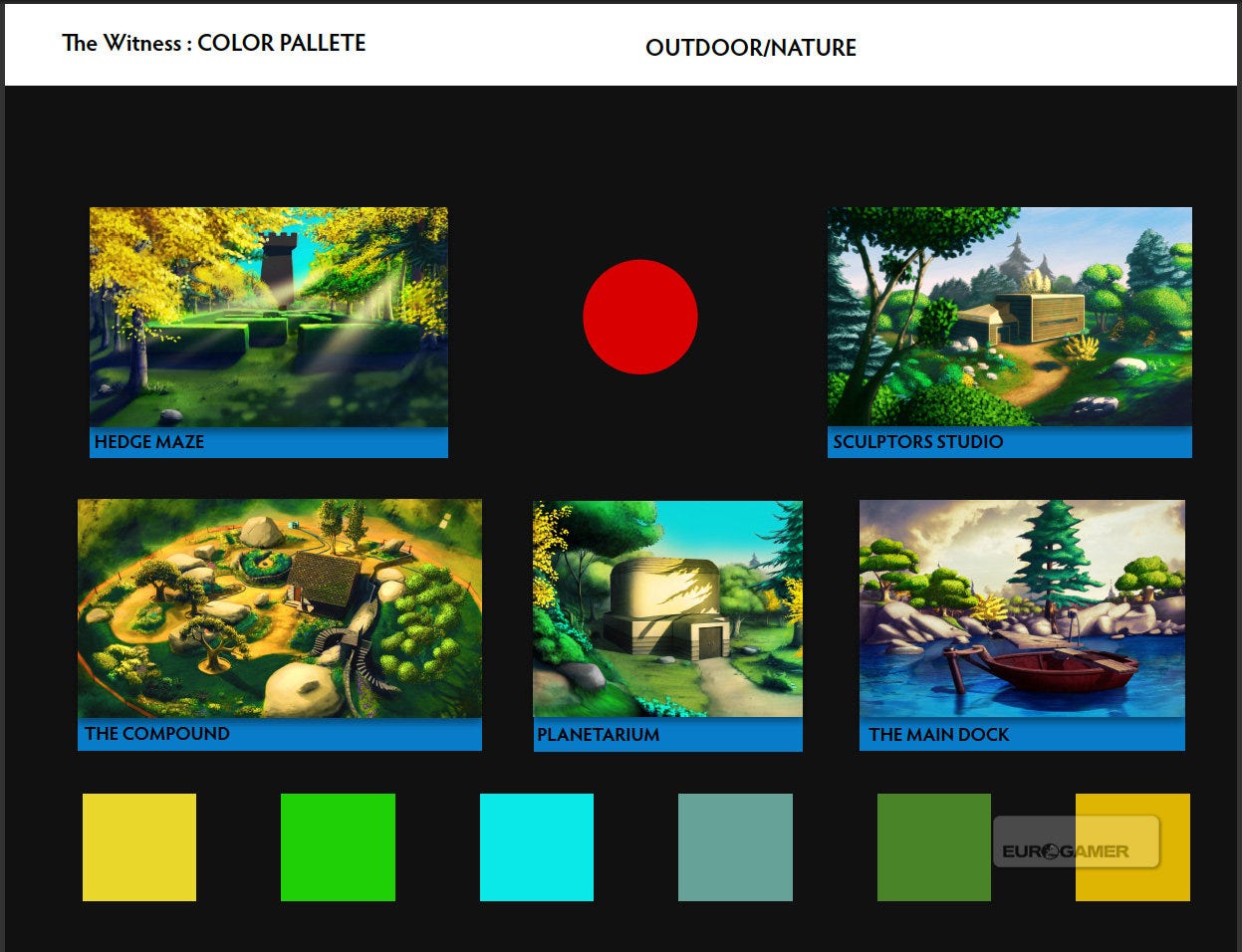
Eurogamer: How different for you has it been working on a game set in a 3D landscape? Are you as hands-on in designing the landscape as you are with the puzzles?

Jonathan Blow: Right now, what the game looks like emerged as a sort of organic process where we weren't trying that hard to make the landscape. It was more about: I'm designing these puzzles and they need to go somewhere in the world, so what seems like a good place? The editor for the game is really amenable to big changes, so at the moment, as a result of that, we haven't worked that hard on the terrain yet. So what's in there right now is a few hills, a few things to make the game interesting, but we still don't have what we want in terms of minute-to-minute visual interest.

That kind of thing is actually part of the phase of development we're going into now. We basically know which puzzles are going to be in the game - we want to improve them, of course - but now we want to focus on the terrain more. Now let's think about the topography. We've actually started working with a bunch of architects.

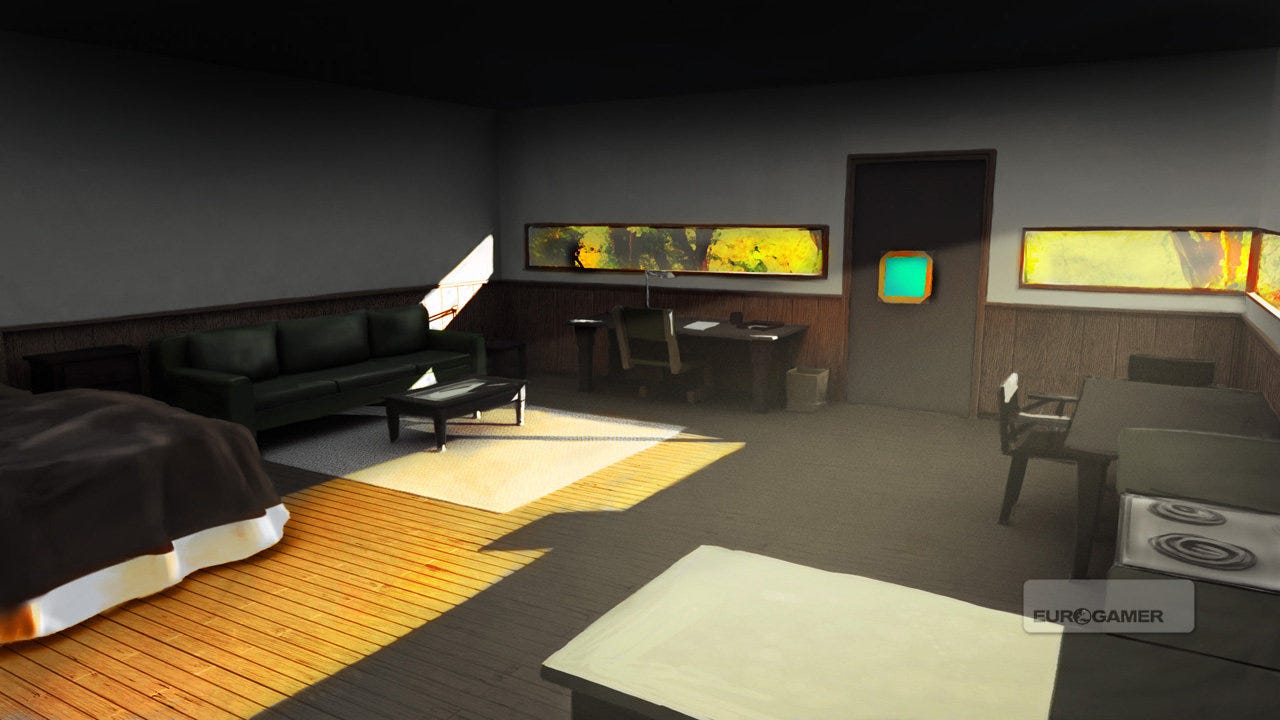
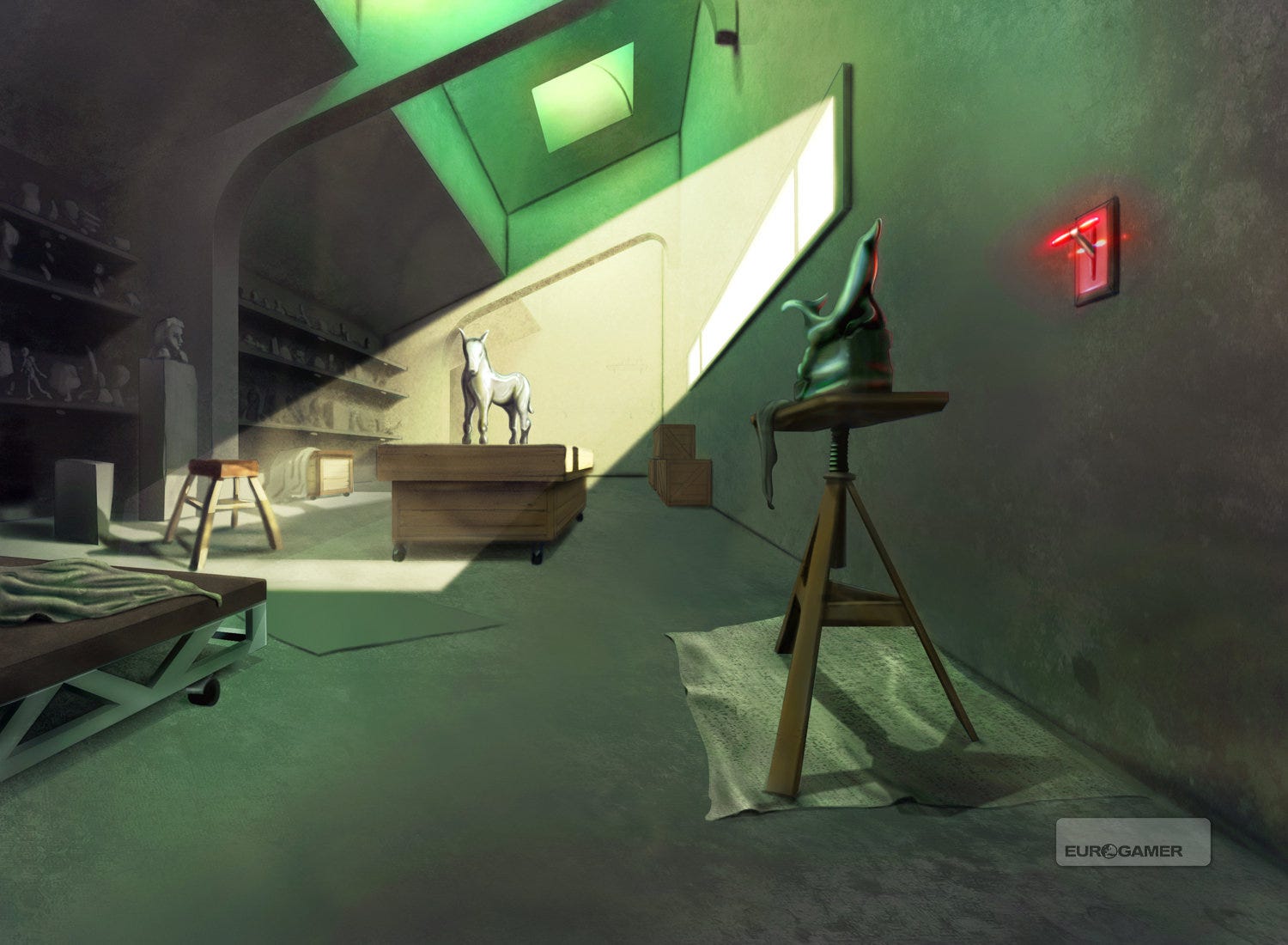
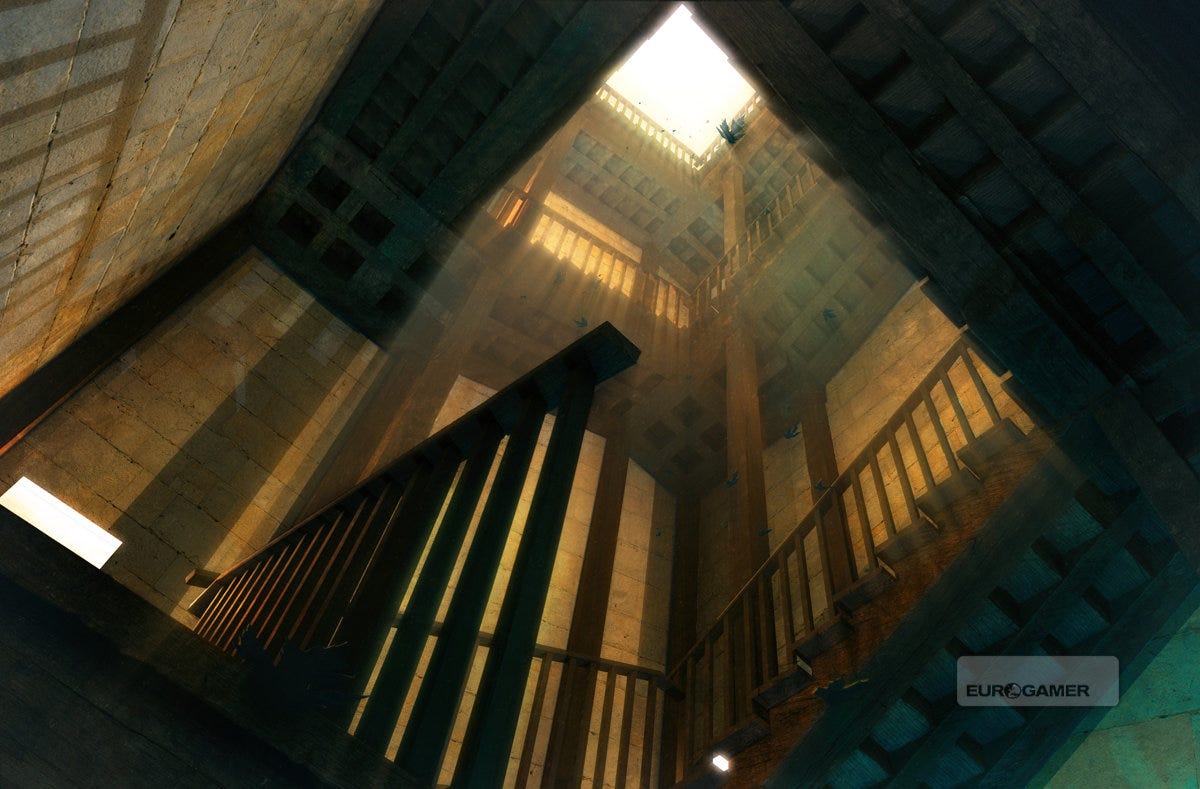
There's a landscape architecture firm, and then a building structural architecture firm that we've been working with for about a month. Nothing they've been doing is in the game yet because there's a lot of basic figuring out that's going on, but once that happens, all the stuff that you can see in the game at the moment - a building's just a box with a window cut in it - that will be a real building designed by a real architect, with an interesting form. And there's the same deal with the landscape.

Eurogamer: When you're working with architects, do you find that they speak the same language as game designers?

Jonathan Blow: No. [Laughs.] We don't find that at all, and that's been an interesting part of the process. I think we're finally starting to come to an understanding. There are things that we care about, right, and these are two things that, in general, architects don't seem to care that much about - and one of them I would have expected they'd think more about.

Thing number one is that I'm encountering this space for the first time, and I'm walking through it: what is my understanding of things and how does that change as I move my viewpoint around? I thought that was something architects spent a lot of time thinking about, but that doesn't seem to be as true as I thought it was, after working with them. I think they tend to think about what something looks like if you were framing it in a picture frame.

On a call the other day, one of the discussions we were having was, "Hey, we'll have these cliffs, and they'll be made out of a certain material, and we'll have these buildings that will reflect the structure of the cliffs, and it will look nice in that picture framey sort of way." But it wasn't about what you see as you walk into the building.

Part two is that we always care very much about the theme of an area, and then we want the fiction of the building to be appropriate to that. They don't tend to think much about that at all, so we have to keep reminding them. But it's been interesting.

Eurogamer: The Witness seems weirdly literary. It reminds me a little of books by Italo Calvino: that blend of the abstract and the really personable and tangible. Is that an influence? And how much autobiography is in this game? Are you addressing the player directly through the narrator?

Jonathan Blow: I've read a lot of Calvino. I wasn't really going for that here, but I couldn't help but be inspired by it. He's one of my favourite authors. It's inspiration in kind of an indirect way. I never thought of it this way, but he'll definitely combine a concrete manifestation of something with a theme that it echoes. Braid was very definitely inspired by that in quite a clear way. This wasn't, but it might be something that's worked its way into my design technique by this point.

As for the autobiography, I will leave that open to question, but answer it in a different way. You were saying that it feels literary in a certain way. Assuming that that's true, I ascribe that to the intention of the game. Most of the stories in games are what I think of as entertainment stories. That's not what this is. It's more like I'm writing this about issues that I'm concerned with, or things that I think about that seem to be important.

"If you're not doing an entertainment story, that's considered highly weird. It's considered art game."

That's often the way that a novelist will write, and we don't get confused by that when novelists do it. We know there are adventure novels or romance novels, but we have no trouble envisioning a novel that works differently. And the novels that are written with those sort of intentions, we don't think of those as art novels. Art novels are something weird and experimental, like George Perec, right? Or maybe even Calvino sometimes. But it's weird that in games, it's completely the opposite. If you're not doing an entertainment story, that's considered highly weird. It's considered art game. For Braid, at the time, I thought that was a label that really applied, but for this game, I used to think of it as an art game, but now it's not really an art game to me. It's just a game that's what it would be like if I wrote a novel where I really cared about the subject of the novel.

The story has come a long way. The first version of the story was very direct about the themes. Then you'd go and listen to the recordings, and they'd talk about these very abstract ideas, and you'd end up thinking, what does this have to do with anything, and why should I be listening to this?

And then after that, I over-reacted to that, and went way back more in the direction of an entertainment story, and that felt more like giving up and losing. It wasn't what I wanted this game to be. What I found was the best way to speak about the issues I wanted to talk about - issues that are perhaps all encompassing - is to speak about them confined in a way in terms only of things I know directly about. That way it comes across as genuine, and not posturing, and hopefully not lecturing or preachy.

Comments (22)

Comments for this article are now closed, but please feel free to continue chatting on the forum!

  • Loading...hold tight!