Xenoblade Chronicles • Page 2

Standing on the shoulders of giants.

It's not clear precisely when the Japanese role-playing game crumbled from one of gaming's core pillars to a battered monument to outmoded design. In the wake of Final Fantasy VII's global popularity, this weave of grandiose storytelling, menu-based battling and lavish production values seemed set to dominate the future of interactive entertainment. But as budgets strained ever harder to fill the widening technological boundaries of each new wave of console hardware, publishers took fewer and fewer risks with their money. Creative repetition led to stagnation led to decline.

Today, the release schedules are peppered with remakes and re-releases of seminal 'JRPGs' from the Super Nintendo's golden era and fans are routinely made to look backwards, rarely forwards. On the few occasions that we are treated to a strong fresh release, such as last year's outstanding Dragon Quest IX, that success leans more heavily on familiarity than novelty.

Xenoblade Chronicles is a rare exception. Here is an endlessly lavish, detailed production based in a newborn universe that is not only filled with unfamiliar faces but also brims with daring ideas and mechanics. Indisputably, this Wii game - released in the twilight months of its host console - is the strongest JRPG to emerge in years. Its vision is so bold and assured that it's difficult to imagine how such a creature could have risen from this brackish swamp of a genre.

It helps, of course, that its breeding is impeccable. Director Tetsuya Takahashi's past credits include formative classics such as Secret of Mana and Chrono Trigger. But Takahashi's work hasn't been without its problems. His most famous self-originated project was Xenogears, a game whose aspiration soundly outstripped its budget, while his similarly ambitious Xenosaga limped to a conclusion just three games into an intended series of six. Both alienated as many players as they made fans with their winding, indulgent cut-scenes and overreaching plots.

1

A strong translation from Nintendo is brought to life by a mostly British voice cast, with few missteps. The full Japanese dub is also included.

But with Xenoblade Chronicles, Takahashi demonstrates creative humility as he brings ambition in line with achievability and moves away from that reliance on cut-scene storytelling, which he recently described as a "creative dead-end". Make no mistake, Xenoblade Chronicles carries a grand narrative, played out by a cast of scores; but that plot is expressed as much in the game's mechanics and environment as it is cinematically.

Its world is shaped like a giant colossus. Imagine one of Team Ico's giants had been blown up to a hundred times its original size and frozen in time, before reeds, trees and lakes were allowed to settle on its features. The Bionis, as it is known, is the world upon which you adventure, its 10-mile limbs the walkways and bridges you clamber across. Exploration off the beaten track is encouraged with experience point rewards for every landmark charted - but this is a world that invites wide-eyed surveying. The joy of discovery is reward enough.

2

Shulk's sword, the Monado, is the point on which the story pivots, imparting future visions to its wielder.

You play as Shulk, an orphan boy with a weighty mystical sword, as per the great JRPG tradition, but mercifully without a chip on his shoulder, in contrast to it. Shulk lives in Colony 9, a tranquil town nestled in a valley on the Bionis' leg, with other members of his race, the Homs. His life consists of amateur archaeology, bug collecting and cowering from the irregular attacks made by the other race that live on the Bionis: steampunk robots known as the Mechon.

When the Colony is attacked by a swarm of Mechon at the start of the game - killing some of the friendly faces you have just become acquainted with and burning the shops whose shelves you've emptied - Shulk sets out with some of his friends to find a way to bring peace to the world.

The premise may be worn, but in the telling, this tale towers. More importantly, perhaps for the first time in Takahashi's oeuvre, it's a tale that plays second fiddle to the game systems. In this regard, the team at Monolith Soft carefully combine mechanics plucked from other titles.

The real-time battle system is closest to Final Fantasy XII's cog-like mechanisms, while the shower of delicious side quests is pure World of Warcraft, filling the world with chances to shine, great and small. Meanwhile, the expansive wardrobe and huge array of weapons (many of which can be customised with crafted gems to add buffs and debuffs) are reminiscent of the latest Dagon Quest.

These ideas are combined with a raft of its own, such as the pinpricks of light that litter every environment (collectibles that can fill a scrapbook for rewards, answer fetch quests or simply be sold) or the flash-forwards into the future that interrupt battles to show you a special move your opponent is due to make soon, allowing you to pre-empt it. The result is a game with a flavour quite unlike any other, and whose onion layers of strategy and motivation prove irresistible - and not only to the JRPG faithful.

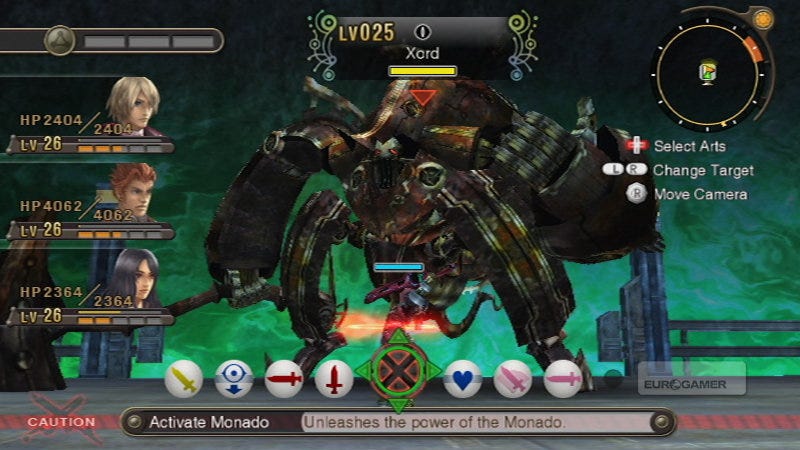
In battle, you control just one character. As in Final Fantasy XII, they auto-attack the enemy with brutish sword swings so long as you position them close to the target. Your job then is to manage the long game of your characters' special moves. These 'Arts' can be triggered at any time, but each has a cool-down period before it can be reused. The strategy comes in knowing when to attack, when to defend and when to cast spells, especially as using Arts raises monsters' aggro toward your character.
3

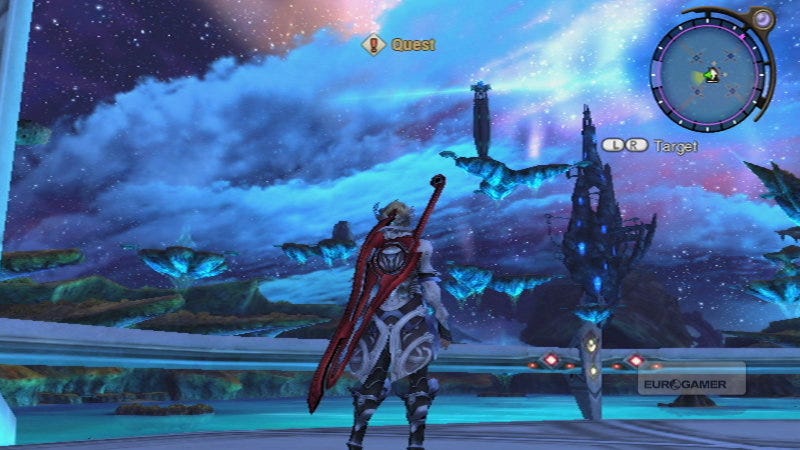
While character detail is low polygon, the sprawling environments offer dizzying depth and draw distance.

As you fight, a party gauge fills. This is broken into three segments. If a comrade falls in battle, you can raise them as a cost of one segment of the gauge. When all three segments are filled you are free to issue a chain link attack, in which each of your characters can issue any attack in quick succession. Chain links can be key to taking down some of the larger enemies in the game, but as doing so empties your party gauge, you temporarily lose the chance to revive one another.

The Bionis has a pleasing sense of ecosystem. Creatures great and small roam its hills, valleys and fields. Some of these are of a friendly disposition and will leave you well alone unless you attack first. Others are aggressive and will hunt you down. Some respond to sound, others to sight and you'll regularly pass giant beasts 50 or 60 levels your senior. Hack away at one of these monsters and you'll be felled in a single hit.

Further responsibility for your own wellbeing comes because this is a world without borders. No invisible wall will protect you from a cliff edge, and while sheer drops are occasionally used to provide some Zelda-style secret areas, a tumble from the wrong ledge will prove fatal.
4

Characters form friendship links as they battle together, opening up link skills that can benefit the entire team.

Xenoblade Chronicles may lack the universal appeal of Miyamoto's adventure series; its tendency toward team management makes this a game for those who prize complexity and numbers over economy and colours. But it shares Hyrule's all-important sense of place and delivers that same heady shot of wonder to the spirit as you explore.

No Japanese RPG has more successfully married its various components this hardware generation. It's a game that invites us to reassess an entire genre, pointing to a bold future while nodding its respect towards the past. It's a towering triumph.

9 / 10

Read the Eurogamer.net scoring policy

Comments (106)

Comments for this article are now closed, but please feel free to continue chatting on the forum!

  • Loading...hold tight!