Introduction
For a moment there it looked as if music games had died. Activision had pulled the plug, at least temporarily, on Guitar Hero and DJ Hero, while Viacom had washed its hands of Rock Band developer Harmonix. Soon the news stories became obituaries for the genre that had conquered and cluttered the world with toy guitars.
But just as when the New York Journal pronounced Mark Twain dead by mistake, reports of music gaming's demise turned out to be an exaggeration. Guitar Hero's best days may be behind it, but Ubisoft's Just Dance is flying off the same shelves that were once packed with imitation Gibsons and there's a more-than-healthy supply of new music games on the horizon.
What those declaring the genre's death forgot was that games with pretend instruments are but one strand of a game type that also counts the booty shaking of Dance Central, Rez's techno remix of the on-rails shooter and Donkey Konga's tub-thumping platforming among its number. "Music games include rhythm action controller titles, musical shooters or platformers, simulation games like Rock Band and dance games ranging from Dance Dance Revolution to Dance Central 2," says Greg LoPiccolo, the vice-president of product development at Harmonix.
Q Entertainment's Tetsuya Mizuguchi, the creator of Rez, agrees that music games transcend genre: "Each game we make has a different theme. Lumines is a puzzle game. Child of Eden is a shooter. Space Channel 5 is kind of a musical. We really love music and we're so happy to put music elements into games. I don't care about genres."
What connects them, says Jason Harman, production director of We Sing creators Wired Productions, is of course the music: "In a music game the focus is the music itself, unlike almost every other type of genre where the music plays a secondary role or plays alongside the main gameplay."
A brief history
So it is fitting that 1983's Moondust, the first true music game, defies easy categorisation. Created by virtual reality guru Jaron Lanier, Moondust asked players to pilot a spaceman around the screen and drop seeds.
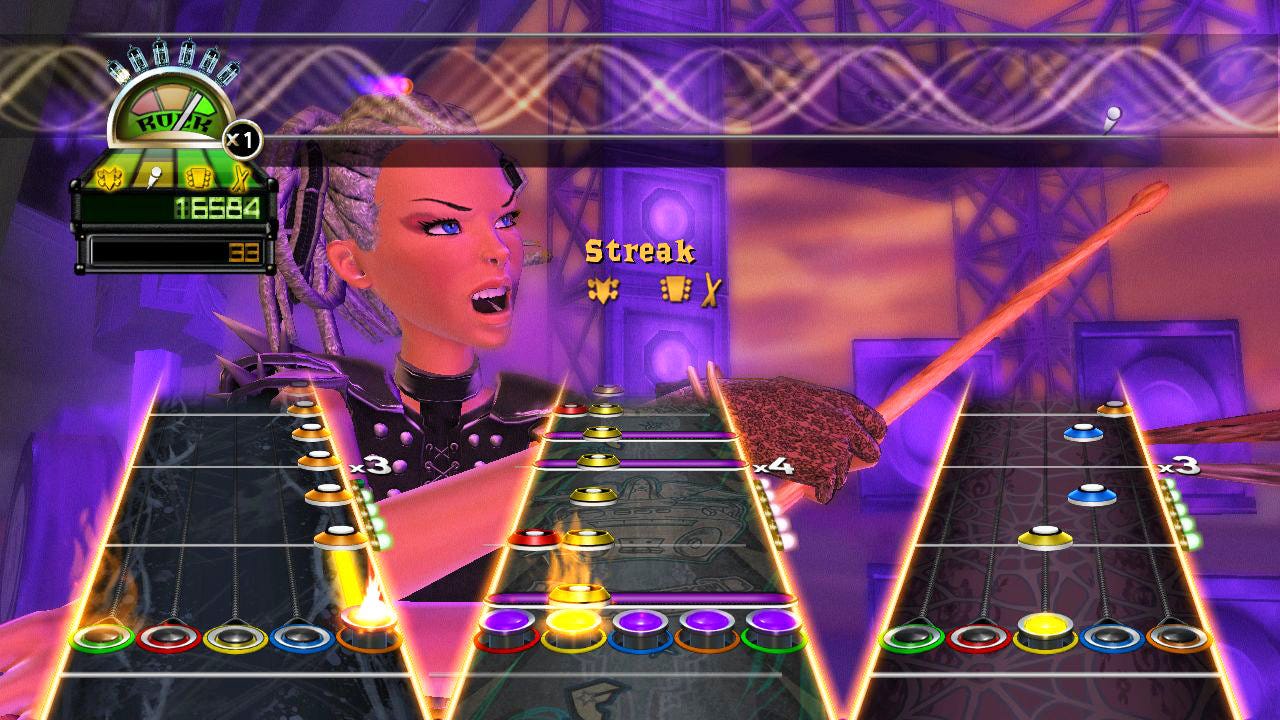
Guitar Hero: The winning streak's over.
Once a seed was dropped the goal was to steer spaceships that mirrored the spaceman's movement over the seed in order to smear it towards a shape that Lanier describes as a "writhing, organic, vaguely female-symbolic, astral phenomenon." Freud would have a field day, but more importantly every push of the Commodore 64's joystick would alter the soundtrack allowing players to play it as both a game and an oddball instrument.
The following year the warm and fuzzy tones of the Commodore 64 delivered another step forward for music gaming with Break Street and Break Dance, both inspired by the breakdancing craze. Break Street was more a dancing simulator where you performed and recorded moves, but Break Dance challenged players to copy the actions of a rival b-boy, hitting on the repeat-after-me formula that would become the bedrock of later music games.
The next music game landmark was 1987's Dance Aerobics, a dancercise game for Bandai's Family Trainer – a dance mat-style controller for the NES. But after that the trail goes cold with only brief glimpses of what was to come such as the dancing mini-game in 1993's ToeJam & Earl in Panic on Funkotron.
Then in 1996, a Japanese pop star turned game designer changed everything with PaRappa the Rapper - a hit PlayStation game about a cartoon dog who wants to be a rapper and gets help from a sweaty onion and a Rastafarian frog. Within a year Konami had added to the momentum of PaRappa with the arcade game Beatmania, the first of its Bemani line of music titles.
Equipped with a fake DJ deck for a controller Beatmania challenged players to hit the buttons at the right moment to keep the music playing and established the template for the rhythm action sub-genre.
Together PaRappa and Beatmania opened the floodgates for music games in Japan. As well as copycat releases there were also more daring experiments in music gaming such as Rez and Vib-Ribbon. But it was the innovations of Konami's Bemani games that really advanced the genre, introducing the dance mat with Dance Dance Revolution in 1998, handing us guitar controllers in 1999 with Guitar Freaks and turning karaoke into a video game with Karaoke Revolution in 2003.
Karaoke Revolution was also the breakthrough moment for Harmonix, a struggling games studio from Massachusetts. "The company had been making interactive music toys like The Axe, a PC joystick expression tool," says LoPiccolo. "After playing PaRappa and other early Japanese music games it was clear to us that bringing musical experiences to a mass audience was best accomplished through the medium of video games."
Moondust: Music gaming's oddball origin.
Harmonix's first two games, 2001's Frequency and 2003's Amplitude, were critical hits but commercial flops. But then the company figured out that oddball and abstract music games were alienating potential customers and came up with 2005's Guitar Hero with its plastic guitars and 'be a rock god' appeal, which propelled music gaming into the mainstream. "This was a huge leap for music games: an experience with music people knew and mechanics that didn't need a lot of explanation to understand," says LoPiccolo.
For the rest of the decade, plastic instruments were all the rage. After working on the first two Guitar Hero games, Harmonix went on to create the rival series Rock Band that added drums, bass, keyboards and vocals to the mix. By 2008 the popularity of fake instrument games had grown so much that Activision started talking about charging music labels to have their games included in Guitar Hero rather than paying a licence fee for them. But then the bubble burst.
State of play
The fall of the plastic instrument music game was spectacular. In 2009, the fifth edition of Guitar Hero sold 499,000 copies in its first month, but 2010's Guitar Hero: Warriors of Rock sold less than 100,000. DJ Hero 2 did even worse and Rock Band 3 also experienced slower sales. But while analysts and industry watchers rushed to pronounce the genre dead, two more recent trends were suggesting that music games were far from deceased.
The first trend was the shift from retail to online that began in 2007 when Guitar Hero, Rock Band and SingStar moved onto the current generation of consoles. "The genre shifted away from regular disc releases," says LoPiccolo, pointing to how Rock Band has clocked up more than 100 million song downloads through its store. Sony's SingStar, meanwhile, offers not just new songs through its SingStore but My SingStar Online - a YouTube-style service where players can share videos of themselves playing the game.
Konami's Dance Mat Revolution.
"It was great to see how inclusive it is," says Chris Bruce, senior producer at SingStar creators Sony London Studio. "You see little kids playing right through to entire families and then grans and granddads. Some people want to put on the greatest performances, some people want to dress up in crazy wigs and whatever else they have lying around. And it doesn't seem to be slowing down at all, which is testimony to the longevity of music games."
The arrival of motion controllers has also revived dancing games. The sub-genre had stagnated thanks to the limits of dance mats, but in 2009 Ubisoft tried something different with Just Dance: a dance game that ignored the feet and focused on the movement of the Wiimote. Now Just Dance is the foremost series in the music genre, clocking up millions of sales and encouraging a new wave of motion-controlled dancing games.
"It's a natural progression from music games where you used to detect movement via your feet on a mat to being able to detect motion with your hands and further with Kinect," says Harman of Wired Productions, which is working on We Dance – a dancing game that combines mat and motion control.
It is developments such as these that suggest music games are far from dead. "Music is a powerful and universal experience for people of all backgrounds," says LoPiccolo. "There is an innate desire to connect more deeply to what you're listening to, whether it's tapping along on a steering wheel, playing a game or dancing and singing along to the radio."
Reading list
If, by now, you're in the mood for dancing, singing, rocking out or playing with Freudian astral phenomena, here's where to start:
PaRappa the Rapper (PlayStation)
Even putting aside its historical importance, Masaya Matsuura's whacked out game of a rapping dog is still visually fresh and gloriously ludicrous. It's also a game that gives the player room to improvise, an idea too few subsequent music games have taken further.
Space Channel 5 (Dreamcast)
Move aside Barbarella, the camp-tastic dancing space reporter Ulala is the swinging space chick we want. If only reporting for Eurogamer involved aliens doing the Can-can, tiny miniskirts and dance offs with rival websites to win scoops. [erm, it does. - Ed.]
Freakin' out in Space Channel 5.
Vib-Ribbon (PlayStation)
As if PaRappa wasn't strange enough, Masaya Matsuura followed it with this odd platform game with vector graphics that generated levels based on your music CDs. Try it now before all the CDs end up in a landfill.
Guitar Hero III: Legends of Rock (PlayStation 3, PlayStation 2, Xbox 360, Wii, PC, Macintosh)
A turned-up-to-11 celebration of rock complete with plastic axe duels with Slash and Rage Against the Machine's Tom Morello. All the guitar god wish fulfilment you could dream of.
SingStar (PlayStation 3)
The finest signing game around, SingStar caters equally for those wanting carefree karaoke fun and those seeking serious vocal challenge. And with more than 2,000 songs available through the SingStore there's plenty for everyone. Even fans of one-hit wonder Falco.
With SingStar you can be a great pretender too.
Rock Band 3 (Xbox 360, PlayStation 3, Wii)
If your wallet can cope, this is the ultimate complete band video game offering drums, bass, guitar, vocals and keyboards. And as if that wasn't enough it also tries to teach you to play for real on its advanced custom controllers.
Just Dance 2 (Wii)
It might feel as disposable as the bubblegum pop on its playlist, but embrace it for what it is and Ubisoft's dancing megahit is a smile-a-minute exercise in dancing like a fool in front of friends for the sheer fun of it.
Child of Eden (Xbox 360)
We've all seen the rave casualties who think they can control the music in clubs with their hands and now you can feel just like them without taking six dodgy pills thanks to Child of Eden, the beautiful and entrancing successor to Rez.
What's next?
You can't stop rock 'n' roll or music games it seems...
Rocksmith (PlayStation 3, Xbox 360)
Forget those plastic guitars, Rocksmith is out to revive instrument-based music games by letting you plug real-life six-strings into your console. Not only that but it will also double as a guitar tutor.
Not a day-glo fighting game but Just Dance 2 doing Kung Fu Fighting.
Dance Central 2 (Xbox 360)
The original was the highlight of the Kinect launch and its sequel is promising more depth and a much-needed two-player mode.
Just Dance 3 (Wii, Xbox 360, PlayStation 3)
The camp disco queen of dancing games intends to spread its love of cheesy party fun beyond the Wii this autumn and has a new four-player mode to boot. It's also got 'I was Made for Loving you' by Kiss. Kiss doing disco. Perfect.
Music in Motion (Xbox 360)
Due for release on Kinect Fun Labs, Music in Motion seeks to replace plastic guitars with air instruments with the help of Microsoft's electric eye.
The (sound) shape of things to come.
Sound Shapes (PlayStation Vita)
Vib-Ribbon meets LittleBigPlanet. Using the Vita's touchscreens you construct music out of samples that take the form of animated landscapes that can be played like a platform game and shared with others.
