Scott Henson is serious when he talks about Kinect creating magic. He believes that for its target audience, that's what it does. And as boss of famed UK developer Rare, that's the direction he is going in.
Here, in an interview with Eurogamer conducted at the Develop conference last week, Henson reveals what gamers can expect from Kinect in the future, and explains why Kinect Sports will remain Rare's focus.
Eurogamer: What improvements have been made to the accuracy of Kinect on the software side?
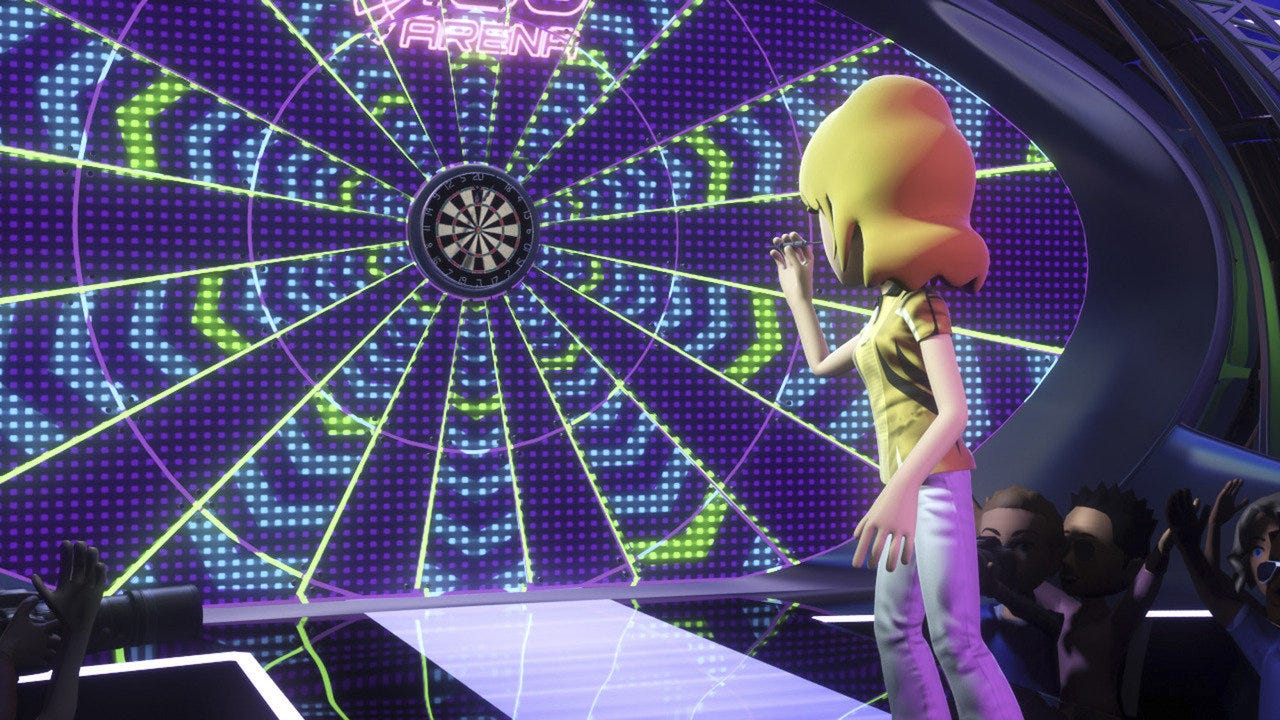
Scott Henson: Accuracy is an interesting word. Ultimately at the end of the day what you want is for the user to feel like they're in control and they're having fun. Last year we were throwing javelins and making big huge movements. This year we're throwing darts. From a consumer perspective, that's a fundamental difference. The idea you move your hand that far and we can track it and it actually makes a difference, and we can track how the hand moves down or up, and that will change the trajectory the dart goes: pretty big deal.
We're going to continue to make more refined movements, doing it in a way that scales between the people who want that fine control and people who just want to have fun. It's a spectrum we're working with.
Last year there were a lot of things we didn't know were possible. Kinect is in its infancy. It's just in its larvae state, so to speak. Less than a year after Xbox Live we didn't have a million users. We have 35 million now in 38 countries. It was six countries when we launched. That's a nice extrapolation. We've innovated quite a bit with Xbox Live. You're going to see the same thing with Kinect.
If you use Xbox Live as a proxy and you think about where we are with Kinect, we've got a huge journey ahead of us in terms of the kinds of experiences you're going to see.
Eurogamer: Kinect is fastest-selling consumer electronics device in history. Did you expect it to be so successful?
Henson heads up Rare, but he had a hand in the launch of Xbox and Xbox Live.
Scott Henson: It's very exciting. You don't know what you don't know when you launch something new. We didn't know with Xbox 360. We didn't know with Xbox Live. You have these ambitions and these dreams. Did we have big ambitions and big dreams? Of course. That's the bet. Go big or go home.
We're just honoured. It's great because it validates a lot of things we believed, that there would be a lot of excitement and a huge potential audience around this. It bolsters our courage and conviction, if that makes sense.
It's like, OK, we think this is going to work, we think we've done a really good job, we've talked to thousands and thousands of people, we've got them in front of our software, they seem like they're excited, let's go see what happens. Wow, millions of people are excited. OK, let's do more. Let's raise the bar further. Let's push further, too.
Kinect gets to be one of those players. It gets to be one of the major things that's happened not only in our industry but in consumer electronics, that will define the way people engage and interact with entertainment. That's really cool.
Eurogamer: The second wave of Kinect games are designed to demonstrate improvements made to the tech on the software side. But how long before you outgrow the hardware? Is there a point where you will need to release a Kinect 2?
Rare is putting the finishing touches to Kinect Sports: Season Two, due out this Christmas.
Scott Henson: We have far more ahead of us than we have behind of us. Far more. I wouldn't even want to begin to hazard a guess of when we think we'll hit the limits because we're just getting started.
We'll see more this year. You'll see more titles. You saw quite a bit at E3. There's a whole bunch of stuff we didn't talk about first party. I'm sure there's plenty of stuff that hasn't been talked about in the industry. You've got years and years and years ahead of what was released last year. It's a long road ahead. But I'm not going to categorise it with a date.
The bullish part is around software. Microsoft is a software company. That's the foundation, the very essence and ethos of why Bill started the company back in '75. It's why I joined the company. It's the brains of what we do. We've got a lot ahead of us with both Xbox 360 and with Kinect.
Eurogamer: Do you get sick of being asked when Rare will make a hardcore game again?
Scott Henson: No, I don't get sick of it at all. One of the great things about Rare is it's got this great heritage and history people have passion around. I grew up on Rare games. I would like for people to really understand our future is bolstered by the history we have, but we're buoyed by the innovation that's ahead of us.
It's interesting when people ask questions like, well, will you do this kind of game or that kind of game? Some of those things I find limiting in terms of what the experience is. If you go talk to just an average person about what we've done with Kinect or Kinect Sports, honestly, it's magic to them.
They cannot get their head around the idea they're moving and then there's an avatar on the screen doing the exact same thing. Turn that into a sport and a whole bunch of activities with skill ranges and refined movement and big movements and it's an incredible thing.
Hopefully people get as excited about that as we do. We know there are millions of customers out there that are getting excited about it.
Sports is a great category, too. We all went to the schoolyard and played dodgeball or tetherball or whatever. We all have some general notion of sports. Literally every sport that's in Season Two, I played them all growing up. So I have a passion for the sports side. For me it's like this dream job.
When I get questions like that, hopefully people get the sense what really excites me is what we're doing now and how we're driving and leading innovation.
Eurogamer: Is Kinect Sports the focus because sports, generally, are more accessible than core game genres?
Scott Henson: Yes. [Sports] has got to be one of the most accessible and evergreen categories in entertainment. You could make the definitive statement it's the most accessible category in entertainment. If you think about the number of people that engage in sports, it's the majority of the planet. The Premier League has two billion people who in some way, shape or form tune in. So then you have two billion people who have a general notion of what football is. That's a pretty cool basis to start an experience on. That fuels and motivates us as well.
Kinect Sports: Season Two recognises more player-spoken lines than any other game.
Eurogamer: How much of an issue is the Kinect space restriction?
Scott Henson: There may be dogs and cats and coffee tables. There may be big living rooms and small living rooms. They may be arranged in all kinds of different ways. How do we adapt to that? That's the challenge we have. And how do we do that in a way through the power of the software, we're subtly communicating to the user, OK, this is where you need to be, but we're not doing it in an obtrusive way.
Every canvas has its borders. We just work with those borders in a way that keeps people immersed in the experience but lives within the realities and constraints of whatever might be someone's living room or situation.
This is where software comes into play. We look at all kinds of things, from clothing type to lighting type, to, OK, if there was a coffee table cutting off the bottom half of my play while I'm running, what do I do? Can we still make that work and be great?
The sales have been really good. Our customer satisfaction numbers are incredible. Thumbs up.
Eurogamer: Can you make Kinect work in smaller living rooms with software updates?
Scott Henson: It comes down to what the activity is and how much space you need. If you think about darts, we only need about a foot to play that sport. Tennis is very different than darts. It's about making it feel like tennis. You do drop shots and cross-court shots. It's not a play space constraint, per se. It's really adapting to what the expectations would be around the experience you're trying to create.
Eurogamer: So the play space is set to give enough room to play the games, rather than being a limitation?
Scott Henson: Yeah. If you're just doing this [moves hand close to chest], that doesn't feel like tennis. We could do that by the way. We kind of did that with table tennis. We kept the experience right here to make it feel like there is a table in front of you while you were playing. But we still pushed you a bit in table tennis. But most of that experience was right here, just side to side.
Eurogamer: At E3 we saw the start of Kinect's voice recognition with Microsoft's Mass Effect 3 demo. How will voice work with Kinect in the future?
Scott Henson: We'll look back fondly on that last year as the beginning of the journey you're asking about. The vocabulary will continue to increase. Then we're going to continue the way you talk. You'll just be able to speak naturally. It will pick up the right phrases no matter what the language is, no matter who it is.
If you say something like Harry Potter and then you get delighted with a bunch of results with a very simple command, and you do it in a way that's very natural and effortless, you're not thinking about it. It moves from a point of convenience to a point of being very natural and effortless.
"Tell Me" became a part of Microsoft a few years ago. A lot of their technology and the speech recognition team's technology underpin what you see in Kinect. Their special sauce is a lot of voice activated systems where you talk naturally. They have this big server rendering that listens to what you say and you get the result you expect. You're starting to get glimpses of that with what we're doing with Bing.
You'll literally say something like, 'you know caddy, I think I need something that helps me with the wind conditions.' Then the caddy will respond with, 'well, it could be either a six iron or a seven iron.' And you say, 'oh, I'd like the seven iron.' It'll be that natural of a conversation.
Eurogamer: Really? It will be that natural?
Scott Henson: Yes. In our game it will be, 'change club seven iron.' But absolutely, without question, the journey we're on is what I just described. That is where we will go. And guess what will be there? Software. Software will be the key that unlocks why that's possible. We already have the microphone there. Now we just need to continue to adapt and grow and build our software to make that better.
Eurogamer: Did early demonstrations of Kinect that included Minority Report style interaction and Project Milo give us false impression of what the tech could do at launch?
Scott Henson: It's a tricky thing. When we talked about Xbox Live we talked about instant, always available games you could download any time you wanted and they'd just be there and you could just play them. That was the bold ambition.
Back then I was trying to convince people that downloadable content actually might be a big thing. I can't even say it without chuckling, because it seems so fantastical right now we would have even have had that conversation.
Will Rare make another hardcore game? Henson explains why Kinect Sports is the focus.
With Kinect, a lot of what we're communicating is what our ambition is and where we want to take this and where we want to lead and go. We know it's going to be a journey. No-one should ever think what we've released is final. That's just not how it's going to be with first-party or with the platform in general.
I remember people saying, well, you didn't do scanning objects - because we had the skateboard and stuff like that. I'm like, guys, that doesn't mean we won't. It's just we haven't got to that yet. It's just part of our journey, and we're trying to show our ambition and where this will go. Think of this as not a destination but a journey.
This year, in Kinect Fun Labs, we're scanning in objects and we're turning them into 3D objects in real-time. It's a great example of us talking about our ambition and then, of course, we delivered on the ambition. We'll continue to deliver on the ambition. It really is limitless. It's up to the creativity of the industry to see how far we're going to take this stuff.
Eurogamer: What about the Minority Report ambition? Is that realistically possible?
Scott Henson: Do I think it can be done? Absolutely. I saw Ubisoft stand up on stage and show something that looked very Minority Report. Remember, before I came to Rare, I was working on the platform team. I ran the industrial design team and the software dashboard team. A lot of what we were doing was exactly what you're asking about.
The question we have to wrestle with all the time was how far down the path do you go between simplicity and refinement? Ultimately, at the end of the day, from a user interface perspective, you want to get people quickly on their journey and into the fun. And you want to do it in a way that's clear for folks, too.
Our industry is a very engaged industry, and very smart. They know technology inside and out. When you build something for tens of millions, hundreds of millions of people, you have to scale to tens of millions, hundreds of millions of requirements as well. We need to strike that balance between what's possible and what actually works and people can understand.
It's analogue, and they need to have a great experience, and we take that very seriously. The more skilled you get at it, the more you need to be rewarded as well. Everyone needs that fun, but at the same time there needs to be this sense of progression and skill. It's a challenge. We welcome it with open arms.
