Version tested: Xbox 360
Editor's note: Catherine is released in Europe this week. Here we present our review of the North American release of the game, first published in July last year. To the best of our knowledge it's still accurate with respect to the European version.
The main character of Catherine, Vincent Brooks, is the type of guy who you might describe as "aimless." Except in Catherine, as in life, there's no such thing as aimless. If you choose to go nowhere, life will aim you on its own, straight into the choppy waters of the future. Life's kind of a jerk that way.
Yet still Vincent attempts to coast. He's a 32-year-old software designer who has been with his girlfriend, Katherine (with a "K"), for a few years. She's been hinting about marriage lately, asking Vincent when he's going to meet her family. It's around then that he starts having these dreams.
When Vincent goes to sleep at night, he enters a bizarre realm of building blocks. The blocks are stacked into towers that seem to extend into infinity, and they're governed by two primary rules. First, you must keep climbing the block towers. Second, if you fail to climb, the ground collapses beneath you, and you die - both in the dream and in the waking world. (In Vincent's waking world, that is. The game does not possess the capacity for actual murder, as far as I know.)
The puzzle of each level in this nightmare realm is how to ascend. You have to push and pull the blocks to form a staircase into the sky; yank a few blocks out of the wall, hop on top of them, yank a few more blocks, and so on.
By the end of the first couple levels, you'll have the hang of it. And then the next level will seem impossible, forcing you to improvise new techniques. That's the cycle in Catherine. You will experience a number of triumphs where you feel like you're a stairway-building genius. They're the moments right before the game turns you into an idiot again.
The science of pushing and pulling blocks is more complicated than it sounds. The blocks adhere to a skewed sort of gravity. They'll fall to the ground if they're unsupported, but they qualify as "supported" - i.e., held in place - even if they're only touching another block on a single thin edge. (Note: That's touching on merely an edge, not even a full side.)
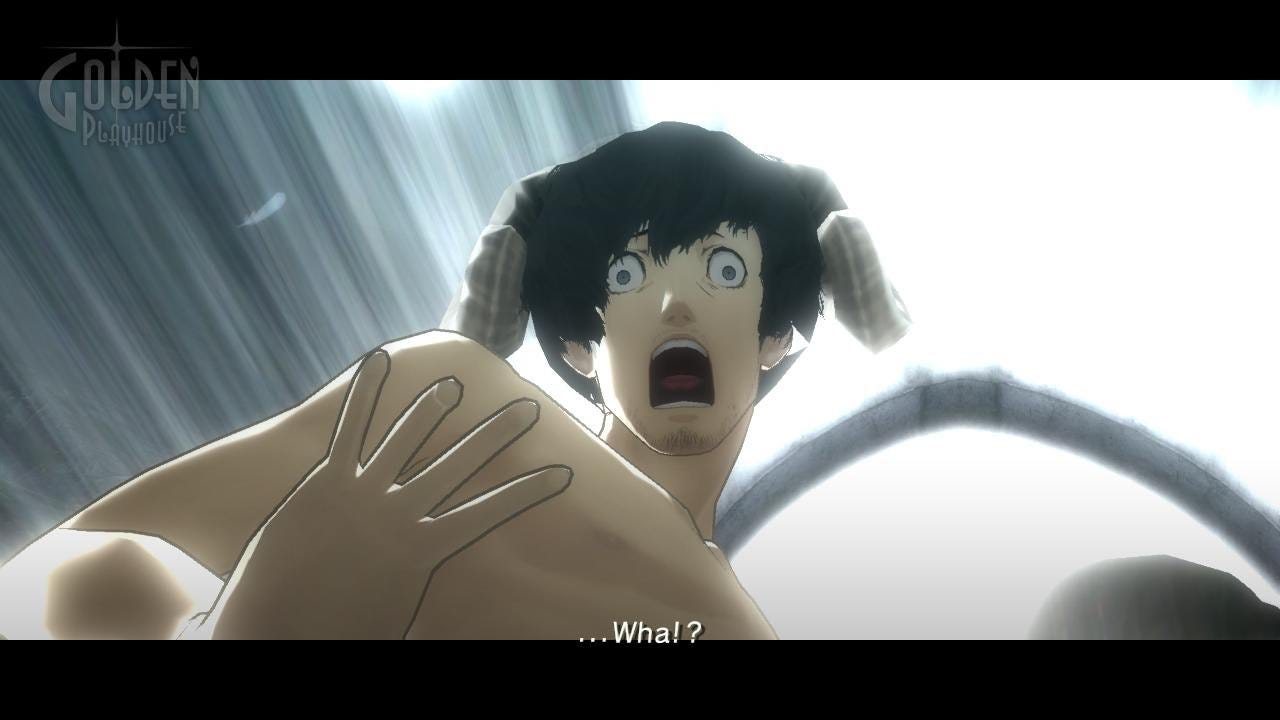
That about sums it up.
This alternate take on the laws of physics presents a slew of implications for you, the poor sap who's just trying to climb out of harm's way. The blocks fall into counterintuitive patterns, but their behaviour also allows for some great eureka moments as you realise how to use their eccentricities to your advantage.
There are also the bomb blocks, and the ice blocks, and the crumbling blocks, and other cubical gremlins that force you to reinvent your approach.
Catherine is menacing in its difficulty. It taunts players with ludicrous setups, giving you only a second to remark "That's impossible" before reminding you, with a distant boom, that the ground underneath Vincent is always crumbling away. At these moments, the impossible becomes plausible by virtue of being the only option.
Yet Vincent is a quick, agile character (at least in the dream world), and when you do get in a block-pulling groove, the frustration melts away. A winning run gives you the sensation of a spider prancing along a web, putting each leg in just the right place with every step.
So the controls are solid, with one exception. Vincent has the ability to hang from blocks and scramble along their edges before hoisting himself up again. If Vincent is facing away from the camera (i.e., with his back to you), this is a simple move: you push left on the analog stick to move him left, and right to move him right.
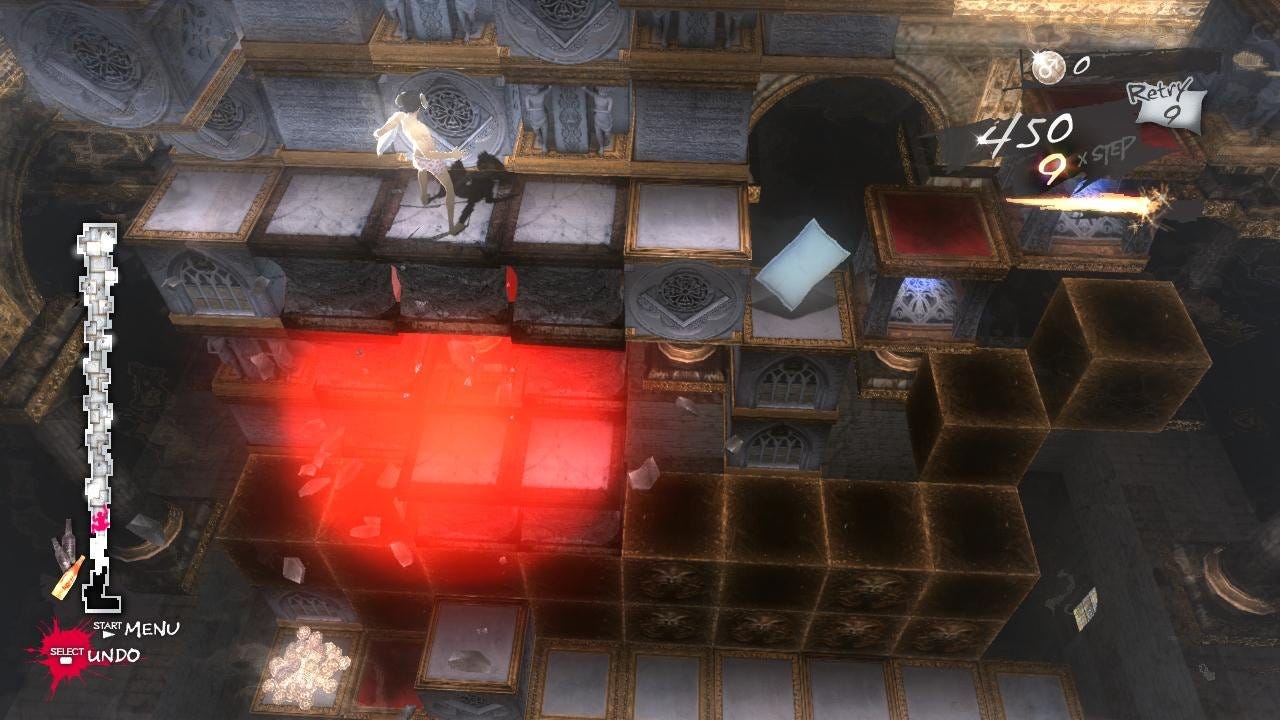
This is the last time I play Jenga on shrooms.
When he's facing sideways or, heaven forfend, toward the camera, it's tough to determine which way he's going to go. The control scheme sometimes changes from block to block, so pushing him left will send him in one direction, and then pushing right will send him further in that same direction. What the hell?
It's aggravating, but hey, this is a dream. Have you ever had that dream where you forget how to run? Where "left foot, right foot" is suddenly an incomprehensible notion? That's what this is like. Points for accuracy, I guess.
The nightmare logic is bizarre in other, less exasperating ways. During each night of climbing, Vincent gets to rest at midway points, where he can chat with other climbers who have been relegated to this same recurring nightmare. I can try to describe these rest stops, but it's going to be strange, like someone telling you about a dream. Because that's what I'm doing.
See, all the other climbers are sheep. Vincent isn't a sheep, except yeah, he basically is a sheep. They're all sheep but also people, OK? A church bell tolls incessantly. There's not really a church, but there is a kid in a confession booth who asks you personal questions. The booth may or may not have rockets.
It's a hallucinatory aesthetic that may sound disjointed when described piece by piece - as any dream does - but coheres in a striking vision of gorgeous dementia. And it's not pure pastiche, either. The nightmare has a logic to it, even if it is an avant-garde logic that makes a game critic sound awfully dumb when he tries to put it into words.
The nightmares are only half of the game (albeit the half where you'll spend the majority of your time.) Much of the material for Vincent's subconscious world comes from the "awake" part of the game, which is far calmer and more dialogue-driven than the dreams.
Each day in Vincent's life presents the player with a couple of cut-scenes before depositing you at the Stray Sheep bar, where Vincent spends every night hunting for respite at the bottom of a sake bottle.
He doesn't find it. The various patrons of the Stray Sheep - most notably his three closest friends - fill his head with more stress and doubt. Some of them muse on the nature of love or on the difference between the sexes. Others offer theories about the peculiar wave of deaths affecting local men who are about Vincent's age. (They're dying in their sleep. Hmm.)
For those who just want to return to the puzzle action of the nightmare world, most of the conversation on offer at the Stray Sheep can be skipped. But these boozy dialogues are an essential part of Catherine's brilliance. They provide little fragments of meaning that are later explored in the dream sequences.
The characters of the Stray Sheep are drawn with care. Their dialogue is crisp but still shaggy enough to feel human. Vincent and his friends are real, grounded beings, with naturalistic voice performances. Troy Baker and Liam O'Brien (the voices of Vincent and best friend Orlando, respectively) give their characters an approachable sound, which is no mean feat.
At the Stray Sheep, Vincent encounters Catherine (with a "C"). She's a blond sylph who develops an instant crush on Vincent. It's hard to imagine how that sullen shmoe could inspire love at first sight, but there we are.
The other side of the equation isn't as hard to figure. When Catherine sits down across from Vincent, he sees a youthful bundle of pure sex - like an overripe peach, just waiting for him to pluck her off the branch and slide his teeth in. She is not unaware of her power over him, nor is she afraid to use it.
Is that almost kind of a sidelong glimpse of a woman's general rear-end area? How dare they! WHAT OF THE CHILDREN?
So Vincent frets. Does he give himself over to the stability of married life with his overbearing partner Katherine, or does he give himself over to his lust for the coquette who sends naughty pictures to his phone? It feels like he's relenting in either case. These women are happening to him, and Vincent is swept away in their tumult.
To call this situation a love triangle doesn't do it justice, as every day adds another hilarious complication into the mix. So let's say it's a love polygon with a hell of a lot of sides. For his part, Vincent just watches it grow.
Each new twist in Vincent's love life lodges itself in his tortured brain, which sets the stage for the game's most epic moments: the boss battles that conclude each night in the dream world.
Before Vincent can wake up on a given morning, he has to climb a tower while being chased by an enormous manifestation of his worst fears. On the night after Katherine proposes to him, he's hunted by a witch who attempts to pin him down with a dinner fork.
The night that he meets Catherine, he finds himself pursued by the bottom half of a woman's body with a snarling beast's mouth between her legs. It's a great motivator. There's nothing like a razor-toothed crotch-maw to put a spring in your step.
Stop winking at me.
These big showdowns are not just about flashy special effects. This game has style. It does more than wow the player with bombast and wackiness (although it certainly does those things). Catherine also confronts us with a vision of a human psyche in its twisted, baroque glory.
This psyche is a split personality. The daytime Vincent is a pathetic figure. He's paralysed by his inability to make a decision. In the dream world, though, Vincent is practically an iconic figure. Playing as dream-world Vincent, you're hailed as an innovative climber and offer inspiration to your fellow sheep.
Life presents you with a number of crossroads, Catherine suggests, and it's only in choosing a way forward that you gain an identity. In Vincent's case, it's the difference between being a mere protagonist and a hero.
The game will draw attention for its wonderful weirdness, as it should, yet that's only half of the story. Catherine plays its eccentricities against its more down-to-earth side, which makes for a richer comic world than you might get from bizarro fare alone. The upshot is an experience that's both fun and provocative - a nightmare worth staying awake for.
9 / 10