Mario Kart 3D
Let's go fly a kite.

Mario Kart's punchy drifts might not have as much praise heaped upon them as the playful arc of the plumber's jump, but they're just as well defined. They've been the backbone of a series that's been one of Nintendo's most consistently brilliant, as well as one of its more lucrative.
Mario Kart's real trouble is that it got its formula down pat back in 1994 with Super Mario Kart, and only when it's veered too far from that original template has it strayed from unbridled success. Hence the disappointment of Double Dash!! and its needless tinkering, and hence the success of Mario Kart Advance and Mario Kart DS, the two hearty handheld compendiums that offered more of the old and restrained themselves of throwing up too much that was new.
Seeing Mario's kart spontaneously sprout a set of canvas wings in the series' 3DS outing is understandably going to get people a little worried, then. Watch it sprout a propeller as it heads underwater, and it's easy to think that Mario Kart hasn't just jumped the shark, it's gone swimming with the fishes while it's at it.
Happily, these augmentations have been well woven into that classic Mario Kart template, and the 3DS edition is, like its portable forebears, another witty compilation that's thrown a few of its own thoughtful additions into the mix.
It's got old-school credentials, and not just in its combat-based racing, iconic character roster and colourful track selection. Coins can be collected to go that little bit faster, a system first seen in the original (and best) Mario Kart that's been sorely missed since.
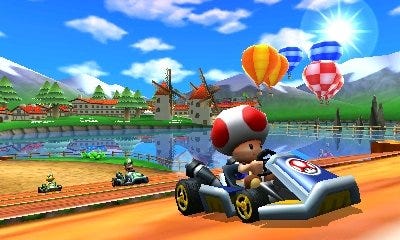
Mario Kart 3DS has also sought counsel from the series' ugly duckling, Double Dash, but at least it's lifted the right things. The vehicle customisation introduced by the GameCube outing makes a full-blooded return here; karts are composed of three slots, with the chassis, wheels and wing all up for alteration. [Correction: Double Dash did not feature kart customisation, but it did allow you to select two riders and from a broad variety of karts, which might be what Martin was thinking of. -Ed.]
The first offers a grand cosmetic overhaul that comes with a few performance tweaks, but it’s the second option that has the most dramatic effect. When loaded out with miniscule pinwheels, the karts bear a resemblance to Double Dash's garage not just in looks; handling is skittish, the karts cornering with all the grace of an overloaded shopping trolley.
There's a middle option that's a straight facsimile of the series' more traditional handling; with these slick racing tires bolted on, the karts feel responsive and fresh, and that defined drift is kick-started, as ever, with a neat little hop before entering a corner.
The last option straps on monstrous tubes of rubber that lend the karts a lurching sensation wherein the whole track's transformed into one long and lazy drift. Alongside the pinwheels, it presents two playful handling extremes that counterpoint the purposeful feel of the standard driving model.