The National Archives, Kew: home to records, documents and other ephemera of cultural importance. It may be a short distance from the grime and bustle of Westminster, where Britain's future is cut and shaped daily, but to enter its leafy grounds is to press pause on that work. Instead, it offers a chance to reflect upon and study the notable detritus of our past, a national Wikipedia made of bricks and mortar, where history is held and filed in neat, curated rows.
It's here that Iain Simons and James Newman, co-founders of the National Videogame Archive project, have called a meeting to discuss their efforts to preserve the digital heritage of the interactive entertainment industry. It's a poignant choice of venue. For all the great many things preserved at The National Archives, not one is a video game.
A Link To The Past
"In part, it's because of the self-destructive nature of video games," says Simons attempting to explain why there has been no successful effort to preserve the medium's past to date. "The games industry has created a cycle where it actively chooses to de-value its own heritage. It has, in fact, created business cycles entirely predicated around the idea that new stuff is better than old stuff. The next game is always the best game. Logic tells us that old games should disappear because the new ones are the only ones that are relevant. It's not even an upgrade culture: it's an obsolescence culture."
To illustrate his point Simons pulls out a paper bag, emblazoned with the video game retailer Game's logo. The idea, he explains, is that consumers grab one of these bags from one of Game's stores, take it home and place their old games in it, ready to trade in for new ones the next time they visit. "It looks like a sick bag," observes Newman. "It's a cross between cash-for-gold scheme and a receptacle for digital vomit."
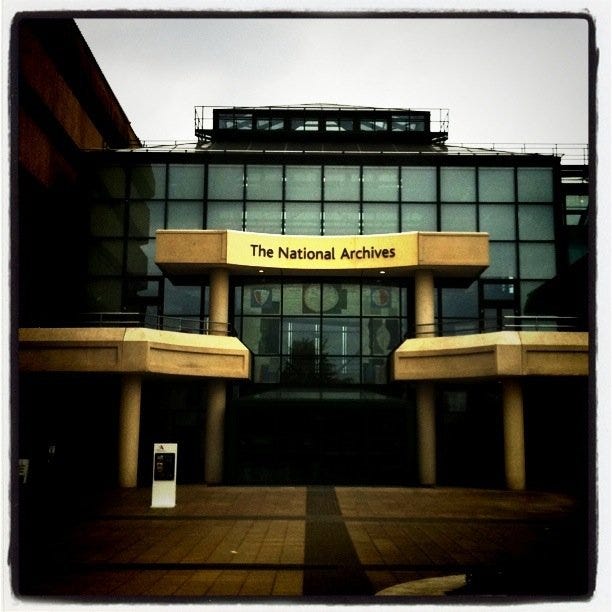
The National Archives.
"There is a churn in the games industry of something that was once valuable at its point of sale that then becomes inevitably recyclable," says Simons. The trade-in economy writes out the value of old games, he argues. "There becomes an urgency to get something played as quickly as possible before it turns to worthless rubbish in your hands. The obsession with pre-owned games alongside the astonishing depreciation of games in the pre-owned market is something that is particularly influential in focusing players on the future and discarding, or at least devaluing the past."
While the sense that old games are little more than currency to be used in purchasing new ones is built into the contemporary retail landscape, for Newman it's also built into the development cycles of our industry. "We have become used to thinking about videogames as hardware and software rather than cultural products. We talk about them in marketing and advertising in the same way we talk about Windows or Office.
"Even when games are reviewed we often see talk of 'graphics' and 'audio'. We focus on the technological. We obsess about polygon fills and screen resolutions. We look at how much more 'photorealisic' the characters are in the sequel compared with the original. So often, we invoke old games and old games systems as benchmarks by which we judge how much better, faster, wider, the successor is."
Indeed, of the 40 or so people in attendance at the presentation, only two of us are journalists. Everyone else works for the National Archives. It's a clear illustration of the institutional disinterest in our medium's heritage at every level of the industry, from publisher to retailer, to consumer to press. Who would want to read about bygone games? We are taught that they are old, obsolete, worthless.
Defender
Simons and Newman do not share this point of view. "The idea of a National Video Game Archive came about after a frustration that there was no single resource to direct students or parents to if they wanted to find out about games," explains Newman. "Iain and I wrote a book called 100 Videogames for the British Film Institute in 2007 and one of the frustrations was that we had was that a lot of the games we were writing about simply couldn't be played. Even seminal titles like The Legend of Zelda: Ocarina of Time - titles that frequently top 100 Best Games lists – weren't easily available unless you wanted to rummage through bargain bins or download ROMs and emulators.
"We thought that bargain bins and consoles that eventually end up falling apart (because, we should remember that everything falls apart eventually), illegal ROMs and emulators that get 80% of the experience of the original are clearly not the way to preserve the history of gaming. Games are an important part of popular culture and any attempt in years to come to understand what the popular culture of the late 20th/early 21st century would be pretty impoverished with no access to videogames." So the pair partnered with Nottingham Trent University and the National Media Museum to begin working out what a video game archive might look like. But while it's easy to argue for the relevance of preserving gaming's past, working out how to go about preserving that past is another question entirely.
"The technical issues faced are substantial," says Simons. "Some games are extinct; some are missing; the ones you can find have to be migrated to new systems and emulated, whereupon they sometimes become almost unrecognisable from the originals; and then there's the army of Intellectual Property lawyers to stop you doing any of it anyway." As such, the Archive's approach to preservation has, thus far, been somewhat scattershot.
"Our aim is to collect, preserve and exhibit a whole host of materials from game cartridges and disks, through to design documents, marketing and advertising, fan-made maps and artworks, and videos of players playing," explains Newman. "So, we try to cover the full extent of videogames, from the initial design through to the objects themselves, to records of how they were played once they were released."
Gotta Catch 'Em All?
The collection of these artifacts is currently held in vaults at Bradford's National Media Museum, with parts of the collection available to the public. Despite having premises to house the collection, the question of storage is, of course, pertinent and leads to another question: how much to endeavor to collect? Surely the plan isn't to make a library of all games?
"No museum can attempt to save everything so we have to be selective," says Newman. "We have a collections policy that identifies specific collecting themes and we have an exhibition strategy that guides our collecting as we acquire objects for display. Similarly, although it's the National Videogame Archive, it's not a British collection per se. Rather, it's intended to reflect the games that impacted on this country and helped to create our gaming culture. So without doubt that means collecting from the UK's rich heritage but it also means looking to Europe the US and Japan."
Bradford's National Media Museum.
If the plan isn't to attempt to preserve all games, then someone must have the job of choosing what games are to be included in the archive. As such, what constitutes notability? "That's a really tricky issue and is at least part of the reason we have collecting policies and themes," Newman explains. "We try to tell stories as much as preserve individually important games.
"By picking particular narratives to tell, whether they are something like 'user-generated content' or particular genres of games, for example, we can select titles whose features will contribute to enhancing understanding. This also allows us to move away from simply dealing in the 'best' games to being interested in the most illustrative. Things like the IGDA Game Canon is absolutely great but we probably already all agreed that we needed to look out for Tetris and Doom. What about Horace Goes Skiing? Game & Watch Parachute? N64 Superman?"
Indeed, Newman believes that 'bad' games can be just as important as 'good' games to capturing gaming's history and that there's a danger that our history becomes exclusively defined by titles that enjoy universal acclaim. "We need to be careful that we don't just end up with a list of the usual suspects - all those lauded games that everybody agrees are great. They're not the only things we want to preserve. The history of games is full of terrible games just as it is full of AAA successes. Look at the Smithsonian's Art of Games crowdsourcing project - there's not too many surprises in there. We must be careful not to preserve only that which is universally lauded in its time."
Another World
The idea of a collection of a relatively new medium's formative creations is romantic. But, why does the team believe so strongly in its importance, especially when the industry itself seems uninterested. "Maybe it isn't important," says Newman. "We think it is, but maybe it isn't. However, we think it's better to preserve the stuff and later work out it's unimportant than let it disappear and work out later that we should have saved it.
"Second, we'd probably also say that it isn't just gaming's formative history that needs saving. Certainly, we stand to lose plenty of games as well as the stories behind them as their creators pass away - but we stand to lose just as many modern games.
"With digital distribution we see the disappearance of physical media which means there is no material object to preserve, with online patching and updating games change so it is increasingly difficult to work out what the game is as new levels are added and gameplay fixed/changed; with online games we might even ask where the game is and how we could ever archive or preserve it. Even if we could get access to the servers, the gameplay isn't stored on them, it happens and is gone forever. Unless we devise strategies for dealing with and recording gameplay we stand to lose far more than just old games."
But, to play devil's advocate for a moment, in a medium that, unlike many others, is iterative in many of its product releases, is it really important to preserve, say, FIFA '98 when we have FIFA 2011? "The idea that the games industry is in a permanent state of innovation and disruption that sees each new title or hardware platform render that which it replaces obsolete is an interesting and potentially problematic one. In one sense, it doesn't matter to us – FIFA 98 is potentially as interesting as '11, '12 or beyond. They are documents of their time and they represent attitudes towards game design at a specific moment.
"Where it becomes a problem is when we think of the new game being better than the old one. This is an idea that marketing and advertising tends to promote - quite understandably - and it's certainly something we want to challenge. Comparisons with other industries and cultural forms are always difficult but it's worth considering whether we think the same way about old music as we do old games. Despite the apparent technological progress that's happened in the recording studio, we don't automatically denigrate music that didn't have the benefit of 24-bit Pro Tools HD or Autotune. The Beatles albums don't sit in bargain buckets for 99p because they are old or because they don't take advantage of the latest studio technologies."
Wipeout
On of the greatest challenges facing the collection is ensuring the ongoing playability of any video game collection's specimens. Consoles, joypads and peripherals are all made of plastic, which is inherently unstable. Contacts on cartridges and chips corrode and stop functioning while even the data stored on optical discs or EPROMs eventually disappears as the storage media decay.
However, where games present particular challenges is by virtue of their interactivity. Games want to be played and we need to work out what to do with the play. How do we preserve it? Or do we try to preserve the game so that it can be played in the future?
One potential idea the pair is toying with is an oral approach to preserving play, for example with videos of players playing through a game while talking about what they are doing, and describing the cultural context in which they first played a title. "Games do not necessarily have to be playable for their play to be understood by a viewer," says Simons. "Increasingly we believe that play is what we have to capture, not playability."
The National Archives, Kew. And some lovely malards.
Newman agrees: "We question that value of making a game available to play in 100+ years time when the player may be so utterly divorced from the lived reality of the game as it was. It isn't just about seeing Jet Set Willy in the historical context of the miner's strike in the 1980s, or even as a sequel to Manic Miner. We also forget how much knowledge you need to play games. Take a modern beat-em-up. It relies so heavily on references to Street Fighter II in its control system that without that knowledge, it is difficult to properly appreciate and certainly difficult to play."
"Although it is typically the goal of games preservation, we're not sure whether trying to ensure that games are playable in the future is necessarily the best objective. We're not saying we shouldn't do that but just that we might learn as much from seeing them being played by the players that really knew them, hearing those people talk about them etc. We know this idea is a little off-the-wall and isn't the official position of the National Videogames Archive, but we think it's possible that 'non-interactive' media like gameplay videos might be a central part of the interpretative strategy for videogames as we move forwards."
Whether through storing consoles and game boxes in warehouses, or oral documentaries of playthroughs on YouTube, few who truly care about video games would argue against the value in preserving the tapestry of our medium's evolution. And beyond that, interesting video games remain interesting. The idea that new creations supersede old ones is a fallacy. The National Videogame Archive is a project not only to preserve that heritage as a museum, but also to acknowledge the fact that that many video games -- despite what their publishers might want us to believe as they promote the next big thing, and the next, and the next again -- offer timeless experiences. They just need someone to bottle them.
If you are interested in donating games, hardware, artwork, code or even narrated playthroughs of games to the National Videogames Archive then visit www.nationalvideogamearchive.org for more details.
