When the Wii was first shown at E3 2005, still known by its codename 'Revolution', Nintendo decided to hold back the controller. The most exciting snippet of information offered by Nintendo's poker-faced president Satoru Iwata was that if you had three DVD boxes held together, Revolution was slightly longer and deeper in size.
By December 2006 the Wii had launched in all major territories, one year later than the Xbox 360 and at the same time as PlayStation 3. No HD, an offbeat online interface built around 'channels', and a single magical gimmick with the perfect launch title to showcase it. What happened next seems inevitable with hindsight: Wii dominated the competition, and did it while making a profit on hardware.
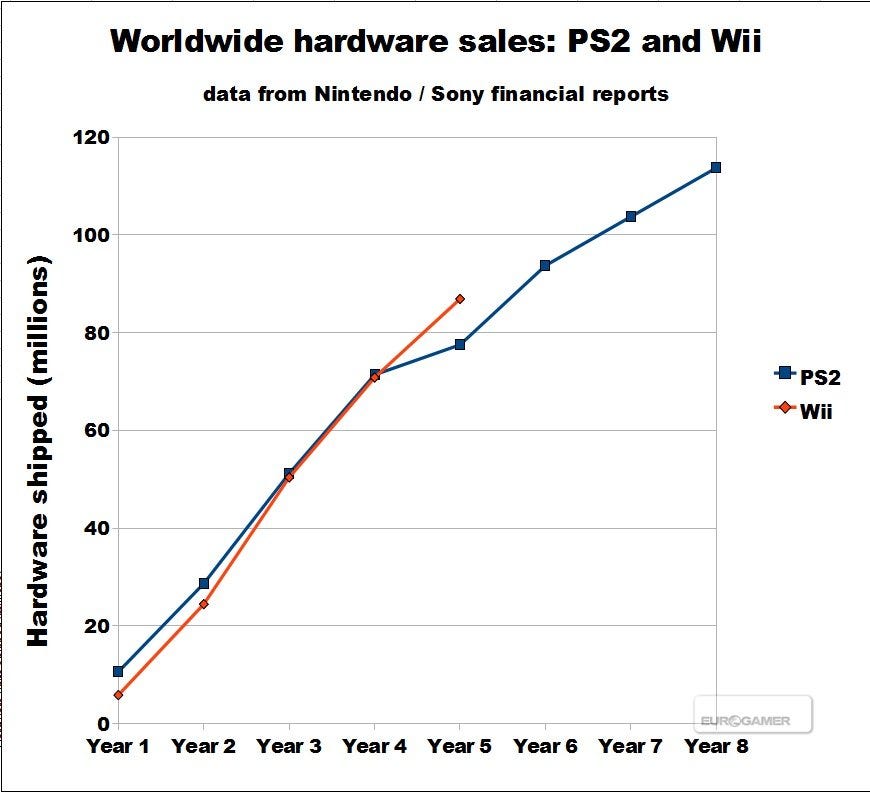
This isn't the place to tease apart the reasons why but, in perhaps the phrase of our times, the market had spoken. Since launch the Wii has not only outsold the current generation of Microsoft and Sony hardware, but it's done it by a distance. The Wii hardware currently sits at just over 86 million units sold, compared to 53 million for the Xbox 360 and 50 million for PS3. Perhaps it's impolitic to say so, but after the N64 and GC days it was thrilling to watch Nintendo come back on their own terms, and so assuredly wrong-foot their lumbering opposition.
This November will mark five years since the Wii's launch, the usual gap of time between new Nintendo hardware, and its successor is confirmed to be shown at E3 this year: our favourite rumour thus far is the one where it has an in-built LED projector. Whatever, the Wii's winding down and Nintendo's net profits for the last fiscal year dropped 66.1%, a decline explained thus: "The decrease in unit sales was mainly due to a lack of appealing software titles which encourage consumers to buy."
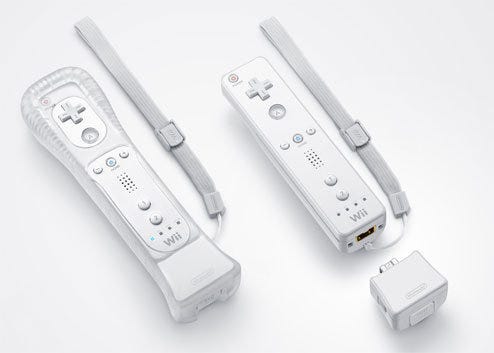
Not every experiment was a success: MotionPlus, despite selling a bajillion, only has three games to date that absolutely require it.
We'll come back to that. The immediate response from Nintendo is a global price cut for the Wii, and a line of budget software – in the UK it's now £129 for the console with a choice of game, while in the US it's $149. Reggie Fils-Aime reckons this puts the console at a crucial level of affordability, citing the PS2's ongoing indian summer as Nintendo's target. "For us this is a very important move," he says. "And in the last home console cycle, the leading system at the time sold almost 50 per cent of its volume at a price point of $149 or below."
A price cut should sort those declining sales out, right? Wedbush Morgan analyst Michael Pachter, who's been calling for a Wii price cut for some time, hedges his bets: "I think that price cuts will stabilize hardware sales for the Wii, and perhaps drive them 20 – 25% higher [but] given that the price cut happened barely 6 weeks into Nintendo's fiscal year, it's safe to say that they expect sales to flatten out or to decline slightly."
It's that PS2 comparison that's interesting, though. "The Wii should enjoy the same success that the PS2 enjoyed from 2004 – 2009," says Pachter, "fairly robust sales and decent software sales, but declining each year."
Sony announced on January 31 2011 that long into its tenth year the PS2 has sold over 150 million hardware units on January 31 2011, and a mind-boggling 1.52 billion games. That works out at an average of just over ten titles sold per hardware unit. The Wii's sales stand at 86 million for hardware and 695 million for software.
That's an attach rate of 8.2 per Wii console. There is, however, a crucial difference between the PS2 and Wii stories: software. The PS2's success, particularly in later years, has to be attributed to its ongoing third-party software library – in the year its price hit $150, the PS2 hosted GTA: San Andreas, Burnout 3: Takedown, Spider-Man 2, Katamari Damacy, MGS3: Snake Eater, and Killzone.
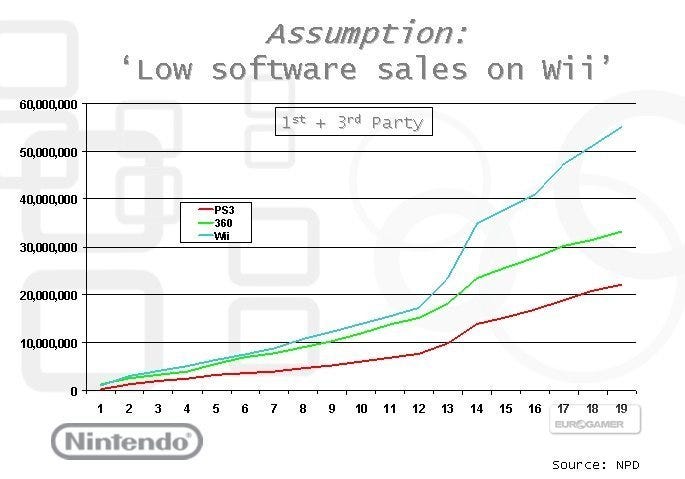
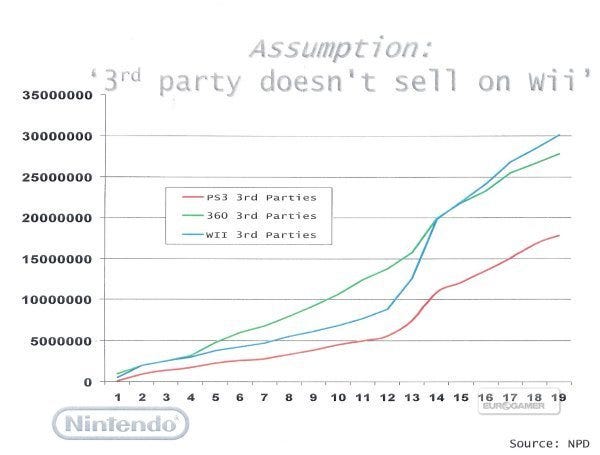
Since its earliest days one observation about the Wii has been pervasive: it doesn't have the software. More specifically, it doesn't have the third party support you'd expect for the market-leading console. Nintendo answered this point last year and, being Nintendo, did so with sales statistics: Fig 2 show an undeniably impressive 8.2 games sold per console and total software sales of 695 million units.
There's a caveat, of course. Nintendo released at the same time a list of the Wii's biggest sellers: remove the Nintendo-published and developed games from that list, and 695 million becomes 398.5 million – or an attach rate of 4.7 games per system. So far in 2011, 12 of the top 20 selling Wii games are first party.
The falling sales and dominant position of one company suggests a stagnant software market, in which a small group of titles claim the vast majority of sales. Needless to say, most of them are made by Nintendo. That doesn't mean third-party publishers haven't tried, with varying degrees of success, to carve out a chunk of the pie.
Most successful are Ubisoft, and their hits and misses encapsulate the Wii's software market. Just Dance and its sequel are the two top-selling third-party Wii games (5.8 million worldwide sales for the original, 7.2 million for the sequel, and counting), while other big hitters are fitness games like Your Fitness Coach (2.25 million).
Whatever happened to the Vitality Sensor? Iwata, on a recent call, claims Nintendo want '99% accuracy' before release, which sounds ominous.
Ubisoft's attempts with more 'traditional' games are a stark contrast, with the likes of Red Steel 2 (430,000 sold) or multiplatform ports like HAWX 2 (less than 25,000) much less successful. Particularly when you consider something like Family Feud: 2010 Edition shipped 530,000.
There are other case studies – Sega's more gamer-oriented slate of Ghost Squad, House of the Dead Overkill, The Conduit, MadWorld, Nights and Samba De Amigo had varying levels of success, but all sold under a million. EA's sports titles drastically underperformed compared to other platforms, though EA Sports Active shifted 3.7 million.
But the games are drying up. EA and Activision have cut their Wii commitment drastically: Sega's decided it's better off elsewhere; Ubisoft is sticking around for Just Dance 3 and a few spinoffs, but it's doubtful we'll see Red Steel 3. "Third party software support has been slipping for a couple of years," says Pachter, "with EA cutting the number of Wii games by half, and Activision doing the same. I think that Ubisoft and THQ will continue to support the Wii with fitness and dance games, but I don't think we will see many third party titles that are compelling content going forward."
What this shows more than anything else is the draw of multiplatform development for third parties. Making a separate Wii version of any titles, even ones like Black Ops, simply isn't worth the investment. The Wii's the leading console of this generation but not for a moment has it ever been the standard, and the current appeal of its software is reflected in declining sales.
Last month, Satoru Iwata admitted as much in a Financial Results Briefing: "We had continuous growth in the number of Wii users, but we are now seeing a downward turn. In other words, we are not making a situation where users are continuing to play after their first experience. This is a big challenge we are facing."
Or to put it another way, the Wii is entering its closing stages in an absolute rut – the supply of first-party and third-party games, which was always somewhat constricted, is now barely a trickle, with only Zelda on the horizon. Here are the highlights of the next few months' software: Transformers: Dark of the Moon, Get Fit with Mel B, LEGO Pirates of the Caribbean: The Video Game, Cars 2: The Video Game, Karaoke Revolution Glee: Volume 2, ExerBeat, Wii Play: Motion, Green Lantern: Rise of the Manhunters. Three movie tie-ins, a fitness game, a singing game, a Nintendo minigame collection and a Lego game. Just to emphasise: the highlights.
The most fascinating thing about Wii is how conservative its software market has become. Everyone knows what works: minigames, dancing, fitness workouts and board games. The greatest months for innovation were, in fact, the very first: titles like Wii Sports, Elebits and the criminally underrated WarioWare: Smooth Moves. Wii Sports' intuitive interface and laser-like focus on getting players into the game and playing (so little clutter) makes Sports Resort and the banal Wuhu Island look a little clumsy.
With Elebits and Smooth Moves, it was a case of ideas that would've been impossible without the Wii remote: in the former, a game about pointing, shaking and making a mess; in the latter a hundred surreal takes on what the remote could represent. They should have been the vanguard.
Best Wii moment ever: seeing your mates at the side of the court. Unbeatable.
Instead, the Wii remote has come to seem almost incidental in its best games (Galaxy springs to mind), and the disappointment isn't to do with the surfeit of party games and lack of multiplatform ports: it's that the Wii's software rarely innovated beyond the obvious. Sports and fitness games are all well and good, but the interface never developed beyond curios like Let's Tap, while Nintendo's most recent games are either decent but traditional 2D platformers like DKCR and Kirby's Epic Yarn or forgettable fare like Mario Sports Mix.
Sony's corporate barbs for Nintendo always laser in on the childlike aspect of Nintendo's products, which is from another angle their greatest strength. It's the idea that encapsulates Wii: complexity and depth is less important than fun.
The simple brilliance of that led to some kind of revolution. And here we are: the Wii will toddle onwards, selling many more millions over many more years. It's a classic console with some unforgettable games. But it's also one where the majority of upcoming software is either simplistic or blandly mainstream, a console that retains its core appeal but has never grown beyond it.
In the heady days of its launch, Wii promised a new way to play, a new experience. Four years down the line, it's run out of steam badly, and Nintendo's attention is clearly elsewhere. The success story of this console generation has turned out to have the most boring ongoing narrative. It was a gimmick, in the end, as surely as the Ultra Hand. But wasn't it a magnificent one?