Twisted Metal

Mettle detector.

"What is it you guys call me? What it is over there?" David Jaffe is racking his brain for a British slang term he gets labelled with in Eurogamer comments threads. "Wanker?" I suggest, recalling a similar conversation with Cliff Bleszinski about his online relationship with gamers.

"Wanker I like, wanker's kind of fun, but it's something like... Jaffe's a..." It feels inappropriate to venture anything else. "A nob! It's a nob! F*** you, you know! Anyway the point is... There was a valuable point... What was I talking about? Oh, fun!"

Seven minutes with David Jaffe feels like an hour of quality time with anyone else. Wind him up with a question and watch him go, tackling a subject with serious gusto before veering off wildly, losing his way, then just as dramatically swerving back on track.

Jaffe may have a testy, periodically fractious relationship with the industry and the internet, but in person he's warm, funny, smart and wonderfully 'NSFW'. And, as the creative brain behind God of War, a guy who's earned his airtime.

The above tangent comes during an impassioned response on his reaction to Nintendo president Satoru Iwata's now infamous GDC keynote, in which he effectively railed against Apple's App Store gaming strategy, arguing that games development is "drowning".

Having gone around the houses, Jaffe is back on point. "You can't put a value on fun," he insists. "I don' t care if it's 99c or $150 or $1000 over the years in sub fees to an online MMO. Fun is fun, so I think it's an absurd concept to say, this is the criteria, these are the ingredients you have to use to make fun otherwise you can't play. That's bullshit, man."

It's an issue relevant to all game makers and publishers, and Twisted Metal, a PS3 reboot of the other series Jaffe is known for, is no exception. The game – the latest in PlayStation's longest-living franchise no less – began life as a download-only PSN title. Then, somebody in Sony saw greater things ahead and encouraged Jaffe's studio, Eat Sleep Play, to beef it up into a full-price retail product.
1

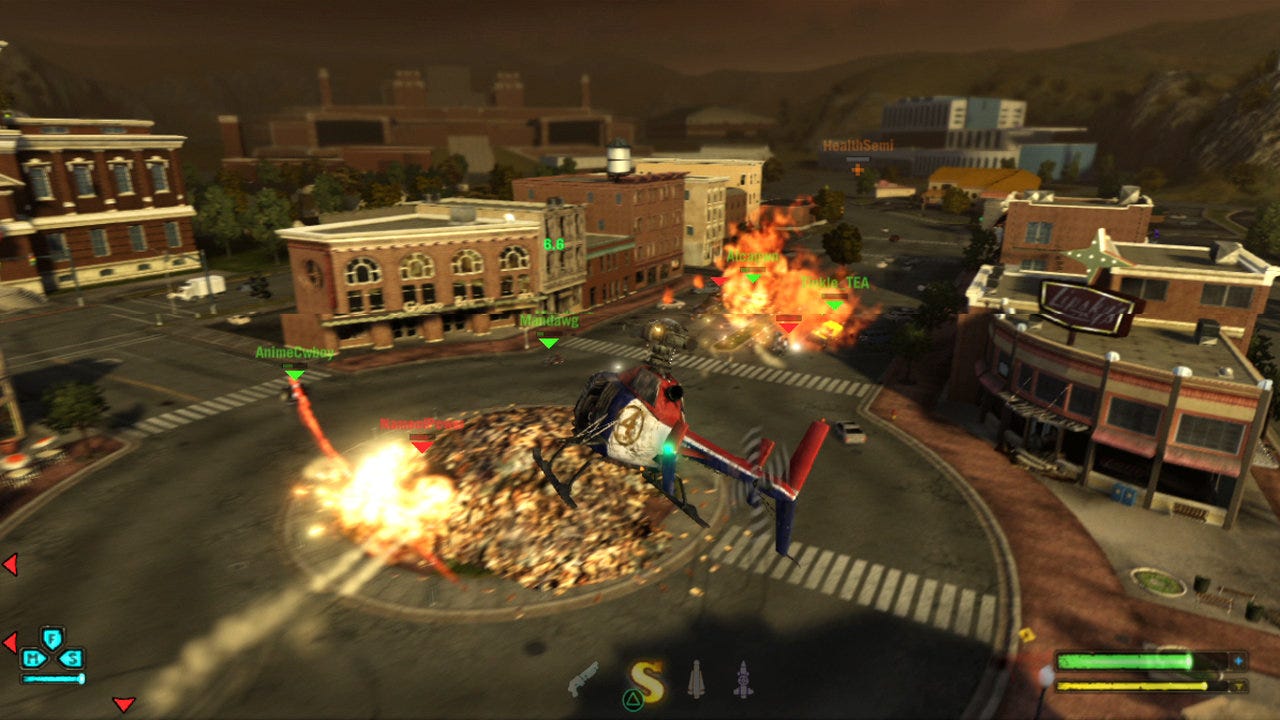
Talon is Twisted Metal's first flying vehicle – which can give others a lift with its magnet.

But with an increase in scale and price comes an increase in commercial risk, and with the games market increasingly polarised between mega-marketed triple-A titans like Call of Duty and 59p timesinks of the Angry Birds variety, those releasing games in-between have more reason to be anxious now than in previous years.

And Twisted Metal, for all its many, many millions of sales on PSone and PS2 (with greatest success on home soil in the USA), is making its first appearance in this generation at the most fiercely competitive time of the year at retail: Q4. But somehow you suspect Jaffe relishes the challenge.

"We love Twisted Metal, we love the competition and the multiplayer and we want to bring this to new audiences and new hardware," he says.

There's no sign of single-player at the game's latest hands-on event in Los Angeles, but there's a big chunk of multiplayer on show. And at this stage suffice it to say there are no obvious doubts raised about the promised depth of the experience across its various modes of play.

Jaffe continues: "Our online modes are very deep - you'll hopefully agree that there's a lot of tactics and teamplay and strategy. Our multiplayer local game is very deep in terms of split-screen two- and four-player."

On tactics, teamplay and strategy it is indeed hard to disagree. Although, as Oli noted during last year's E3 hands-on, it remains a little overwhelming at first due to the complexity of the controls.
2

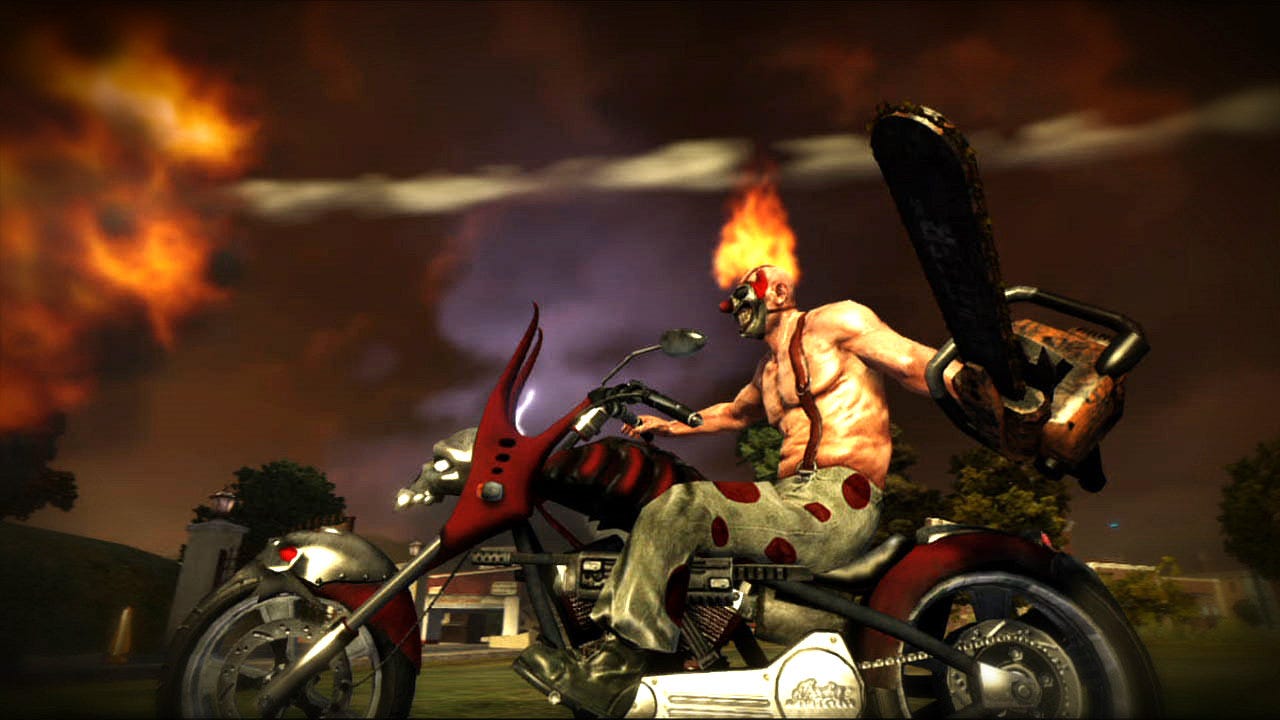
Dressed for a night out in Camden.

The shoulder buttons, d-pad, both sticks and face buttons, not to mention button combos, are all drafted in to perform essential functions. I learn this the hard way, as it's only towards the end of my gameplay session that I discover the right stick provides a booster reverse, double-tapping square is turbo and L1 plus R1 equals jump.

This is less a criticism of over-complication, since I'd been having plenty of fun regardless, and more a realisation that there's a steep initial learning curve leading towards the game's full suite of fun.

This tallies with Jaffe's positioning of the game, which he's previously compared to a beat-'em-up. The basic controls are the kicks and punches, moving onto the more advanced super-combos. The trick, of course, is making it work at all levels.

Today, he's calling the game "a shooter". "We really do put ourselves in the same category as Bulletstorm, Call of Duty, Quake," he says. "I haven't played the multiplayer of RAGE, but it seems like they might be going in a similar direction." (Check out our RAGE multiplayer preview to compare and contrast.)

This is to draw a distinction between his vehicular combat title, and recent action racers like Blur, Split/Second and MotorStorm, all of which have been commercial failures, despite being "great, great games, amazingly produced games".

"There is a wholesale abandonment of track-based racing," says Jaffe, considering why they failed. "Unless you're dealing with real hardcore reality racing simulations, people just seem to be going, you know, 'I can get that and more in these games that are amalgams of a number of genres.'

"Every genre is getting assimilated into experience versus genre [so] that the idea of genre-specific games – this is a fighter, this is a racer, this is a shooter – I really think, in the next generation beyond this one, it will continue to become what we'll one day consider relics of the past."

Whatever Twisted Metal is, it's a blast. I try out three modes of increasing complexity: free-for-all Death Match in a suburban setting; Team Death Match in a dynamically changing arena of destruction; and, lastly, Nuke, Twisted Metal's take on capture the flag.

The first offers a suitably freeform, riotous opportunity to get to grips with the various vehicle types and their firepower. Additionally, it highlights the improved environmental destruction – something the game was slapped for at E3 and Eat Sleep Play has worked hard on to improve. After all, why go around the house when you can go through it?

It takes a fair few hits before a player is destroyed, so risk-taking and experimentation are encouraged. There's sufficient warning that your health is low, but if an opponent spies your empty health bar, you'll be under severe pressure to make it to a health pickup in time.

Black Rock Arena is up next, a dazzling homage to Twisted Metal 2's Suicide Slides. Around the large, open battle space in the middle of the arena there are wide, high ramps, lava pits, electrified routes, spikes stabbing up from the ground and giant wrecking balls swinging in the sky.

The arena itself dynamically alters, walls rising and falling, changing the space from, as Jaffe puts it, "open battlefield to rats in a maze", forcing you to adapt on the fly.

The scope for strategic teamplay is obvious. Take, as an example, the health orb flying around the arena. If you drive under its beam it recharges health, but its reserves are limited.

3

There's a dizzying array of attacking options that overwhelms at first.

So do you use it as soon as you need it then destroy it to prevent the opposition from benefiting? Or, if an ailing ally in a slow vehicle is far away and you're in the chopper (the series' first aircraft), do you magnet-whisk them away from danger and towards a health boost?

Meanwhile, the Juggernaut, new to the series, offers sanctuary to the severely damaged, with team-mates able to nip up a ramp and into its trailer, providing temporary safety and mounted guns to play with.

Life conservation is especially important in the mode I play, Team Death Match with shared lives, where everyone draws from the same pool. Once they and you are gone, you're confined to the role of spectator.

There are strategic decisions to be made right across the map. The lava won't kill you but will drain energy, so can you make it through using your shield to grab that pickup?

Finally, it's time for Nuke, a hardcore multiplayer mode Jaffe calls the game's "deep end of the pool". He's not kidding. It's team-based capture the flag which, having evolved since its E3 showing, is now divided into baseball-like innings, with teams alternating between offense and defence. "We're so proud of this, it's so much design work," Jaffe tells the assembled press.

The idea in offense is to capture a faction leader, drag them to a missile launcher, wait a pre-determined time in the 'sacrifice zone', then launch a missile that must then be steered into an opponent's statue, earning you a point. Phew.

It's easy to see how well-organised teams will prosper. Time required in the sacrifice zone varies by vehicle. The helicopter is super-slow, but can carry a fast-sacrificer to the zone. The Juggernaut's container offers even greater protection when flanked by a convoy of tough SUVs. But even this defence can be breached by Specter's secondary Special – a 360-degree EMP attack – which takes out everyone's engines, leaving them wide-open to attack.

4

Single-player’s still under wraps, but each character will have its own story to unfold.

And so on. The demonstration videos Jaffe shows do a much better job of illustrating the potential than my own cack-handed, still-confused efforts. It seems likely that only the truly dedicated Twister Metal players will reach these mesmerising heights of co-operative endeavor, and its creator acknowledges the challenge this implies.

"I'm so hopeful that at least a large enough group of gamers play this mode and really get into to the tactics and figure it out," he says. And if Twisted Metal is more shooter than racer, its October release date will put it right in the firing line of online attention-hoggers Battlefield 3, Resistance 3 and, presumably, Modern Warfare 3.

"I'm real proud of it," Jaffe reveals. "Some of the best design we've ever done is in this game, some of the best gameplay we've ever provided. The chips will fall as they will, but there's no value to worrying about that once you've pulled the trigger."

Asking the studio to turn its PSN title into a no-holds-barred full-price experience was a huge vote of confidence by Sony, which, lest we forget, did rather well out of Jaffe on PlayStation 2.

But that means the marketing department, particularly in Europe, must now also vote with its wallet, to give the game the best possible shot in the sink-or-swim end-of-year maelstrom.

As bold, brash and irrepressible as his games, you can count on Jaffe do his bit. Really, you'd be a nob to think otherwise.

Comments (13)

Comments for this article are now closed, but please feel free to continue chatting on the forum!

  • Loading...hold tight!