After a faithful 16-year love affair, Insomniac Games and Sony are officially seeing other people.
Having birthed PlayStation icons like Spyro and Ratchet & Clank, the studio hooked up with EA last year to work on a "brand new universe and franchise". And it's currently flirting with mobile and web games, through the new Click division.
But from the PS3 pods and giant Ratchet boots in the reception area of its impressive 200-man HQ in Burbank, California, through the corridors plastered with the achievements of a relationship worth 35 million game sales, it's clear Insomniac's heart still belongs to Sony.
As, of course, do its biggest franchises. And for the third outing for its Resistance series, expectations are high for the team to build on the considerable success of the previous game.
The premise this time is that, after the grandstanding of Fall of Man and its sequel, Resistance 3 tracks the personal journey of Joseph Capelli across a ravaged US, where mankind has been crushed to the brink of extinction by the Chimera.
Insomniac calls it The Road meets District 9, marrying the intimacy and haunting isolation of the former with the effervescent sci-fi of the latter: survival in a brutal world. After the tumult on show the last time we sat down with the game , the campaign offering at today's event represents a deliberate tonal shift.
The mission appears halfway through the game. Dropped into a valley in Mount Pleasant, Pennsylvania at twilight, Capelli is immediately under threat from the Chimera and must cautiously, delicately make his way forward.
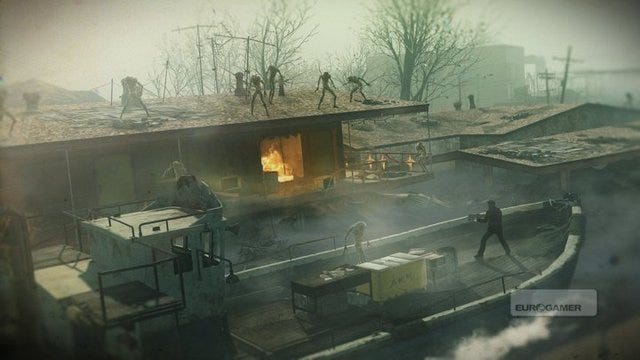
With most of humanity already flattened, Resistance 3 is a game of desperate survival.
Variety in pacing is at the heart of the studio's aspiration to create a "rollercoaster" experience, with peaks of ethereal calm plunging into troughs of synapse-frazzling frenzy.
This represents a marked contrast to Sony's other recent FPS heavyweight, Killzone 3, a game with only one pace: off its tits. Guerrilla's epic consciously, unapologetically overwhelms as the action is unloaded with machine-gun force. But the trade-off for this undoubted sensory rush is an absence of moments to gather oneself and just soak up the experience.
"The intensity of the combat setups is heightened if you have a bit of a break, rather than it being balls-to-the-wall for three or four hours," reckons Resistance 3 lead designer Drew Murray. "You just get numb to it."
He concedes that previous Resistance games made the mistake of feeling "somewhat relentless", and reveals that a change in approach for part three was, as a result, a challenge the team initially found "unnatural".
A level set on a boat sailing down the Mississippi, playable for the first time at today's press event in LA, illustrates the point. "We give you a minute and a half of not much to do; you're just absorbing the world," he explains. "There was a lot of panic and fear [in the studio]. 'This is just boring. It kinda sucks. People are gonna go crazy and hate this.'"
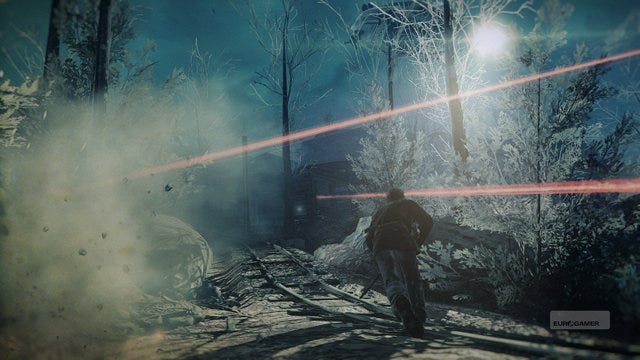
Creative gunplay is the game's key asset in a genre not exactly short on solid shooters.
But – wisely – the team stuck to its guns. Or, rather, kept them holstered, to allow this eerie journey across the water to unfold steadily, building the tension impressively before the inevitable arse-clenching firefight.
"I think it's been very different for us," admits Murray, "but it builds a deeper connection to the world than just shooting everything."
Perhaps the most significant single creative decision has been the reintroduction of the weapon wheel. It's about freeing-up player choice: why litter a game with spectacular, varied weapons only to severely limit what can be carried around?
The response Insomniac received at a recent community event for fans proved encouraging. As players discovered the wheel there was, Murray relays, a spontaneous round of applause. After all, whether it's Resistance or Ratchet & Clank, kickass guns are what Insomniac does best.
Speaking of which, there's a new one on show in the latest build. Dead Eye is a Chimeran sniper rifle whose secondary fire is a powerful, charged shot that explodes on impact. It's the weapon of choice for a new enemy, the Sniper Hybrid, which also boasts cloaking power – not to the point of total invisibility, but enough to have you nervously squinting around the environment looking for any sign of movement. The dead giveaway – silly Sniper Hybrid! – is the red laser-targeting light blazing a trail through the darkness.
After surviving outdoors, Capelli ducks into a railway tunnel to encounter another new foe, the Shield Drone, which protects Chimera behind an impenetrable force field. Only when it is destroyed can they be attacked.
It's an idea that's been done plenty of times before, but here it's used to highlight the flexibility of the weaponry. Forced to reprioritise targets, what's best for taking down the drone may not be best for popping one in Sniper Hybrid's bottom. With the weapon wheel at your disposal, what works best for you could be very different from the next guy.
In short, Murray claims, there's "a pretty incredible amount of choice as to how to approach the game". Which may be true within each mission, but also serves as a handy defence when the thorny issue of campaign length is raised.
Feeling short-changed by a shooter's single-player content is a regular (and frequently justified) complaint of gamers. Last year's Medal of Honor was a particularly shameful offender in this regard. Resistance 2's campaign was more substantial than many of its rivals, but where does Insomniac sit on the matter?
"Multiplayer is obviously the thing that keeps people playing for hundreds of hours," says Murray, while promising that Resistance 3's single-player offers replay value by design. "You're not going to get all the weapon upgrades on your first playthrough – there's reason to go back. And there's campaign co-op, which we've brought back from Resistance 1.
"We're definitely trying to focus and make a higher-quality game experience, and if that means it's a little shorter then we're okay with that. I don't think people are going to be dissatisfied."
Introducing the Sniper Hybrid. Imagine the passport photo.
The buzzword for multiplayer, as with the campaign, is "intimate". After the frenzied 40- and 60-player firefights of Resistance: Fall of Man and its sequel, Resistance 3's limit of 16 may come as something of a shock to junkies of previous outings.
Multiplayer lead Cameron Christian explains that, while the scale and intensity of battles worked, it often became too "chaotic". With the return of the weapon wheel and the loadout variety this enables, it was decided that reducing the player count would place greater emphasis on player choice and strategy.
This dramatic scaling down almost certainly delivers handy performance benefits. But the flipside is a balancing headache for the multiplayer team tasked with accommodating every weapon and upgrade found in single-player. "We're trying to make it as balanced and fair as possible," says Christian, sounding a touch beleaguered by the effort but confident of success.
With this in mind, it was a priority from the outset to avoid one-shot kills. Even a fully upgraded Magnum won't completely take out an opponent with full health. You still have to "soften them up a bit", says Christian.
Health packs are one single-player element that hasn't been carried over to MP. Their introduction in the campaign, against the grain of the modern shooter, should result in a more difficult, yes, but more exciting, nerve-shredding experience. But this was deemed inappropriate for the ebb and flow of multiplayer, which retains a familiar recharge system.
The train yard multiplayer map delivers claustrophobic, frenetic fun.
In changing tack on multiplayer, Insomniac will of course have closely studied rivals. "Call of Duty is still pushing it. It set the standard," acknowledges Christian. "We looked at a lot of things, because our damage model is a little lower than Call of Duty, so we looked at Halo too. We're somewhere in between [those games] – we have a lower damage model, but we have perks and abilities like Call of Duty and lots of options."
The multiplayer map setup for playtesting pits Chimera against humans for an eight vs. eight Team Deathmatch set in a ramshackle train yard in Bogoto, Columbia. The map is tightly focused and small scale, provoking some desperate shootouts, and it offers a peep at species-specific perks, such as humans' ability to create a shield.
There's nothing in this map to suggest Insomniac is attempting anything mind-bendingly new at this stage, but it's solid and fun with the promise of satisfying variety through weapon choice.
In a crowded field Resistance has always boasted a distinctive look and feel that sets it apart. 2011 has no shortage of blockbuster shooters on the way, but what we've seen of Insomniac's third outing in the genre so far suggests that the studio and PlayStation still make a lovely couple.
