Let's be honest. We've never asked ourselves, what if Capcom's Devil May Cry team employed its action expertise to create a game which could be described as Monster Hunter meets Oblivion? But then we're not in the business of making games. Capcom is, and that's exactly what it's done. Say hello to Dragon's Dogma.
It sounds like a crazy combination, and it is. But the more Devil May Cry creators Hideaki Itsuno (director) and Hiroyuki Kobayashi (producer) talk about Dragon's Dogma at Capcom's Captivate event, the more the Monster Hunter meets Oblivion description makes sense.
Here we have medieval fantasy at its most clichéd: swords, shields, daggers, mages, giant griffins and, as you'd expect, dragons. It's all set in an open-world environment (Capcom's first) packed with quests, NPCs and a day/night cycle.
You can travel as far as you can see. If you spot a giant creature attacking a village in the distance, you're welcome to stray from the main path and fight it. The game world is full of huge fantasy cities in which you can power up your weapons, buy bits and bobs from shops and replenish your health. One of the biggest cities is home to over 200 NPCs - each fully voiced, each living on a 24-hour time scale.
And Dragon's Dogma has a story. A silly one, but a story nonetheless. The game opens with the rebirth of the dragon. It takes over the heart and mind of the main character – i.e., you. It talks to you, asking you to seek it out and help it with something. Why does it call to you? Why does it send you on quests? Unknown.
Expect dragons. Lots of them.
The dogma bit, that's the dragon passing on its teaching to you as you get on with the game. Hardly War and Peace, but for a Capcom game it's progress, and it's very Oblivion.
On top of the fantasy role-playing there's third-person combat and a party system that sees you fighting alongside three "pawns". These get on with the business of slaying horrible beasties as you dish out commands. This is the Monster Hunter bit.
Surprisingly for a game so far from launch, Capcom is already allowing the press to play Dragon's Dogma. Specifically, to take part in a simple boss fight set on a wide open field of green grass.
We're locked in to the strider class, one of three in the game. The strider seems to be a fusion of the rogue and archer fantasy archetypes. He's got two daggers for melee and a bow and arrows for ranged damage. The other two classes are the fighter and the mage. Fighters are designed to soak up damage in true tank style, and mages, as you'd expect, do ranged damage and healing.
Using the d-pad you can command your pawns. Nothing fancy, just "go" and "help" and the like. Pawns communicate with the player, too. When Itsuno says they're fully voiced, he's not kidding. In fact they never shut up.
The fight begins with a scrap against a goblin pack. "Goblin pack!" one of your pawns screams. Yes, I see that. "Goblin pack!" "Goblin pack!" Yes, I get it. I can see them. They're right there. "GOBLIN PACK!"
Got to get a head.
The goblins don't like fire, nor do they like rear attacks. We know this because one of the pawns keeps pointing it out. "Goblins hate fire!" "Goblins hate fire!" "GOBLINS HATE FIRE!"
Adding insult to injury, everything that's said shows up in a text box set on the left hand side of the screen, obscuring much of the action. It's easy to see what Capcom's going for here: it wants communication between player and pawn to be clear and concise. It wants to aid the player with audible clues. But this is going too far. Here's hoping the design team tones down the pawn VO spamming and tweaks the giant text box so it's less... Giant.
So: fighters, striders and mages. Dagger skills and bow skills. Revival spells and fire enchantments. But Dragon's Dogma's action roots are keenly felt. Mages, for example, do not cast spells with magic points. Instead a chanting system is used. The longer a mage chants a spell, the more powerful it is. Strider abilities work in the same way. They do not consume points, and only a cooldown limits their use.
Mashing the attack button is all it takes to slice and dice with your daggers. An occasional press of the other face buttons triggers special abilities when they're available. Firing arrows is slightly more challenging. Aiming brings up a targeting reticule. You then need to prepare the type of shot you wish to make, be it the Charge Shot or the area of effect Arrow Storm. Both dagger and arrow attacks are fast, responsive and make simple work of dispatching goblins.
Fighting the GOBLIN PACKS!, you feel as if Dragon's Dogma is a pretty, MT Framework-fuelled fantasy game with OK combat – and little more. But then the giant griffin turns up and things get interesting.
As it flies about, slamming into the ground and diving into your pawns, it seems best to sit back and aim for the griffin's wings with your fire enchanted arrows. That's what the mage advises we do, anyway. Time and time again.
Eventually the beast's wings catch fire and it tumbles to the ground. A quick sprint and we're up close, hacking and slashing with our daggers. But with a press of the R2 button we can grab the beast anywhere, then cling on for dear life, climbing, pulling at its feathers, stabbing frantically, eking down that boss life bar.
Grabbing onto and climbing around bosses is one of Dragon Dogma's most impressive features , and certainly the most thrilling one we've been shown so far. As the griffin flies into the air we hang on for dear life, moving about its body with animations that link together in a silky smooth, realistic fashion. We move from the tail to the back, seeking out weak spots, to the point where we're almost riding it. And stabbing it, of course.
"In a lot of action games, with big enemies the tendency is just to have you hacking away at the shins. You don't get the full effect of fighting a giant boss," Itsuno says. "With this game you can climb all over it. If it has a body part, you can attack it."
The grab attack levels up our interest in Dragon's Dogma. On the ground it lets you pick up smaller enemies and chuck them about, and enables you to come up behind them and hold them in a grip, allowing your pawns to kill them. But it is when used against the game's huge monsters that the grab shines brightest.
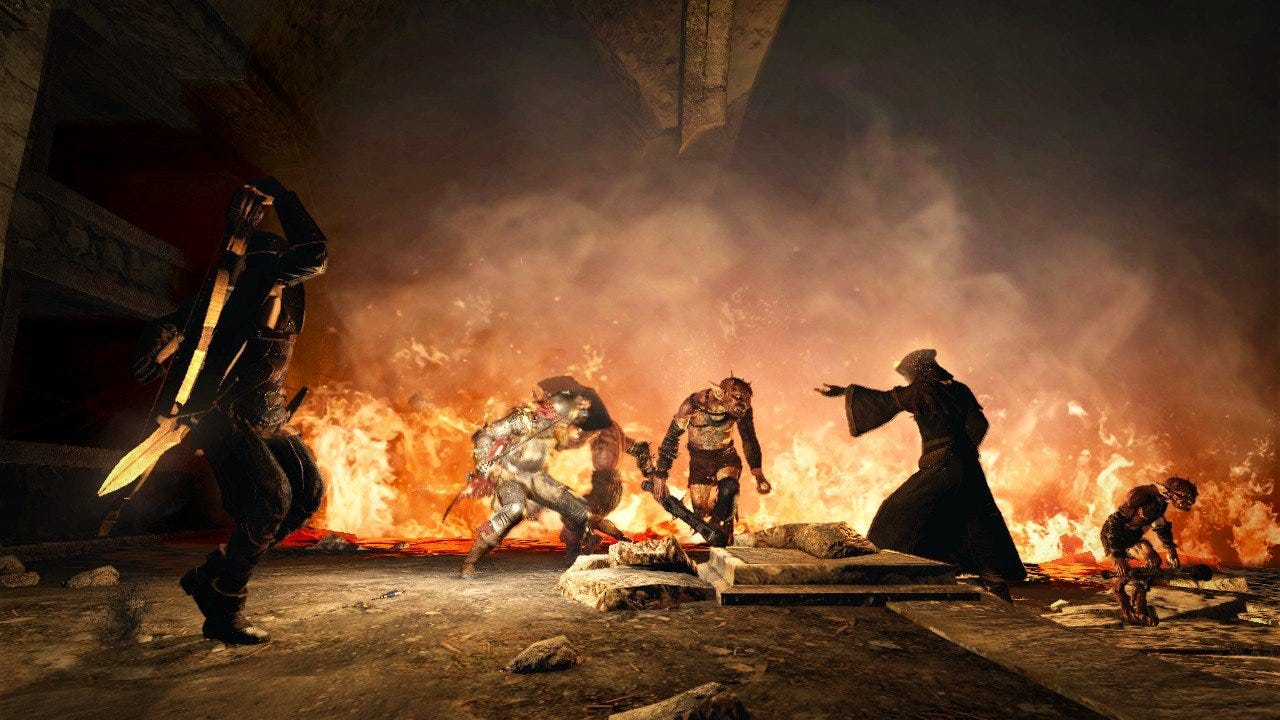
Certain enemies only come out at night.
In another boss fight, shown only in video form, the main character attacks the mythical hydra. Cut off its head and it grows another. If one of your pawns gets too close, it'll get gobbled up. As we watch the giant hydra spit and hiss we wonder how best to take it down using the grab attack. Where should we grab? Where should we climb to? Where could its weak points be? It's at this point that a third potential influence springs to mind.
"Yeah, I love Shadow of the Colossus," Itsuno admits. "That's a great game. But I don't know if it had a direct influence or impact on this game. It wasn't like we set out to say, 'Oh, let's do Shadow of the Colossus.' It was more, we wanted to create these great creatures, these monsters in the game.
"As we did that we asked, what would be cool about fighting them? I want the players to be able to do what they want, give them the freedom to fight like they want to fight. It was more a result of the way we produced the game that that style of fighting presented itself to us."
Perhaps inevitably for a game due out in 2012, and despite multiple playthroughs of the griffin boss fight, we're left with plenty of questions. Dragon's Dogma surely features multiplayer, or at least a system that replaces pawns with real players. "We will put a spin on the multiplayer facet with this game," is all Itsuno will offer on the subject.
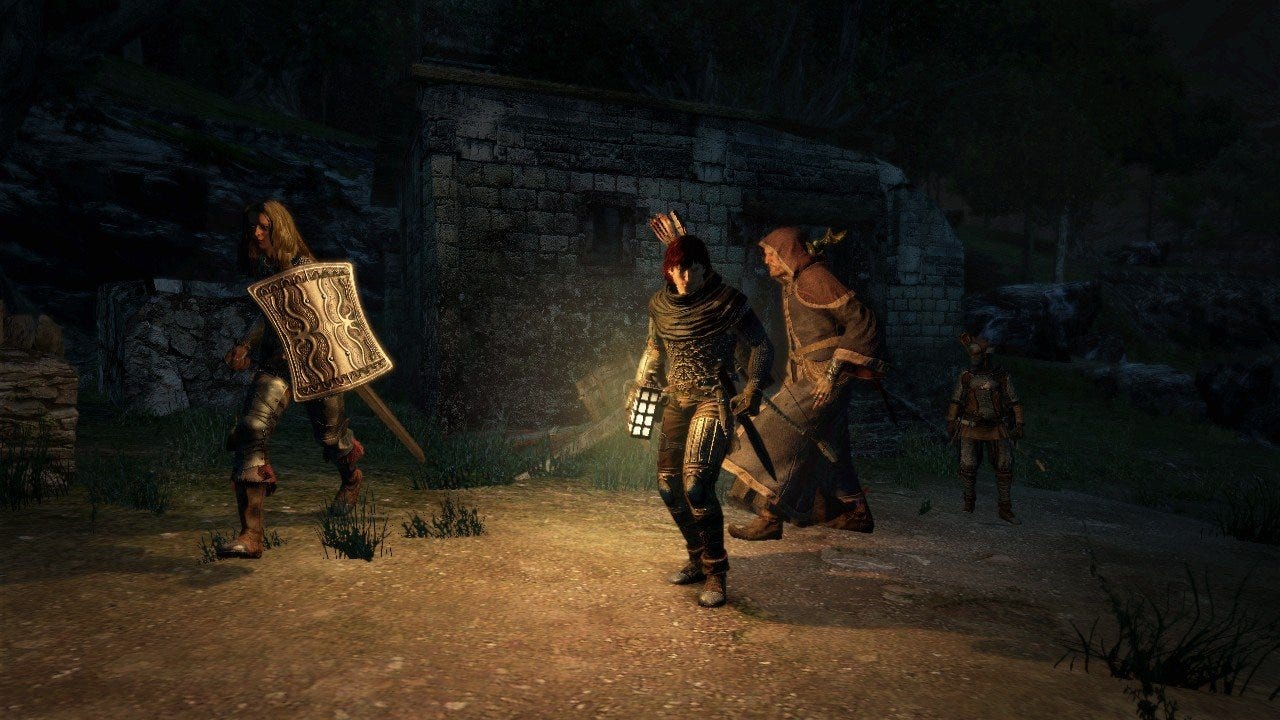
Talk to NPCs to convince them to join your party as pawns.
Is there a dialogue system, with conversation trees and the like? "There are multiple endings depending on the path you choose and the decisions you make. There are areas you can choose to fight or not to fight." You're able to fill the game world with NPCs that are "dependent on the style of game you want to make". But what this means, exactly, remains a mystery.
And then there's the inevitable question: can you ride the dragon? "You're asking me to reveal all the secrets before I'm ready to," Itsuno laughs. "You can run and walk, but there will be features in the game that allow you to cover great distances in a short time. Just know they will be available."
The development team working on Dragon's Dogma is the largest Capcom has ever assembled and it includes many action game veterans. Development began in earnest two years ago, but planning began three years ago. With Devil May Cry stalwarts Itsuno and Kobayashi at the helm, and the game engine that powered Lost Planet 2 and Resident Evil 5 igniting the visuals, it's clear Capcom has high hopes for Dragon's Dogma. It wants this game to be a big deal.
But will it? It has elements designed to appeal to a wide variety of gamers. Action game buffs, fantasy fans and loot whores should all get something out of it. And perhaps those who idolise Shadow of the Colossus will find something to like, too.
Dragon's Dogma seems to be something of a mashup, a game inspired by an eclectic list of rival titles. As always, it's hard to know whether these different influences will come together to create a unique whole. But it'll be interesting to find out.
