Although EVE Online is considered by many outsiders to be populated by the more Machiavellian, sociopathic elements of humanity, there's a surprising amount of camaraderie uniting the players who have travelled to the Icelandic capital of Reykjavik for this year's Fanfest convention.
For many, it's a pilgrimage: one that involves less backstabbing over bacon in the hotel breakfast room, more celebration of a world that has become every bit as real and meaningful to its inhabitants as their experience of Iceland itself.
The atmosphere is friendly and good-natured amongst the warring Alliance leaders now sitting across the table from each other – mischievously referencing old campaigns and poking gently at old wounds – but there are more twinkles in their eyes there are in Iceland's night sky.
Torfi Frans Olafsson, creative director at EVE developer CCP, has a clear vision about our misconceptions of what constitutes a reality. Sitting in his kitchen one evening, working out his budget through an internet banking service while dabbling with his EVE Online market orders, he found himself momentarily shocked at the similarities.
"It's become more real. We started with a simulator with basic mechanics from the real world – but analysing the social, political, and economical facets, it became evident that it was more than the game design," he says.
"We thought, in the eighties and nineties, that virtual reality would be lasers drawing pictures into your eyes, or like The Lawnmower Man. But we have virtual reality; we have realities which are shared. There are religious sects which have lower numbers than EVE Online. They can't touch their world any more than an EVE player can, but they believe it. Reality has become virtual."
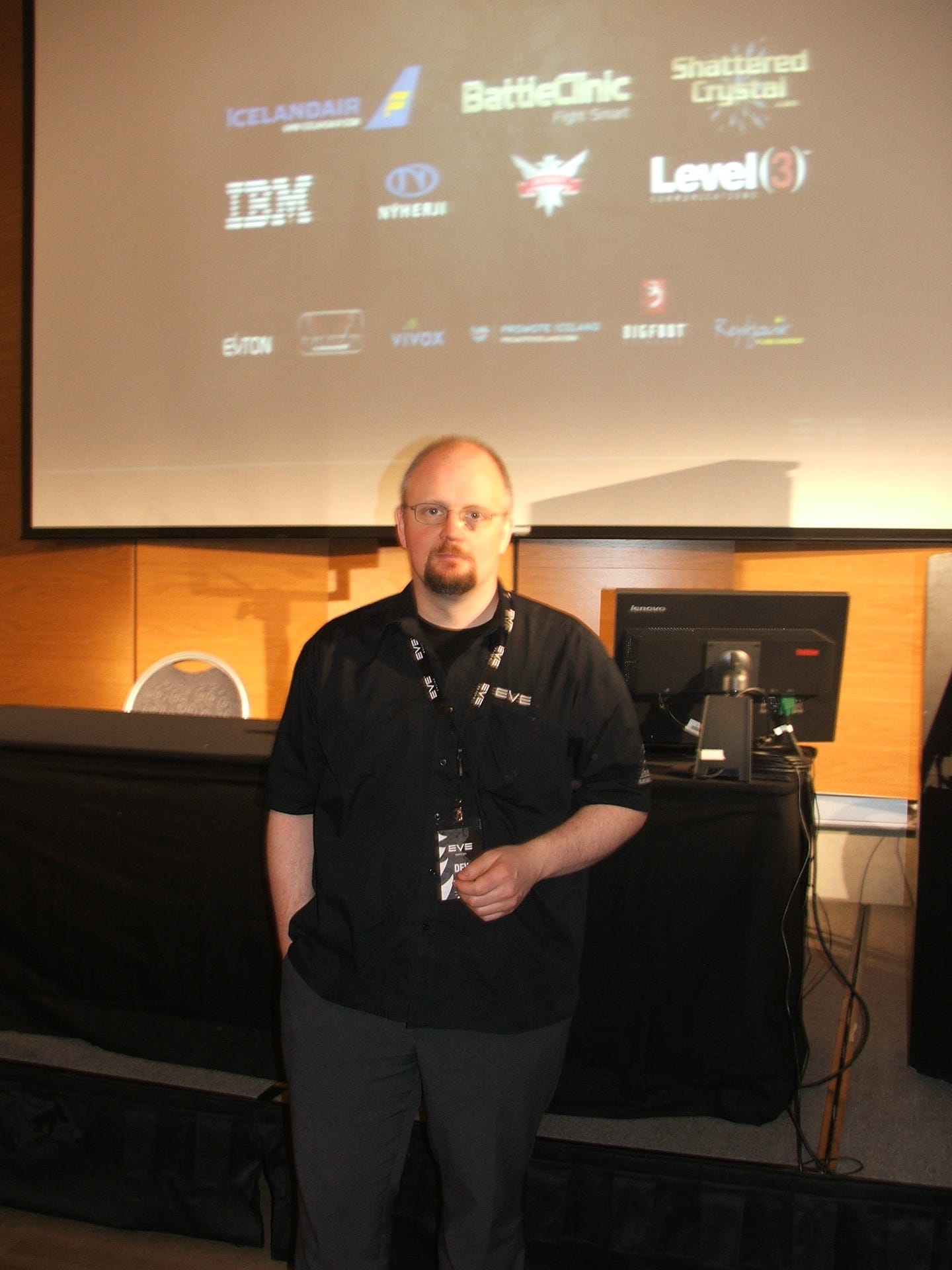
Dr Eyjó – economics made interesting.
Tony Gonzales, author of the EVE novels, considers the physical reality of playing in these virtual worlds: "Ask anyone who plays the game and has six months of work locked into their hold," he says. "Targeted at a gate, you get the blood-pressure rise, you start to sweat, the fight-or-flight mechanism kicks in.
"From a design perspective, we've been saying 'EVE is real' all along. The game has a reputation for being very dark and very harsh, the strict death penalty and that kind of thing. Corporations only make the news when they get destroyed or screw up.
"We make The Times when these awful things happen, but what doesn't get told is how much people bond in response to that. The person who got screwed is in a Corporation – they'll help him, he'll remember what they did to help him get on his feet, and he'll remember it long after he forgets the bad thing that happened."
On the back of some very real economic troubles, the Mayor of Reykjavik appears on stage to welcome the Fanfest attendees to the city and kick off proceedings. EVE is as real economically to Iceland as it is in spirit to its army of loyal players. As the tiny country's third largest export after fishing and aluminium, EVE matters. CCP matters.
Talk to locals unfamiliar with EVE, and they'll profess an admiration for the company regardless. When you hear tales of developers landing in a pub during Fanfest and including the locals in a drinks free-for-all, it's easy to understand why: if you're not Icelandic and you think you can drink, you can't.
It's almost too easy to draw comparisons between the bleak landscapes of Iceland and the sense of coldness and isolation within the game. While it's true that EVE Online could only ever be a product of this country, there's more than an aesthetic similarity to take into account.
Our tour guide for a post-Fanfest expedition talks about the survivalist mentality of the Icelandic people in the wake of a recent double whammy: the economic recession followed by an eruption from the world's most unpronounceable volcano, bringing Europe's airspace grinding to a halt and effectively cancelling that year's tourist trade.
He laughs it off with a shrug of his shoulders: "This is Iceland. Two years ago – recession. One year ago – volcano. Next year? Plague."
While some have travelled from as far afield as Australia, Eyjolfur Jonsson, an Icelander and a player, also gives his thoughts on the correlations between the harsh realities of his country's environment and the open-ended challenge of EVE Online:
"The freedom and opportunities in the game fits the mindset of Icelandic people – for thinking outside of the box. I think the game is getting more and more close to life as we know it. Icelanders also know well how EVE is helping Icelandic tourism in these dead times. Most are proud to see so many people coming to visit Reykjavik."
Hardiness of character isn't just the preserve of an inhospitable island country, of course. Martin Clapson made the journey to Iceland a mere two days after being diagnosed with Bell's Palsy, which has left one side of his face paralysed – a frightening experience that would leave most people scared to leave the safety of the NHS.
"Some people take this game very seriously, and dedicate a lot of their free time to it," he says. "With any other game I would write it off as painfully unhealthy, but EVE is the only game I know of that's open enough to allow you to become that involved, giving minimal guidance and a whole universe of bastards to share it with.
Developer panel.
"As games go, I guess it's the 'realest' out there – and I'm not complaining, because EVE's still the closest thing to the computer game we all dreamed about in our youth. We're steadily getting closer and closer to that dream as CCP continues to expand the universe."
As for his diagnosis and how it might have impacted his travel plans, Martin was determined: "As soon as I found out that it wasn't permanent and there was nothing I could do about it, I was buggered if I was going to let it stop me. Having said that, the steroids really got in the way of enjoying the night life."
Undoubtedly, it's the 'single-shard' nature of EVE Online's server architecture – where at peak times, 65,000 people come online simultaneously to integrate with each other, for good or ill – that takes the world of New Eden from a merely artificial reality to a truly complete and tangible space in the world.
Every player attending Fanfest has his or her own story to tell, whether it's about the extraordinary collapse of their sovereignty power bloc, or the simple interaction of trade where limited manufacturing opportunities – combined with supply and demand – keep the economy in a constant state of flux.
Directly or indirectly, everyone has shared a part of the overall experience. We can't all be dominoes, but we're all buffeted by the never-ending sequence of events. As with our real-world relationships, nothing comes for free, and everything has consequences.
Dr Eyjólfur Guđmundsson, CCP's lead economist for EVE Online, takes the view that the nature of our communication through tools like Facebook is redefining what we can consider as reality.
"In the future, we are going to be defining ourselves much more in terms of the social circles we engage with rather than geographical locations," he says. "You become part of something in this world and you can communicate with someone anywhere else. The ability for us to help you engage and find new people and have new experiences is actually adding to the real value of yourself.
"These worlds are not virtual. If you're in a conference call to your grandmother, are you in a virtual world? No, it's two real people talking through a device. You can look at any game client as a communications device, but there are real people at the end of each device.
"I truly believe that we can understand real-world conflicts in general in terms of EVE. By studying social groups, it is easier to understand where conflicts come from and this knowledge could be applied in real life."
This year's Fanfest featured a chess-boxing match between two developers. Painfully real.
Dr Eyjó is also responsible for curating the Council of Stellar Management. Democratically elected by the player-base, its members travel to Iceland twice a year as legitimate stakeholders in the organisation to present player concerns. It's not often pretty, and global CEO Hilmar Pétursson puts it bluntly, albeit with good grace: "They call us out on our bullshit."
Given the anecdotal atmosphere that permeates throughout the discussions at Fanfest, it's hard to resist sharing a story of my own with Nathan Richardsson, senior producer for EVE Online, following our interview: that the exploits of the Eurogamer Corporation led to a published article, which led to further work, until eventually I'm sitting here telling him this story face-to-face.
A quietly charismatic man in conversation, Richardsson has chosen to take a step back in order to allow the next generation of CCP developers to have their moment in the spotlight. That, of course, doesn't stop him from stripping down to his bright red budgie-smugglers for an on-stage appearance with the band at the closing party – there are certain expectations, after all.
Smiling, he tells me his own story. An old-school 0.0 Alliance player, he would create reams of design documents, bombarding CCP with his outlandish demands, until eventually they relented and offered him a position at the studio. For both of us, the virtual sandbox of EVE Online has had a very real and tangible effect on our lives.
It's a hell of a commute to CCP's offices.
As the last of the stragglers from this year's Fanfest make their way home, I find myself chatting to a player at the airport. He seems distracted and weary beyond the tedium of airline processing on the back of four days of hard drinking. Somewhere in the realms of outright agitation, in fact. Perhaps he's a nervous flier, I think, or maybe he's feeling the natural post-trip blues already.
Instead, we're back to that mischievous twinkle at the breakfast table.
With a look of good-humoured exasperation on his face, he tells me that an old adversary met with him at Fanfest, explaining at the end of their conversation that his absence from the game had been taken as the perfect opportunity to unleash a full onslaught onto his Corporation's infrastructure, now lying in near tatters.
For this particular player, the long and tedious wait at the airport gate, combined with the tiresome mechanics of real-life travel, has become an artificial barrier sitting between him and a resolution to the problem back home – where reality impatiently awaits.
