Have videogames lost the plot?

A look at why games don't tell good stories.

Despite the advances of the past decade, from physics engines and motion control to near photo-realistic graphics, there is one area in which games still have huge scope for improvement. Why, after all this time, are so many videogames still so bad at telling stories?

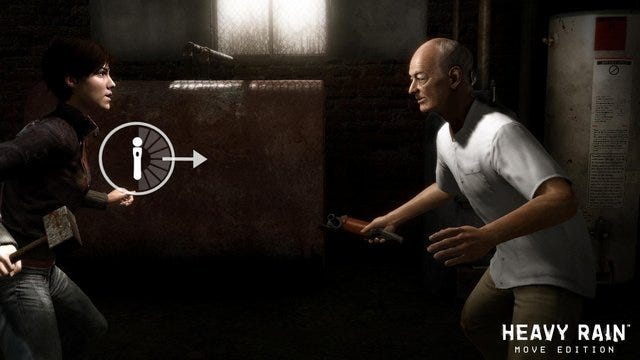
True, there are more examples of better quality writing to be found these days. More adult themes and activities have crept into titles like Heavy Rain. But there's no escaping the fact that for the most part, most games have about as much narrative sophistication as a Choose Your Own Adventure book.

Scripts, voice acting and the range of choices available to the player have all improved, while open-world games offer a sense of freedom which exists outside of the boundaries of plot arcs. Yet in some ways, these advances serve only to highlight the jarring nature of what happens when you are funnelled into pre-scripted paths.

Why is this? Will it ever be possible to play a game with causality, where you can truly affect the outcome of a story? Eskil Steenberg, the solo developer behind the innovative first-person MMO Love, certainly thinks so.

"It's already been done, except we don't think about it as story-telling," he explains.
4

When will videogame stories allow true freedom?

"Take Counter-Strike, for instance. You wouldn't call that a strong story-telling game, but its a game where most of the players have stories from the game. It's a very limited story, which involves mostly bombs and hostages and how many people are left. But they are stories and they are told by gamers."

This concept of players developing their story within a set of rules is known as "emergent narrative". Indie games like Dwarf Fortress, the oft-mentioned Minecraft and Steenberg's own Love are leading the way in this field. By offering up gameworlds you can interact with on a deeper level, they create the potential for dynamic, player-authored storylines.

"The human mind is hard-wired to construct narratives as means of explaining what one experiences in one's real life, when watching a movie, or when playing a game," explains Mark Riedl, an assistant professor at the Georgia Institute of Technology's School of Interactive Computers. He is currently conducting research into intelligent narrative computing.

"But while an experience – in real life or a game – can be compiled into a narrative, there is no guarantee that that narrative will be a 'good' one.

"Emergent narrative is simple to achieve; all you need is a rich environment and a good set of rules with which to simulate the microworld," Riedl continues.
2

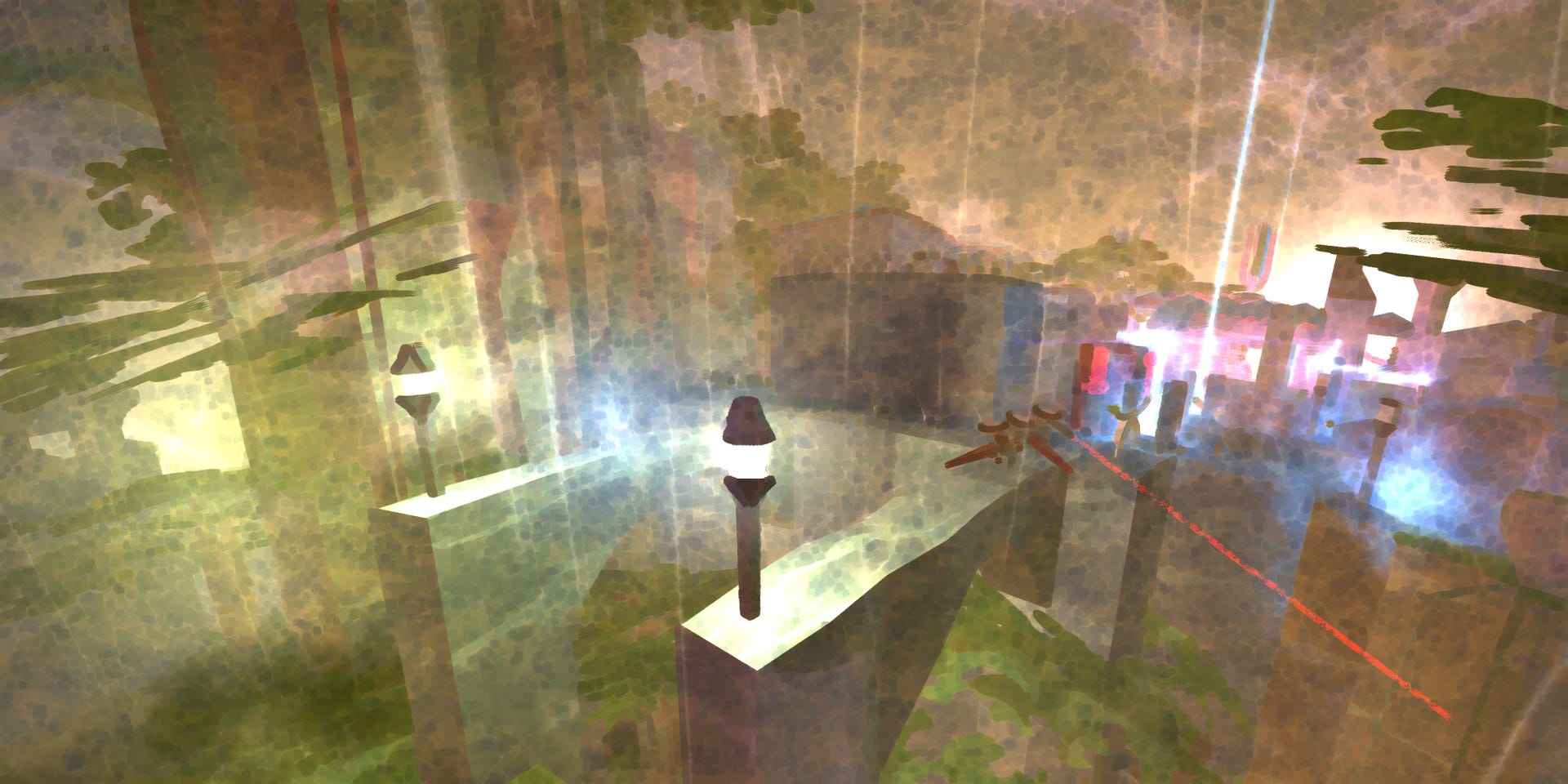
Love is beautiful.

"The alternative, which I refer to as "managed experiences", relies on a storyteller that is looking at the microworld, the player, and future possible narrative trajectories, and attempting to enforce some sort of structure."

Steenberg has adopted a similar approach for Love. "The game itself generates the entire world. The players can build a settlement anywhere in the world, and the AI are independent AI characters," he explains.

"There are five different tribes: they fight the players, they help the players, they do all kinds of things – they act as if they are independent actors. And that creates a story that is very very dynamic and a lot of things can happen."

This strategy is markedly different to the one most developers employ today. "Currently I think that games are kind of depressing," says Steenberg. "If you play the first Zelda game – it's 25 years old, but you can do more things in that game than most games you can play today."

He adds: "That tells me we haven't really gotten very far. The games that are closest are games like Fallout, but they are very scripted. They are sort of brute forcing it. Instead of making a roller-coaster, they're making a roller-coaster with multiple tracks and various places where you can switch tracks."

Chris Delay of Introversion Software (the studio behind indie classics Uplink, Darwinia and Defcon) has a different take. Though Fallout 3 is scripted, he feels the game manages to create a sense of freedom with its narrative.

"They did a very convincing job of populating the world. I didn't feel like I was too on rails or anything. It certainly felt much more open than the average first- or third-person shooter," he says.

"So in that sense, they successfully did it. They created a whole world and filled it with interesting stuff. The world never felt to empty or sparse, there was always stuff to do."

Riedl argues that true agency – the freedom to change the world and plot – isn't actually necessary for gamers.

"I think this is where game designers have excelled: scripting plot lines to create the perception of agency, without actually enabling the player to significantly change the direction or outcome of the game's plotline," he says.

"Players have what I call 'micro-agency', the ability to affect the simulated world from moment to moment, but not the ability to affect the overall plot."

5

Fallout 3 featured a vast post-apocalyptic world, populated by various warring factions.

But this approach creates a huge burden on game designers, according to Riedl. "Theoretically, for every branch point the amount of plot-related content that must be authored at least doubles, resulting in an exponential growth of plot-related content."

As the sole coders on their games, this is an issue Steenberg and Delay are only too aware of. "It's very, very expensive to produce all this content – its only an option for a really big company," says Delay.

"And of those really big companies, very few choose to go that way, because it's actually much easier and in many ways more reliable just to churn out a Call of Duty: Modern Warfare-style scenario, where generally everything is on rails."

The cost of development means indie developers are frequently more reliant on procedural content – that is, content generated by the game itself.

Delay's latest project, Subversion, is a Mission: Impossible-style game in which the player pulls off heists. The game is set in a rich, procedurally generated gameworld that simulates entire cities, including the interior and exterior of buildings, and the security systems that protect them.

1

Subversion simulates whole cities in which to pull off heists. Hopefully a map too.

"The typical way to make a heist game would be to design some levels and in those levels to script specific things, like this button switches off the security and this guard walks this path and so on," he says.

"But then you get a predictable result and you get predictable gameplay. Rather than coding specific events and set pieces, I've been programming the world to be as general as I can – so that security systems genuinely work.

"If you have a camera in a room it doesn't just automatically trigger the alarm – it has to be wired into a monitor somewhere, and there has to be a guard watching the monitor and when the guard sees you on the monitor, he has to press the alarm button. And any one of those is a fully simulated system that you can tinker with to your own advantage."

It is this rich simulation of gameworlds which will afford players the option of a wholly dynamic approach to heists. They can approach missions as they choose, and because the world is so deep, numerous options for emergent narrative will exist.

"My initial design idea was to have a gameworld in which there were procedural missions wherever you looked. In any building, anywhere in the city there would be things that you could steal or break into, but that wouldn't be the core game," Delay says.

"My plan is to have this rich gameworld in which the game of Subversion will be set, and the core game will make much more use of hand-crafted levels."

So if well-simulated gameworlds provide scope for emergent narrative, where does this leave the traditional plot? When it comes to RPGs and adventure games, we're used to narrative arcs, plot twists and character development – complex structures that emergent narratives so far don't produce.

According to Riedl, procedurally generating plots in games may not be so far away. "I think procedurally generated side-quests could be low-hanging fruit, in the sense that many of the technologies are ready to go and can be performed fast enough for games to realistically use," he says.

Riedl has already embedded his branching story generation algorithm into the Unreal Tournament engine, as part of work that is partly funded by the US military. By simulating a marketplace, the system challenges the player to prevent a terrorist bomb attack through talking to NPCs. If the player thwarts an NPC's efforts, the algorithm rewrites the narrative - dynamically changing the responses of the NPCs to the player's actions.

"Once one game demonstrates its effectiveness, demand may follow. There will always be room for emergent narrative, when used properly," says Riedl.

"Procedurally branching game narratives, in which a procedural content creation system makes small adjustments to the main plotline of the game, or weaves emergent sub-plots into the game, may come a bit later. In some respects, Mass Effect 2 has taken a step in this direction."

6

Could procedural content be the next chapter in gaming narrative?

Riedl suggests that similar approaches could be used in multiplayer games, either to co-ordinate NPCs or to co-ordinate player stories when teams break up. However, he's unable to elaborate further on his own plans in this regard due to having signed a non-disclosure agreement. For Delay, there are issues with dynamic plots that go beyond the purely technical. "There's a a wider question – is it possible for a videogame to tell a good story, in the traditional sense? Because I'm actually not sure," he says.

"Stories tend to be quite character driven. The story emerges out of the characters doing what they would do in the world. And those are the really great stories. But in videogames you've got this massive problem – the main character is controlled by the player. So it just doesn't have any of that inner emotion or drive in the same way that a screen character would do.

"If you then ask, is it possible to procedurally generate a good story, I would say it's even harder. You're starting from a medium that isn't that great at telling stories in the traditional sense, and you're trying to do it electronically."

While Riedl has had success with story generation algorithms, he says developing emotion in the output is challenging.

3

The argument over the office tea round reached epic proportions that day.

"In academic research labs such as my own, we have AI systems that can generate short fairy tales from scratch and AI systems that can generate branching story trees for games and training simulations," he says.

"This is because the structures of fairy tales and many computer game plots are relatively straight-forward, focusing on action and causality. The harder problems involve the conveyance of nuance and emotion through story."

So what does the future hold when it comes to story-telling within games? Steenberg and Delay are in agreement: creating the deep, simulated gameworlds needed for well-developed dynamic and emergent narratives is incredibly complex, and success is hard to measure.

"Right now, if I were a commercial game developer, I would be very hesitant to make the kind of game that I've made, for those reasons," says Steenberg.

"On the other hand I'm sort of convinced that at some point, and I think some of my players are at this point, people will play a game and they will understand what a game can be, and how dynamic a game can be.

"And that will make other games feel incredibly old."

Comments (113) Latest comment 1 year ago

Comments for this article are now closed, but please feel free to continue chatting on the forum!

  • Jacksie66 #1 1 year ago

    Mass Effect/Mass Effect 2 = Best story in a game series in recent times....

    P.S. Its my first time having a 'firstie' comment on an article... Go Me!!!
    Edited by Jacksie66 at 08/03/11 @ 11:46
  • darkmorgado #2 1 year ago

    But the writing in Heavy Rain was dire... massive plot holes, the ending made no sense and was completely inconsistent with the characters, it played tricks to try and explain things, left large plot devices completely unexplained, and relied almost completely on random coincidences to propel the narrative.
  • youhavenomail #3 1 year ago

    Games generally don't need good plots. Like with FPS games all you need is for some bad guy to do something bad and for your mates to say 'let's go get that bad guy!'. And then you start shootin' people and it's all good.
  • cianchristopher #4 1 year ago

    INteresting article, but I felt it focused too much on the idea of procedural generation and player-agency.

    While taht's all well and good, I'm more concerned (currently) with the appalling state of good old-fashioned scripts for games. Y'know, the "story". What it's "about".

    HEavy Rain gets bandied about left-and-right as an example of the "maturity" of modern games, when in reality the plot of the game is no better than a "TV Movie of the Week" or a lacklustre episode of Law & Order, or a crappy mid-90s serial-killer thriller (think: Along Came A Spider, or Kiss The Girls).

    It's for that reason that I generally skip all cutscenes in all games, never paying attention to the crap that they try to shoehorn in.

    Even a game as good as Mass Effect, is barely on the level of Farscape, or Babylon 5.

    It's hardly The Sopranos or The Wire, is it?
  • sega #5 1 year ago

    It's because most games employ a sci-fi or supernatural style storyline. You're hardly going to get anything along the lines of The King's Speech when there's aliens and monsters running around. Of course you also have to fit gameplay into the story and, usually, that means you need enemies to kill so you always have to be a space marine of vampire slayer of some sort.

    I think some of the best stories in games I can think of are Shenmue, Silent Hill: Shattered Memories and adventure games like Broken Sword and Hotel Dusk. Basically any game that takes away the cliche supernatural/space element and focuses on the characters or the adventure (I know Shattered Memories has monsters, but it's not that simple in that one).
  • butler` #6 1 year ago

    "Take Counter-Strike, for instance. You wouldn't call that a strong story-telling game, but its a game where most of the players have stories from the game. It's a very limited story, which involves mostly bombs and hostages and how many people are left. But they are stories and they are told by gamers."

    This can't be stressed enough. So glad to see it come from Eskil as well.
  • Essien #7 1 year ago

    The plot in Portal is immense. Easily betters most films I've seen.
  • FreakyZoid #8 1 year ago

    But the writing in Heavy Rain was dire
    As was the acting. But hey, it had mature themes though!

    Also players were making up their own stories in games like GTA and Sims long before those indie games you mentioned, and no doubt in other before that.

    Mass Effect/Mass Effect 2 = Best story in a game series in recent times
    Really? What's the story in ME2? Some inconsequential filler enemies are up to something not particularly important while you sort out the personal problems of a merry band of cliches. Post credits: Oh look, here come the real baddies we told you about an entire game ago.
  • DiamondIce #9 1 year ago

    I am persevering with Deadly Premonition because of the story. It certainly isn't for the shooting bits.

    Not many games draw me in because of the story. Mass Effect 1 and 2 were good and kept me interested from start to finish.

    Uncharted 2 is one of the few games where I didn't dread a cutscene. The way the characters interacted with each other was on another level.

    I am looking forward to LA Noire because I am hopeful they can balance a story / cutscenes with great gameplay.
  • butler` #10 1 year ago

    This one time, my mate did a jumping, spinning 180° flying headshot with a pump action shotgun from the ramp outside B on a guy at A long.

    No one was FRAPSing.

    Actual true story.
  • Telepathic.Geometry #11 1 year ago

    Interesting article. For my money, this is the very reason that DEUS EX was so good. The basic story was fixed, but you could choose to be liked or feared, a sneaky hacker or a balls-flying-in-the-breeze run and gunner. Every problem had multiple solutions and best of all, you could kill everybody or nobody.
  • gimo80 #12 1 year ago

    I still think the characterisation and plot lines in point and click games are pretty awesome (most notably Grim Fandango), but the vast majority of gaming doesn't really take these things into consideration at the moment. MGS4 is a prime example of this - convoluted beyond believe, despite being pretty entertaining.
  • messiahjason #13 1 year ago

    Interesting article, personally I feel as though there is too much pressure on games to compete with Hollywood in terms of storytelling, in many ways it's counter-productive. The joy of games is at the end of the day the gameplay, and story should be told and become compelling through interaction. In some respects Heavy Rain got that right as it allowed you to become more attached the characters by making you live every little action, which is the games greatest strength.

    I think game plots work on different level to films generally, even a text heavy rpg or Metal Gear Solid 4 and it's many cutscenes can be compelling as you embody the characters in the stories. Shenmue's dialog and voice acting leaves a lot to be desired yet many gamers are still waiting endlessly for the story to be concluded, me included. That's down to the gameplay and the fact you literally have to live through Ryo as if he were alive in that game.
  • spudsbuckley #14 1 year ago

    The majority of games have poor/nonexistant stories but honestly I couldn't care less. If you're playing videogames for the story then you have the wrong hobby.
  • Ryboy #15 1 year ago

    So, CoD Blops is good because so many talk about how immensely shite it is?
  • arcam #16 1 year ago

    Plot is overrated. A good story can never be told by someone else when you are in control of the main character. Instead the best stories are the ones you make for yourself, and the best games are the ones that give you a framework to do so.

    I've never told anyone about the time Darko betrayed Niko for a thousand dollars in GTA IV (had to Google it, couldn't really remember many plot points), but I have talked wildly and enthusiastically about the time me a and a friend dropped in the wrong area of Arma 2 and had to hold a hill deep in enemy territory. That only came about because I read the mission briefing incorrectly.

    tl;dr - it's me controlling the character, so it's my story to tell.
  • inutaihanyou #17 1 year ago

    I'd say Bioshock told a better story just through exposition than Heavy Rain did in all of its extremely dragged out cut-scenes and long winded overly dramatic quicktime events.

    There are stories in gaming that people enjoy. For example, in my opinion(this is just my opinion ppl) FF 4-10(barring X-2) had great stories, if a little hammy at times.

    Its not that hard to create a good story if you want to. It just has to actually be a good story, and paced well with the gamers interactivity in events. You can't just have a half hour cut scene and expect people to still call it a game any more than they would call it a glorified CGI movie (Looking at you FFXIII)

    Edited by inutaihanyou at 08/03/11 @ 12:04
  • jstar #18 1 year ago

    The article completely skips over the crucial issue regarding narrative in games. There is the traditional narrative and there is the ludonarrative, that is the story you make for yourself as you play the game. So the counter strike example is an example of ludonarrative at work. They both need to work in tandem or you get ludonarrative dissonance. Metal Gear solid is a good example of this. In the cut scenes you are amazing and can do all this cool stuff but when you actually play the game you are not nearly so agile, skillful etc.

    But all this is completely beside the point. You just wrote an article about narrative in games without it seems actually talking to any writers. Stories start with writers. Games start with games designers. You will never get good stories in games while writers are excluded from the design process. In fact the writer and the game designer should be working together from the very beginning.

    The arrogance that games developers display when it comes to narrative in games astounds me. Programmers program, designers design, animators animate. For fucks sake get a writer to do the writing. There are only about a handful of people working in the industry at the moment who seem to have any idea at all about narrative and narrative structure. It's depressing. And no, Bioware are not on that list.


  • Zebula77 #19 1 year ago

    Meh, actually I think good stories in games have existed a long time. Day of the Tentacle and Monkey Island springs to mind.

    I don't think the question really concerns the stories as much as how they're told. I think that's where games designers have to be more creative, so it isn't just gameplay, story told through cutscenes, gameplay etc.
  • spekkeh #20 1 year ago

    Nice to see game scientists get some screentime on EG, Riedl and the Liquid Narrative Group are pretty well known.

    While I do see possibilities with procedural narratives in side missions or short sections of a story arc to either cut corners or create replayability, I think they're big-upping the possible merits of their own creation a little bit too much (but that's only human, god knows I do it with my research all the time). To me, storytelling is very much a process of discourse, which is never completely a one-way street. From the days when we were still huddled around campfires, telling stories as a way of educating the young people about the hunt, story discourse is a way to communicate ideas between the storyteller and the listener via analogies and emotionally laden themes.

    For the listener/player, there's the setting, the protagonist and its relationship to other interrelated characters and the intentionality inherent in that, but in the process of trying to understand the story discourse, in a way you also try to discern the intentionality of the storyteller; the overarching theme and the point that's being made with the story. If this is all procedurally created by an internal mechanic, you start losing this sense of communication, and the story turns from a poignant idea, or art if you like, to a plaything.
  • Capa26 #21 1 year ago

    All this talk of algorithms is a bit silly when the real problem is a simple case of gaming's general acceptance of woeful writing as the norm.

    A story or plot can be generic as hell and be saved by sublime writing. Been mentioned here a few times but the lucasarts crew back in the point and click days nailed this. Heavy Rain did not.
  • BiscuitBase #22 1 year ago

    I really couldn't give a flying fuck about having a plot in games.
  • tiedtiger #23 1 year ago

    The way that developers are interpreting the need, value and so on of stories is not really what games are good at. It starts with the fact that game players are not dramatic heroes, moves on to the second problem that stories work because of a lack of interactivity (inevitability is a key aspect of effective drama) and lastly how most simulation (sorry Chris) that happens outside the player's gaze is completely and utterly redundant.

    What games are great at is painting a moving picture of a world in motion. How exactly it links up and to what depth is irrelevant, and often contrary to the desire to experience and play. This is why, as I've often written, in thirty years of game making there have never been any good game stories.

    Games are a portraiture medium. The art of them is in delivering the impression of things happening and empowering the player to win. It's not really in the narrative, and many tortuous attempts to prang narrative in there are always doomed to clumsiness because of the constraints of play.

    If you're interested, I wrote a lot more about this on What Games Are:

    On players/actors:
    http://whatgamesare.com/2011/02/cars-dol...

    On the benefits of a sense of story rather than actual storytelling:
    [link url=http://whatgamesare.com/2011/02/video-game-writing-and-the-sense-of-story-writing.html
    ]http://whatgamesare.com/2011/02/video-ga...[/link]

    And finally, on why excessive simulation is pointless:
    [link url=http://whatgamesare.com/2011/02/simulacra-or-simulation-what-games-are-not.html
    ]http://whatgamesare.com/2011/02/simulacr...[/link]

    Thanks,
    Tadhg
  • wetTOAD #24 1 year ago

    @Essien

    I second you on that one. For me, Portal was a good example of what games can bring to the table in terms of storytelling. The drip feeding of potential clues wouldn't work in other mediums as they lack the gameplay to fill the gaps.

    Also, having finally got round to completing Red Dead, despite the possibilities for riduculous inconsistencies in characterisation (burning the town one minute, saving it the next), the sense of having been on a journey was pretty impressive, something only the best of TV series tend to do.
  • skuzzbag #25 1 year ago

    To get a good narrative you need a good writer and a good story. Game progression complications aside if your game boils down to "oh noes, teh aliens are invading again!" or "oh noes, the evil monster from teh dungeon is killing all the sheep" then your writer, however brilliant they are, is already constrained by the crap premise.

    I actually quite enjoyed Condemned as an example of a story that had a satisfactory (if cheesily realised) ending. Plus I'll also bang on about Thief again, the story about pagan V's religion was a refreshing topic even in 1998.
  • King_Edward #26 1 year ago

    Games are better when they're not trying to imitate movies.
  • dudefella #27 1 year ago

    I think comparing game plots to movies or books is folly. Sure, a lot of games set themselves up for it by aping those media, but that doesn't mean for a game to have a good story it has to adhere to the same 'rules' that novels and films do. Games have the interactivity, which in my experience makes a massive difference when it comes to emotional investment.

    Does Mass Effect 2 have a great story in the traditional sense? No not really, it's about saving the world from evil robot-aliens. But you *are* Shepard, and you get to make important decisions in a way that hopefully resonates with your personal beliefs. You get to bond with the well-written characters that you recruit for your mission. It's these elements that make it so compelling, rather than any traditional story elements that we've grown accustomed to from other media.

    Same deal with Heavy Rain, which taken as a stand-alone story, fails in a number of ways - the acting isn't always great, the writing isn't great and there is at least one significant plot holes. BUT I became so invested in Ethan Mars due to living his life along with him, the mundane, the tragic and the desperate parts, that I wanted desperately for him to save his son. I couldn't get that feeling of empathy from any other medium.

    There are still way too many games that just rely on long cut scenes and aping other forms of media, of which Rockstar is one of the prime guilty parties in my opinion. We need to embrace the strengths of the medium and break away from the preconceived qualities of a narrative we've learned from other media.
  • Evolution #28 1 year ago

    Modern thinking seems to be that because you are in control of the character, that you have to be able to stamp your own authority on it, or "tell your own story" (See fps games, most Western rpgs like Mass effect). I grew up playing a lot of adventure games, a genre where you are essentially playing as somebody else and playing their story.

    Gimo mentioned Grim Fandago, I'd also cite The Longest Journey here as an example of serious storytelling where you are playing as a somebody who isn't you. I didn't find it any less engaging than say, Mass Effect where you can create your own protagonist, in fact the scope for emotional involvement is maybe even greater because the developers are not writing for various possible character types, and you aren't some bipolar nutter who does whatever they like (as my Shephard appeared to be).

    I agree it is a different experience to play a game and come away with your own stories, I have plenty of my own from playing more open games like Operation Flashpoint and UT, but I do love a good plot all the same :)
  • Goodfella #29 1 year ago

    Thing is it's no wonder they don't tell good stories, for the most part, games are too long. Imagine a film trying to keep you entertained and hold together a plot for10 hours.
  • retr0gamer #30 1 year ago

    Want a good writing, then play Mother 3.
  • tejo.hr #31 1 year ago

    You just made me found out about Subversion, and exited about it. :)
  • TheTrueSpin #32 1 year ago

    I thought the acting in Red Dead Redemption was excellent, even if the game struggled to maintain my interest after a while. But I think that is one of the problems. Whilst films might last 2 hours max, we expect 10-15 hours from our games which obviously results in a lot of padding.

    Red Dead is a great example. The story is strong and the characters, whilst a little cliche, are well voiced and believable within the context they exist. However, the game simply goes on for too long, meaning that you get caught up in increasingly pointless missions and it's during these segments that the story starts to fall apart.

    Games will get REALLY interesting when we see big developments in AI. At the moment even the best sandbox games rely heavily on scripted sequences to push the story along. Imagine a game world where no two games are the same, and people / characters act realistically to your actions. I long for the day when I can have a true conversation with a computer game character.
  • fongy #33 1 year ago

    I think the day that we get to stage where all game graphics look as good as their intros and cut-scenes is the day that developers can start focusing on telling an original story or giving an original gameplay experience, as opposed to wrestling with the technology. Imagine if you took graphics / sound out of the equation - there was a single graphics platform giving intro-quality graphics easily... it would then be up to originality / individuality that would separate games - innovation re: gameplay would be king and not graphics... Maybe the next gen eh?
    Edited by fongy at 08/03/11 @ 12:46
  • krudster #34 1 year ago

    @tiedtiger: you make a lot of good, interesting points, but to say that there has never been a good videogame story in 30 years is hard to agree with. As others have mentioned, what about Portal, and many of the incredible early 90s LucasArts titles?
  • diamond_4444 #35 1 year ago

    I find the trope of saying "games can't tell a good story", or "games shouldn't have stories" quite insulting for video games and video games creators. Seriously ? There are plenty of games that did it right, in a wide variety of ways. Look at the history of our medium, not just at Heavy Rain or Call of Duty (this one shouldn't even be mentioned). Look at the tale of the Nameless One in Planescape Torment. The surnatural adventures of Raz in Psychonauts. The poetic atmosphere of Ico. The gameplay driven riddle that is Braid. The terribly emotional story of Mother 3. I could go on. Others have cited Portal, Silent Hill, Grim Fandango, Broken Sword, The Longest Journey, etc. Sure, there's always some that you'll dislike, maybe for good reasons, but the quality is here.
    Personnally, plenty of games have moved me the way good films and books have. The problem is simply that it's a young medium, where the story is far from being essential. Making a good game is very difficult, making a game with a good story is even more difficult. But I just can't believe some people are blind to the point of saying that nothing good has ever been done, or CAN be done. Generalization at its worst. I often wonder what type of immaculate movies or books these people like.

    PS : Yeah, I know someone is gonna reply "good movies or books". :)
    Edited by diamond_4444 at 08/03/11 @ 13:06
  • Dizzy #36 1 year ago

    You don't need a good story. You need good gameplay OR a good framework so that players can imagine a good story (Amnesia for example). Leave the good stories to books.
  • Goodfella #37 1 year ago

    Good point diamond, film makers just make something you watch, where as game developers have to make something interactive and watchable.
  • linea #38 1 year ago

    The entire idea that a satisfying story can be procedurally generated is indicative of what's wrong with the general treatment of story in games.

    A story isn't simply a series of events designed to lead you from one game event to another- a great narrative is usually bound up tightly with the ideas and characters, and a skillful writer will make the kind of complex and nuanced interellations between setting, concepts, character, and expository mode that I can't see being generated by anything short of an actual conscious mind.

    The issue of procedurally generated worlds (and a shout out to Elite II on this front- a whole galaxy on a floppy!) and their ability for stories (of a different kind) to emerge from them is an interesting one but I think they're two separate issues.

    Bravo for commissioning this article though.... this is the sort of discussion that needs to happen more often (and a good, mostly intelligent comments thread too, huzzah!)
  • CaptainKid #39 1 year ago

    Game needs to give players the tools to make their own gameplay and "storie"
    Need more sandbox!
  • HL706 #40 1 year ago

    "But the writing in Heavy Rain was dire... massive plot holes, the ending made no sense and was completely inconsistent with the characters, it played tricks to try and explain things, left large plot devices completely unexplained, and relied almost completely on random coincidences to propel the narrative."

    And yet it's still one of the best plot driven games of all time.

    Plot driven games will improve once the games industry sees past the whole 'let's shoot everyone in the face and drive fast cars' period it's currently in.
  • Jamiesan #41 1 year ago

    Interesting read, however I take it Riedl isn't a fan of RPGs?
    Is it possible for a videogame to tell a good story, in the traditional sense? Because I'm actually not sure. The story emerges out of the characters doing what they would do in the world. And those are the really great stories. But in videogames you've got this massive problem – the main character is controlled by the player.
    Kinda came across to me as saying "current games have bad stories" and I think he meant to say "current game stories are pretty good, but we have the tech to break free of the restrictions of film or books"

    RPGs (as in, a game where you play a 'role', even if it doesn't involve magic and stats and hoarding items) have the potential to tell a good story, and also let you personally relate to the character during gameplay when you are the character for a while.

    I wonder if procedurally-generated stories will take off. Certainly the tech is capable, but will it make games more fun, or is it just another nerdy, gadget-y thing for programmers to play with? I'm glad that guys like the ones in the article are trying to find out, because the machines we use for entertainment is capable of so much, yet we still only use it to emulate existing forms of media.
  • geeza2020 #42 1 year ago

    All this talk of plot twists and such has made me really want to play KOTOR again so i can see the best plot twist games have ever managed (IMO) and see if I still think it stands up today. Havent played it since the first time all those years ago, when I was still a teenager,and I dont trust my judgement from back then :D Anyone who's played it recently vouch for it? Somehow "the twist" managed to be a personal shock as well as changing the whole flavour of the story; including making you re-think everything you had done up to that point.
  • arcam #43 1 year ago

    @krudster

    I honestly don't think Portal has a good story. It has absolutely fantastic writing, but that's not the same thing.

    If you wrote down the synopsis of Portal's story, I don't think may outside observers would be particularly impressed or intrigued.

    Should maybe say that Portal is my favourite video game of all time, and the writing, atmosphere and setting are big reasons for that, but if we're specifically talking about plot and narrative, that isn't where it shines.
  • Kenshin001 #44 1 year ago

    Article didn't live up to the title, instead waffling on about making your own story instead of addressing the crux of the problem. Video games don't tell good stories because video game writers are overwhelmingly second rate and the whole industry and its audience enveloped in immaturity. For all its failings Heavy Rain was a breath of fresh air and should be commended because it at least attempted to deal with adult themes of love, loss, sacrifice etc, raw human feelings.

    Gamers are at fault for being too undemanding and immature, content to put up with and defend emotionally vacant poorly scripted, poorly acted boobie/gore/action flick dross with the argument of it's just a game. We should be demanding games strive to achieve the same impact as books and films, to tell a strong compelling narrative with believable characters, not making excuses.
  • ph101 #45 1 year ago

    @jstar
    "The article completely skips over the crucial issue regarding narrative in games. There is the traditional narrative and there is the ludonarrative, that is the story you make for yourself as you play the game. So the counter strike example is an example of ludonarrative at work. They both need to work in tandem or you get ludonarrative dissonance."

    Sorry you feel that way - but to say I completely skipped this point isn't really accurate. Ludonarrative (aka emergent narrative as its referred to here), is discussed, as you rightly point out, with the counter strike example. Likewise the 'juxtaposition' between emergent narrative and other ways of dealing with narrative is mentioned at a few points. I'm aware a lot more can be said on the matter, but the piece does cover a few different things and has a fixed length...

    Also, yup, I agree good stories in videogames are certainly down to the writers. But this article is concerned with the different approaches to making narratives more dynamic - not the writing talent... which is kind of a given for me...
  • fragglerocks #46 1 year ago

    Stories in games don't have to be unique, but the telling of the story should be built in within the game rather than just a way to tie the gameplay together. That's were ME 1 & 2 really triumphed, the story doesn't feel tacked on to gameplay mechanics. A story in a game should be what is driving you on not the next boss battle, level or gun.

    Oh and no one has mentioned Enslaved, which had an awesome story, so I will.
  • arcam #47 1 year ago

    We should be demanding games strive to achieve the same impact as books and films, to tell a strong compelling narrative with believable characters

    Why should we? Should we also demand that books and films have the same impact as games? They are different media, and their goals do not have to be the same.

    I would suggest that we demand games break out of the narrative shackles put upon them by fixed storylines, and make the most of the features and opportunities software brings that are impossible on paper or celluloid.
  • Ranger101 #48 1 year ago

  • swisstony #49 1 year ago

    If a game is about the player, then the player defining a narrative would be central.

    Eve does it. And does it better than anything else. Players define a universe with each other. Their narratives are emergent, but they have to be.

    If there is a traditional linear story to a game, rpg style, then you'll never get very far in letting the player add to it without exponentially increasing dev cycles to cater for increased variety of choice.

    Don't bother, give them the tools, let them define their own narratives with each other.
  • Yossarian #50 1 year ago

    I honestly don't think Portal has a good story. It has absolutely fantastic writing, but that's not the same thing.

    If you wrote down the synopsis of Portal's story, I don't think may outside observers would be particularly impressed or intrigued.

    Should maybe say that Portal is my favourite video game of all time, and the writing, atmosphere and setting are big reasons for that, but if we're specifically talking about plot and narrative, that isn't where it shines.


    Well, one of the biggest problems with videogame writing and storytelling is the application of conventional ideas of "plot and narrative" from other, linear media to a new, fluid, interactive one.

    Because once you get past that and start to consider how storytelling works in an interactive rule-governed environment, then Portal is perhaps the best piece of videogame storytelling there is.

    Every 'story' element in it, every subtle piece of presentation, harmonizes thematically with every gameplay or ludic element. Ideas about freedom, escape, the assertion of free human will over an obstructive modern environment... it's all there. There is no dissonance between anything the player does or can choose to do in the world and the story the designer wants to tell. The player can't 'break' the gameworld or 'break' immersion, and there are no artificial constraints or limits imposed on human freedom (no unexplained invisible barriers, nothing). Everything fits, everything works.

    It also draws cleverly on existing storytelling tropes, particularly those of fairy tales: GLaDOS is effectively the wicked stepmother from any number of narrative traditions, the "test chambers" may as well be the Grimms' woods, and you could even toss of a sub-Freudian critique about escape from the womb and the rejection of maternal constraints. These things are experienced rather than told, and at no point do they sideline or compromise the player's agency.

    Sure, if you sketched the 'plot' out on a napkin it would be threadbare... if Portal were a film or a novel. But it's a videogame, and on videogame terms, every element in it is a triumph. It marries its design, gameplay, and its storytelling elements in a way that is nothing short of prodigious, and so well done that people don't even notice the effects acting on them.
  • diamond_4444 #51 1 year ago

    @arcam

    But if Portal had a good GAMING story ? The thing is, we're not in movies here, we're playing a game, and so, in my opinion, the rules are not the same. The story of Portal told in a movie form could be good (in a "Cube" way maybe), it could be utterly boring, but to me it was as good as it was BECAUSE it was a game, because you could explore, listen to the comments of Glados, feel the place where you were. Maybe, when it comes to video games, our traditionnal definition of a "story", with plot points, characters, order of events, should change.
  • MojoDex #52 1 year ago

  • Yossarian #53 1 year ago

    Heavy Rain, incidentally, has set the cause back by about ten years. It's an atrocity, an imposition of the worst trash of out other media on horribly undercooked 'gameplay', and if anything it tries to do catches on, the long haul toward smart videogame writing just got that much longer.
  • linea #54 1 year ago

    I also think that Bioshock needs more props on this front- the way the game used environmental and contextual storytelling was utterly outstanding, but what was even more brilliant was the way the crucial moment (the one with the golf club), as well as being a brilliant plot twist and comment on the issues dealt with in the game, was also a great commentary on the nature of player agency in plot-driven games.

    It's a narrative device which literally could not have been done in any other medium and I think it was a fantastic use of a medium to comment on that medium.

  • kangarootoo #55 1 year ago

    In all honesty, this just feels like another variant of the "are games art" discussion.


    Good storytelling is entirely a subjective definition, yet people try and force objectivity into it. And they use entirely anecdotal examples to suggest that it really has anything to do with the medium in question.

    What is more, people seek to show that gaming is capable of good story telling, as to do so (like showing that games are art) will give gaming greater credibility in the "real world".

    We even see examples of this where people cite examples of good story telling in games, and use as their evidence games that actually contain terrible writing (Heavy Rain and MGS spring to mind). Ohne can only assume that these games are used as examples because at a quick glance they kind of look like films or TV shows (even though we can probably agree, such a likeness isn't necassary... if it was, how would a book tell a good story?)

    As I hinted at above, I think it is a mistake to base any decision on whether games are capable of telling good stories on a handful of real life examples. These examples don't tell us whether games as a medium can tell stories, they simply tell us whether any given author is capable of telling a story within the context of a game. The two are NOT the same thing. If Heavy Rain has a crap story, do we blame the fact that it is a game, or do we blame David Cage (until DC writes a film script, we may have to reserve our judgement)? Or do we in fact believe that DC is a good story creator, but one that struggles with the telling within the format of a game?


    Truth is, games aren't good... or bad at telling stories. Neither are films good or bad at telling stories, or TV shows, or books for that matter. Story tellers are what tell stories, and the game or film or TV show is just a tool that is used in the telling. And how does the saying go... a bad workman blames his tools? Maybe we are blaming the tools as well, when in fact the problem really is just that we rarely meet a gifted and creative craftsman/woman that also knows how to use the tools properly.
    Edited by kangarootoo at 08/03/11 @ 13:34
  • king26 #56 1 year ago

    Uncharted 1 and 2 were both very good action adventure stories. The GOW trilogy is much better than Clash of the Titans. FPS stories are all mediocre
  • woodyrulesok #57 1 year ago

    @arcam
    "Why should we?"

    Errr... choice? Development of the medium?
    I would suggest he's not saying every game must have an effective compelling story but that if the medium was pushed to that level then you could take your point and click shooter and have a game involving deep character driven stories as well, or crazily maybe both.
  • arcam #58 1 year ago

    @Yossarian, diamond_4444

    I think we agree already - that's what I was trying to get across by narrowing my point to plot alone. In the context of a videogame it is fantastic, almost 'perfect' IMO, but that's not because of the plot, it's because of how it makes you feel when you play.

    Portal didn't have much of a plot, and the game would have been ruined if it did. Portal was an experience, not a story, and that's what the best games are.

    @woodyrulesok

    OK, I will concede that some games are suited to a more traditional beginning-middle-end narrative, and there will always be a place for that kind of story led game. But for me, that is not the exciting part of gaming - the exciting part, the part with the most potential is what they do differently to traditional storytelling, not what they do the same.
    Edited by arcam at 08/03/11 @ 13:40
  • danjfor #59 1 year ago

    I tend to think a good way to approach game narrative is to think of the games as metaphors. Games are generally trying to construct reality - a bit of it, at least. But you can't make reality in a game (otherwise it'd be the Matrix), and so you identify the systems in reality that are relevant to what you're trying to express (be they physical, social, political, etc), and then make some systems in your game that work along the same lines.

    If it's a football game, you simulate guys running, throwing, bashing into each other, etc. But what if you want to make a game about, say, man's inhumanity to man? Most developers would take that as cue to make a FPS with some scary gory cutscenes in, like one of the Call of Duties, say, but as a narrative device that doesn't work because the simulation itself is built to show how much fun shooting dudes up can be. But if you create an analogue of the systems in life that allow man to be inhuman to man, you could have something that makes more sense - maybe something like DEFCON?

    Maybe one of the biggest problems about game stories is that no developer is really willing to intentionally not entertain the player. Most of the best stories are about characters going under some sort of unpleasantness and frustration, but games are so busy constantly amusing us we never get to properly feel anything of the sort. And if any game tried, we'd immediately declare it a bad game and stride off in a huff, no doubt...
  • bealios #60 1 year ago

    Left 4 Dead.

    Classic example of no narrative but a set of rules producing individual player stories. I'm sure it got samey after a while, but the first time I heroically left the helicopter pad to go back and save a fallen colleague, and then watch as he refused to return the favour and buggered off to leave me to be eaten was great.
  • Yossarian #61 1 year ago

    @danjfor

    Yep, all good points. You only have to look at how Eurogamer themselves got all hissy about something as mild as the protagonist of Alan Wake being unlikeable to see why developers shy away from putting anything unpleasant or frustrating in games.

    Frustration is always seen as "bad design", even if the experience of frustration was something the designer was deliberately trying to give the player.

    I mean, the real reason why games don't tell good stories is there is almost no demand for them, and meanwhile we continue to fund bad ones.
    Edited by Yossarian at 08/03/11 @ 13:47
  • henben #62 1 year ago

    This is a pretty terrible article because it conflates "why don't videogames tell good stories?" with "why don't videogames tell fully interactive stories?"

    There are some videogames which already tell a 'good' story (by which I mean a story that's emotionally involving, structurally satisfying, original - obviously this is to some extent a matter of taste). For example, Monkey Island or the Half Life series or Red Dead Redemption. The fact that the player controls the protagonist doesn't stop a game telling a decent story via devices like cutscenes and exposition delivered by other characters.

    The vast majority of videogames have 'bad' stories, not because of limitations of the medium, but simply because they are written by bad writers. The typical game attempts to tell a story, but has tedious cutscenes, annoying characters, and clichéd dialogue. Bad game writers persist because a game can still be enjoyable despite totally incompetent writing, especially if all the cutscenes can be skipped; if those same writers wrote a film, it would be an unwatchable mess.

    Even in a fairly well-written game, the mechanics of play can undercut the story - look at Red Dead Redemption where the attempted elegiac tone is undercut by the need to have Marston run errands and engage in massive shootouts where you slaughter the whole Mexican Army; the effect is an uneasy hybrid between Unforgiven and The Wild Bunch. But that doesn't mean that the game doesn't tell a reasonably good story on the whole, or that good stories aren't possible in games at all.

    The question of "how can games tell fully interactive stories?" is totally different. Most games don't even attempt this and are just a rollercoaster ride. Others have minor emergent elements with a predetermined or branching main plot - e.g. Fable and its potential for player expression through bigamy, Far Cry 2 where it can emerge through play that you need to mercy kill an endearing (or annoying) 'buddy' character, etc.

    Generated, interactive stories would definitely be interesting. Perhaps in Grand Theft Auto 5, running over a random pedestrian will have consequences (she was a mob boss's daughter and there's a hit out on you, or you pass the fence you crushed her against a week later and see a wilting bunch of flowers taped there).

    But the main barrier to games telling good stories is that the people writing them are terrible storytellers with no idea about character development, narrative structure, themes or even the ability to convey basic information. What was going on in Modern Warfare 2 or Halo 3? To most people (who aren't nerds steeped in the spinoff books and fansites), I'd argue that the stories of those games were largely incomprehensible.
  • HandOfBeadle #63 1 year ago

    As others have said, I'm seriously underwhelmed by how this feature has almost completely ignored the problem with the game development world's fundamental writing ability. I only say almost, because it almost seems to tease that it is going to broach the subject, but then swerves away before anything worthwhile is said.

    I fully agree that procedural, unscripted narrative (such as the ArmA example someone gave) is far, far more enjoyable than scripted, on-rails CoD battles. But that doesn't mean that every game should consist purely of unscripted gameplay or freeform storytelling. Killzone 3 doesn't have an embarrassingly bad plot and dialogue because it isn't procedural. It has a bad plot because the people who wrote it are not talented scriptwriters - if they are writers at all. If you give these same people access to procedural scriptwriting tools, then does anyone genuinely believe that they'd do a much better job? Who do you commission to sculpt something inspiring, or at least impressive to behold, from a block of marble - a builder, or an artist?


    It's insufficient to quietly mention in the comments section as a given, but not at least acknowledge in a few sentences in the article itself, that the standard of writing in videogames (which includes the Mass Effect series, Metal Gear Solid, Gears of War, Heavy Rain, Dragon Age etc) is well below par when stacked against all but the dumbest TV or film. Procedural writing is certainly something that should be discussed at length, but to package a feature as discussing why game plots are poor and not actually discuss the reason why game plots are poor is obtuse.

    Edited by HandOfBeadle at 08/03/11 @ 13:59
  • altitude2k #64 1 year ago

    You don't have to be a nerd or read the books to understand what's going on in Halo 3. You have to have played the previous games, yes, but it's not Bungie's fault if you don't pay attention to the cutscenes.

    Some people game to shoot things. Others have a lot more attention invested in it. That's just the way it is.
  • neems #65 1 year ago

    Have to agree with Arcam's original point re: Portal. Yes it is fantastically well written, but it doesn't have a great story. Videogames may play by a different rule set, but the concept of a story is still pretty universal. However... does Portal need a good story? No, it's largely irrelevant. Portal is more about a situation, and even more about playing a game. That is what it does so well. The game is the story in a sense, and maybe that's how it should be.

    Did anybody ever play Stalker: Shadow of Chernobyl with the AI 'let off the leash'? Game would go utterly mental. Apparently Oblivion had similar problems with the Radiant AI, which was why it was so watered down in the final release.
  • guernican #66 1 year ago

    I'd tend to agree with cianchristopher... the article certainly purports to deal with one issue and winds up talking about another. Not that the other isn't interesting, but algorithms that procedually generate branching subplots don't strike me as the answer to why, say, Alpha Protocol is solely populated with cliched talking heads.

    As for emergent storylines, players relating their own experience and weaving them into tall stories for their friends... well, yes, ok, but that's got nothing to do with games. People do that about a walk to the bus stop.

    I might grab a quick example here: Odyssey to the West. On the whole, it was pretty well-written. Certainly the voice acting was a cut above. The fact that it didn''t all quite seem to hang together was a problem, but then I may have been put off by what I found pretty repetitive gameplay.

    I'm leaving myself open to the accusation that I'm taking a very traditional, limited view of writing. Perhaps games have some sort of special pleading... after all, you immerse yourself in a novel. You don't duck out of the exposition to spend an hour lining up headshots. And cleverly though Bioshock integrated the ongoing plot into the game narrative, it surely has the same problem. Sander Cohen's a great character. The artwork section was a lovely, twisted little bit of thinking. And then, just like pretty much everyone else, you shot and electrocuted him.

    As a final note, I'd just like to add that Bioware (I think the writer's name was Drew Something, although I'm feeling a little too lazy to Google it) have done more to propagate the legacy of the Star Wars universe in the last ten years than that bearded twat on his ranch has. We might complain about the primitive good / bad choices, but in both games you got a reasonably complex narrative with a half-decent twist at the end, and at least 2 or 3 characters in each game (in thinking of HK47 in particular) that I was very happy to spend time with.

    Christ, did Bastila need a slap though, the self-righteous baggage.
  • darkmorgado #67 1 year ago

    I'm disappointed no mention was given to text adventures - that's where the real advances in gaming storytelling are coming from. Some of them have absolutely fantastic narratives.

    I think too many developers rely on flashy graphics and spectacle to carry a poorly thought-out story. If as much focus was given on designing the game to the narrative, rather than the other way round, we might see some great stuff coming out.
  • andywilkie35 #68 1 year ago

    Nogameshavegoodstorieslol

    Anyone who thinks that clearly has only played Shooty Bang Bang 27, they might want to branch out a bit.
  • Hindle #69 1 year ago

    Post deleted at 23:04:43 04-04-2012
  • Widge #70 1 year ago

    L4D is more akin to re-telling an experience you have had, technically that is a story but only as much of a story as telling people about an awesome night out you had at the weekend. An actual narrative story is a different beast entirely and there is a different appreciation to sit down and become involved in an experience that someone has crafted from their imagination. You might be interacting but it is their vision that is the driver for the experience, rather than the product of toying with your environment.

    There is room for both in the gaming world, I want my L4D and I want my Heavy Rain.
  • Kenshin001 #71 1 year ago

    @arcam

    Why should we? Should we also demand that books and films have the same impact as games? They are different media, and their goals do not have to be the same.

    Why should we? So we don't have to put up with the embarrassing drivel that passes for stories in video games. Is it the goal of video games to tell shit stories with bad acting, bad dialogue and awful writing? I understand the goals of a 2D side scroller are different to Moby Dick but if a game is going to attempt a story I can't see why they can't write something with a bit of depth, something on par with other media. Really, it's not a big ask.

  • tommi2000 #72 1 year ago

    This article, while interesting, sadly reflects one of the misdemeanours that has plagued the industry in recent years: good story telling relies upon forever increasing emergent narrative. I simply do not believe this to be true. While many would argue that movies are different from games, we should not underestimate the enjoyment that can be derived by an audience from a plot that is simply given to us and in which we largely watch and observe the story developing and then, importantly, conclude. I for one am quite happy to simply plod from A to B, watch a decent cut scene explaining why and then again plod from another A to another B, as long as the game features engaging characters and an interesting plot, as well as the essential good gameplay. I suspect that there are a great many gamers out there who might agree with this point. Perhaps this is a reason why Unchartered has faired so well. Game developers take note.

    The tragedy is that while such 'on the rails' stories are more easily developed than their emergent narrative cousins, developers have failed to hit this relative open goal. It is regrettable that games such as COD4 which feature such dire story lines go on to be blockbuster titles as this unfortunately sends a message to game developers that confusing and non engaging plots are quite acceptable to the game purchasing public. While games such as these can be brilliant and engaging in their gameplay, is it now not time that games with richer and clearer plots were developed? I am tired of having to hit the pause button halfway through a game and wikipedia the story line, simply to understand what is occuring and why indeed I'm hitting the buttons on the gamepad at all.

    It seems as though games are the number one grossing media in our society yet the stories tend to be stuck in some nightmarish b-list. Come on game developers, enough is enough.
  • The_Asking #73 1 year ago

    This article was infuriating. It kept mixing two separate issues. On the one hand it was about how stories in games are often poor and on the other it was about how stories in games are often too scripted. They can be completely unrelated. The best stories in history in have been told in books, films and theatre, all of which are completely linear and there is nothing about a game being linear which makes it's story bad. As a player I have no interest in procedural/emergent stories because I know they will have no meaning or message. As a developer I have no interest in them because I know I can't use them to convey meaning or message.Yes there are some cool and fun things you can do emergent and procedural stories but that doesn't you can't tell a good story in a linear fasion.
  • tomkuryakin #74 1 year ago

    Narrative requires conflict, which can be broken down into 3 basic types:
    Protagonist v other people
    Protagonist v the environment
    Protagonist v self

    Games can do the first two types of conflict, although conflict v others tends be either shooting or hitting them.

    Their are many similarities between Cormac McCarthy's The Road and Fallout 3, but a great deal of The Road describes the main character's thoughts and feelings. Fallout 3 doesn't need to do that because you supply those yourself as you play.
  • tiedtiger #75 1 year ago

    @krudster

    I don't think either case contradicts my point.

    What exactly is the story of portal? It's guy wakes, learns to use a fancy gun, learns to use it some more, learns to use it some more, learns to use it some more... sees note about cake being a lie... learns to use it some more, learns to use it some more... avoids burning, legs it, trashes computer along the way. In terms of what is told, that is basically.

    Now in terms of the sense of participation, it's a different thing. You are there. You see the note about the cake. You hear GladOS prattling on and you have the impression fairly quickly that all is not quite right. It's not a mystery you solve (it's entirely obvious what sort of thing will happen) but it is an experience in which you are along for the ride.

    It is inaccurate to call this storytelling though. Storytelling has structure, pace and a dramatic arc. It has subtlety and surprise and plot twists and whatnot. It has characters careeing on their paths to success or destruction that you cannot control. Portal does not have any of those things, but it does have a world-in-motion impression of something going on. That's what I called storysense in one of the posts I linked to.

    For adventure games and RPGs it's kind of the same. You have a sense that things are going on but it's not like the details and twists are actually that, and it's not like you don't end up click-scanning rooms and walking around trying to find keys and locks, killing orcs or whatever. The sense is that the world is in motion, but it's pretty much happening at your pace and nobody else's.
  • anomagnus #76 1 year ago

    For me, its not how good a story s, its how bad it is. I don't care if the game isnt Hamlet. What does annoy me though, are glaring story problems. In fact, Killzone 3 stands out as a recent example of how not to end a game. Without spoling it, as the main character, i commit an action that makes me more a monster than anyone i ever fought against, and the reaction is appalling.

  • Widge #77 1 year ago

    Strange that gamers are massively difficult to please when it comes to story, music, themes... but the apparent key to success is dicktits. All of a sudden critical appreciation goes out the window because it is dicktits.
  • digitalash #78 1 year ago

    I'm sure computers can generate procedural fairytales. But they couldn't write Portal, Grim Fandango, Bioshock, Mass Effect, or Varicella. To write emotionally involving stories, you need a truly intelligent hand.

    When Riedl suggests that side-quests might be "low hanging fruit" it makes me shudder. Imagine playing Fallout 3, but instead of those carefully crafted funny/scary sub stories you were given quests generated with an algorithm; "My X has gone missing. Go and rescue X from Y, at location Z" or "I need 10 A's to make a B. If you collect them I will give you reward C."

    It would just destroy the illusion of a complex world or agency entirely, stripping naked the fact that it's all a series of repetitive fetch-quests that only exist in a computer. MMO developers are going to love this.
  • tiedtiger #79 1 year ago

    The other thing that I think is unhelpful is the assertion that 'players create their own stories' because it doesn't really mean anything.

    When playing Left 4 Dead, for example, stuff happens. It's variable, different players act differently and sometimes this produces scary effects, for others it's hilarious, and so the game moves along at a fair clip. The sense of a story without the unnecessary details is fantastic (and why I personally think L4D is the best big video game of the last 5 years).

    But to get into the 'player creates his own story' idea... what exactly does that mean?

    Does it mean 'he becomes Francis and acts like him in a tale'? No.
    Does it mean 'he has fun playing it and feels for the other characters'? Perhaps.
    Does it simply mean 'he finds it exciting and gripping when running away from a Tank'? This is what I think most people actually mean.

    The thing is, that's just a way of saying it's really good.

    All great games are similarly really involving. It's not drama (which means something quite different in the context of storytelling). It's something else. In my blog I call it 'thauma' (which means magical or miraculous) to make a conscious division between the two because I think games are their own art, and we should be able to think about and express that on our own terms rather than borrowing from movies all the time. Borrowing from movies brings baggage because the language doesn't fit, and it leads people to thinking that games are inferior to movies as a result.

    Taken in that context, the 'player creates their own story' idea is just another way of saying people interpret their experiences for themselves. It applies to every art and life experience equally because it's just a function of how we learn and understand the world. Interpretation is not something that's unique to games at all.
  • loboMuerto #80 1 year ago

    @ph101

    I concur with jstar, this was a misleading article. It really didn't address the crucial points about traditional narrative and it reads as an advertisement for indie games with procedural generated content, including stories, something I find atrocious regarding traditional narrative, as it infers that stories in games will be reduced to something out of 1984, where a machine fabricated music and books for the proles, who didn't know better. Instead of analyzing how to include professional writers in the development cycle, you went about the many wonders of defining your own story. Basically cutting costs through reduced quality.

    My brother currently works in a government project that tries to develop a hub for digital entertainment in our country. Apparently one of the main problems we have as a nation is that we have the technical capabilities to develop engines, art and hard code, but we seriously lack narrative skills, in animation, games and movies in general... our most representative works are derivative as hell. Unfortunately, the people involved has the same attitude this article reflects: they are not humble enough to admit they need professional writers.

    PS.- It's true, some games are great without a proper story, but the most memorable tend to be those who engage both our skills, mind and heart.
  • Kmfrob #81 1 year ago

    Personally, I think there is too much focus on trying to write narratives which will compete with film/TV/literature. All of these mediums involve following a linear story from start to finish using a language that has long been established. Narrative in games has been around at the earliest since the 1980s and has yet had the time to fully mature and develop its own fully fledged devices for storytelling. But this is something which will come with time and experience.

    But this does not mean that we have to, as an industry, follow the example set by these other mediums of storytelling. Instead it should play to its strengths.

    For example, take literature. Books excel in providing us with stories spanning large distances and times with a lot of freedom for characterisation and plot building.

    Films excel in providing striking visual stimulation and placing the viewer into situations both instantly familiar and also otherworldy.

    TV (in terms of series') excel in producing high tension and characterisation. They lie at a halfway house between literature and film and benefit from doing so.

    Now games can clearly take elements from these other mediums and incorporate them into their own structure and language, but that does not mean they have to mimic them. For me, where games are at their best is in creating worlds and environments ripe for interaction from the user. It's not always ideal that narrative and acting in games can be so painfully awkward, but if you immerse me fully into a world I am interested in then I am happy to overlook this (afterall these are things which will undoubtedly improve over time). Being immersed into a game world for countless hours provides just as much fun and entertainment for me than reading a great novel does, or watching The Wire even.

    I think the important thing is that people who go into writing scripts for games ensure that they continue to read novels and watch great films/TV shows that do not necessarily fit into their comfort zone (or whatever you want to call it). It is here that you so often get the best inspiration for stories and this in turn will stop the re-shovelling of the same old tired themes over and over again.

    For example, at the moment I am reading, at the request of my friend, The Time Traveller's Wife, and whilst by no means something I would have picked up otherwise is really hooking me into its world. I now feel richer for having entered myself into its world than I would have reading just another Haruki Murakami or Raymond Chandler novel.

    In conclusion, I think games will benefit more from focusing on their own strengths more than looking to ape elements of other mediums which on the whole would not and have not transposed themselves well to our industry.

  • menage #82 1 year ago

    Heavy Rain was bleh in the story dep. I can write a story too when you're basically showing one thing and reveal it to have happened in another way at the end. That's not storytelling, that's just lying.

    Enslaved was pretty gopd though. yes the main story arc had quite the shit ending, but the rest of it was pretty decent. Same for Bioshock. Dead Space, Mass Effect (2) and Half Life 2.

    I just think a lot of storytelling in a game should be in the setting itself, like the kindergarten/school in DS2 or Rapture in Bioshock. That's where gaming can gain an immense advantage on movies and books.

    And for the record. Most Hollywood films are shit as well.

  • Stuz359 #83 1 year ago

    I think there have been many good (if slightly generic) examples of videogame storytelling.

    My biggest issue has always been suspension of disbelief. In games past, this was not an issue as all dialogue was pretty much text, like a book, you filled in the blanks of the performances.

    Now it's depressing to hear a poorly written piece of dialogue being delivered badly. It completely breaks any immersion in the game world and in the story. There are some notable exceptions of course, but the vast majority of videogame dialogue is badly written and badly acted (looking at you MGS 4).
  • ubergine #84 1 year ago

    No wonder the military are funding research into procedural narrative. You'd think it would just be for better training programs, but it's also a good way to create robots that think.
  • LukeAwesomeJ #85 1 year ago

    If you want bad voice acting with a poor story line which could (and should) have been brilliant, try The Saboteur. =/ It showed itself at E3 to be a dark and sexy stealth game, like Assassin's Creed mixed with Splinter Cell but put into the beauty of Paris during World War 2. The story of the dark side of the war and the effect it had on the French, oppressed by the Nazi regime... however, it ended up being an Irish man (with a god-awful Irish accent) being angry his friend was killed. He therefore just kills some Nazis because he wants to, helped by an English woman (with a god-awful English accent) while running into a Spanish man (with a god-awful Spanish accent) and meeting a few French people (with god-awful French accents) who seemed to be doing fine. Ahem. Anyway, I was disappointed.
  • Murton #86 1 year ago

    A lot of Heavy Rain hate here, I personally found the writing to be better than that offered my most games. Yes, there were a couple of plot holes that could have been covered better, but I'd wager that a few of these went unnoticed by many people in the first playthrough.

    Lucas Arts pointy-click got a lot of things right of course, more modern examples would include Half Life Opposing Force, which was excellent and dealt with some pretty good themes along way such as loyalty and betrayal. The Condemned games weren't great as games, but the writing far surpassed that of most FPS and horror games. Dead Space wasn't too bad until the end, Bioshock was okay, System Shock was better, Deus Ex totally nailed it in the story department too.

    On the other side of the coin most modern RPGs fall down very early because of the jarring experience afforded by side quests while most shooters either don't bother to develop a narrative or rely heavily on cliches to give the illusion of a story while the gameplay/action spurs the gamer to continue, that's how I felt about Bulletstorm which is a great game, but lacks a meaningful story.

    Bottom line, horses for courses. Some games bring great storytelling and others do not, some have great gameplay and others do not, sadly very few offer both, but you can't have everything. I'd rather a game concentrate on doing one thing well and succeed than try to be the best of everything and be crap. If that means I have to play one game for writing and one game for action, so be it.
  • northzzz2 #87 1 year ago

    Not sure why MGS gets bashed by some on here. I know decent/complex writing doesn't equate to an immersive experience but it's one of the few games series that has enough weight that it could actually be translated into the field of literature (albeit nothing special but it's the effort of the writing and story arc i appreciate). I mean a lot of people have specifically stated that games writers are either awful or non-existent, i have to appreciate the work of Kojima as an Auteur because it's pretty rare to find that with games.

    See a lot of people are referencing films as a similar narrative. The reason most Hollywood films end up with pretty rubbish narratives is because Hollywood films are the work of several people in the studio and not that of an Auteur. The big shots who make the calls (The director and producers) aren't the guys who write the story so it ends up watered down from the original screenplay/story. It seems the same with games except at times there's not even a clear original story written specifically to work with. I'm sure we all appreciate The Coen bros more so than most Hollywood narratives because hell they're a few of the working people who write the story and get to direct it with the producers having enough faith in them not to screw things up.

    I did personally enjoy the Arma II example on the previous page (getting dropped in a field because of you're own mistake and having to survive). Making up you're own stories seems to be a pretty unique experience but it's not the be all and end of the quest for immersion. Decent RPGs work (like ME2, KOTOR, Fallout 3 etc which are getting cited here often) because they have a decent basic structure but allow for you do your own thing. This kind of style is just rarer in a lot of other genres.
  • number3son #88 1 year ago

    Commenters like Kenshin001 and HandOfBeadle have it right. This article completely dodged the real issue it pretends to address - that video game writers are extremely bad at telling stories that are not filled with cliched characters in groan-worthy scenarios ('Save the world from aliens! Save the world from monsters! Save the world from terrorists/zombies/demons/etc/etc/etc!), and what the gaming world considers to be the absolute best examples of great storytelling can only barely compare to the most mediocre of books and movies (an example being Uncharted 1 and 2 which are embarrassing ripoffs of the National Treasure films).

    In a way, it's somewhat unfair to expect game writers to reach the same standard of other media. A filmmaker has to worry about writing a good screenplay, hiring talented actors, and creating an exciting production, while game makers have to do all of that PLUS create exciting gameplay for the players. So it's tempting to simply give everyone a pass. But the problem persists even in indie games, where the creators have total freedom and zero expectations yet still come up with the same boring plot lines. And aside from that, good stories don't cost any more money to create than bad ones. So I think the problem is still that developers simply aren't that talented when it comes to writing dialogue and plot. Maybe they never will be.
    Edited by number3son at 08/03/11 @ 17:26
  • Jonathan_Fakenham #89 1 year ago

    Because videogames thrive on the experience of the story and not of the telling of it, I'd say there is a gray area where procedurally generated story without traditional writers could actually work. But even if so, that would be an incredibly hard thing to do, and would happen so many decades down the line, none of us would ever see it happen.. If it would even be viable to go for that option.

    For now though, I'm looking forward to how Skyrim is taking use of procedural generation to mix up the side-quests a bit.
    Edited by Jonathan_Fakenham at 08/03/11 @ 17:23
  • DoctorFouad #90 1 year ago

    I think the next big revolution in video games, after the 3D revolution in the late nineties, would be the AI revolution, this will open new gameplay opportinities + new story opportunities...just imagine that you could talk to AI people as if they were real people ! thats the next big thing in gaming....could this happen with the next generation ? (ps4 / new xbox) the biggest problem I believ its technology : to create those impressive AI you need huge amounts of RAM to store all the data advanced AI characters need + huge amounts of bandwidth RAM + of course unheard of CPU power....Hopefully this could happen in our life not too far in the future lol I am really excited...
  • tiedtiger #91 1 year ago

    People have been saying that AI revolution is coming for a long time. Yet too-smart computer opponents feel unfair because a significant aspect of play is the act of mastering an opponent so you can beat him. If the opponent is non-human and very clever though, it just feels like the game is cheating you.
  • Timobkg #92 1 year ago

    I'm pretty disappointed by this article. As others stated, the people interviewed are of the opinion that writers / game developers can't create good stories, only players can create good stories. It echoes the foolish "games are not art" debate, just changing it to "games can't tell good stories".

    But good stories are subjective. The thing you did in Counter-Strike (or your favorite multi-player game)? Not a good story to me. I wouldn't even call it a story. It's on the same level as "Hey, guess what I saw on my commute this morning!" A re-telling of events does not a story make.

    I've enjoyed great stories courtesy of video games. Planescape: Torment's story still haunts me after I don't know how many years. The Longest Journey held me in suspense from beginning to end. Mass Effect 1 was better than most sci-fi movies / books I've come across. Even Call of Duty 4 had a good story, an exciting military thriller.

    At the same time, I feel like recent games have lost the plot. Describing Mass Effect 2 as "some inconsequential filler enemies are up to something not particularly important while you sort out the personal problems of a merry band of cliches" is dead on target. I found ME2's gameplay to be much more fun, the graphics much better, but the story suffered for it. Modern Warfare 2's "story" was completely incomprehensible. Half the time I had no idea who I was, what I was doing, or why I was doing it. It was more a montage of action scenes than a cohesive story. FFXIII was a blast to play, but the story was adequate at best (as opposed to FFXII, which had a great story marred by boring, poorly-designed gameplay that made it hard to follow or appreciate the story).

    I think part of the problem is that creating a great story takes time, effort, and money, as does creating great gameplay. Marrying the two takes even more time, effort, and money. Overall, gameplay is more important towards creating a great game. As such, money, time, and effort is funneled towards better graphics, better gameplay, and the story suffers. Thus we get ME2, MW2, and FFXIII - games that are a lot more fun to play, but disappointing story-wise.
  • patchbox360 #93 1 year ago

    by July they will be more FPS games in the top ten than any other game, they will have all been rated well (good story or not) and will have taken the lions share in sales - so whats the fiscla sense in paying someone to develop a good story.
  • Ryze #94 1 year ago

    "Currently I think that games are kind of depressing,"

    THIS

    I have to counteract the cold, impersonal and punishing nature of my amazingly enjoyable Blur sessions, with some BLUE SKY OUTRUN FUN, in order not live in unhappy depression - in my Wii-less home.

    Leave your headset on public and play COD/HALO to see how much of a happy time everyone's having! :p

    Competitive - almost always.

    Impressive? Absolutely!

    Compulsive? Usually *groan*.

    Often depressing and chore-filled? - unfortunately... YES.
  • orangpelupa #95 1 year ago

    why reading this artcile make me remember Enslaved.... a game that feels have good story that in harmony/balance with the gameplay and the world.
  • DM18 #96 1 year ago

    I find it interesting that the article talks about zelda. Zelda is very scripted. You can't enter places without first completing other areas. A to b, B to C, C to D, and so on and so fourth. Scripting is limited; in the sense that the developers have to be able to perceive every thing the player may every try to do. Zelda scripting was limited by the technology; being an early game, the rules for rails was less known.
    But there are lots of games trying to develop new types of games. For instance little big planet, SecondLife., home, blue mars. Where the player not only play the game, but make the game.
    Other games of created new levels of simulation. Such as oblivion, good and evil, grand theft auto, and the force unleashed.
    Other games try to tell stories; halo, portal, half life 2.
  • Sunyavadin #97 1 year ago

    @tiedtiger
    The way that developers are interpreting the need, value and so on of stories is not really what games are good at. It starts with the fact that game players are not dramatic heroes, moves on to the second problem that stories work because of a lack of interactivity (inevitability is a key aspect of effective drama) and lastly how most simulation (sorry Chris) that happens outside the player's gaze is completely and utterly redundant.

    What games are great at is painting a moving picture of a world in motion. How exactly it links up and to what depth is irrelevant, and often contrary to the desire to experience and play. This is why, as I've often written, in thirty years of game making there have never been any good game stories.

    Games are a portraiture medium. The art of them is in delivering the impression of things happening and empowering the player to win. It's not really in the narrative, and many tortuous attempts to prang narrative in there are always doomed to clumsiness because of the constraints of play.

    If you're interested, I wrote a lot more about this on shameless plug of blog
    Tadhg - some blogger nobody cares bout trying to act like he knows anything more than all the rest of us, when really he's no more educated on the matter than anyone else, and his posturing and flaunting of his ignorance makes it seem like he knows even less


    Wrong, wrong, and wrong.
    This comments thread is not free advertising for your website, and you fail to both understand the medium and how it is utilised by different developers to deliver both different and similar content to varied consumer bases.
    Your armchair understanding of psychology (At best first year undergraduate) is laughably oversimplified.

    Overall, I'd give your blog, were it a game, 1/10.
    It fails completely to understand the audience, or emotionally or intellectually engage them, whilst the linearity leaves not even the illusion of free will within the narrative, and the fourth wall comes crashing down every time this is reinforced by overly long exposition scenes which strain suspension of disbelief.
  • Moz #98 1 year ago

    Games with decent story are key for me at least, personally I'd rather play a linear game with a good story and voice acting over having to read sections of dialogue or having non verbal exchanges with characters in an open world.

    As for having a "good plot" or "good writing" some games are now reaching the levels of many blockbuster movies games like mass effect and Uncharted have engaging stories it's not bafter award winning but they hold their own again the likes of Star Trek or Iron man or Star wars (Ok maybe Star wars is a bad example as Lucas can't write dialogue for toffee) but my point is that people are being overly critical of some of these games.

    And as for mention of COD come on people don't play COD or Battlefield for the story they play it cos it's fun not every game need a good story behind many people don't even play the single player on some of these games. Next you'll be expecting a good story in the next FIFA or NFL - He kinda touches on this in the article but from a strange angle but some games should just be about the experience and contest something you talk about down the pub the same as a good sport.
  • BuckEntropy #99 1 year ago

    This is an epic comments thread... and in stark contrast to such a not-so-epic feature.

    OK, to be fair a decent read for what it is, but I'll echo the same irritation seen from many others here, the premise is just incoherent. So I'm not saying anything fresh in arguing that the easy conflation of "games have crap stories and storytelling" with "can games even tell a good story" the article seems to make is it's cardinal sin. Others have already made most of the same points I might have, and made them very well, but there's just one core point on that issue of writing that no one else (quite) hit on:

    The auteur distinction is a very good one there, as are the distinctions in yet other mediums like film and print. And to follow those points through: as has been said, it's ultimately subjective, but as a generality cinema and television also have their own expansive wastelands of drivel and dross - so even the premise that it's a hard distinction of videogames is a misapprehension in the first place. That said, cliches are definitely the rule, and the exceptions are far fewer and further between. However, asking the reason why other modern visual media also trends shallow (in comparison then to print), it seems to me we get essentially the same answer: Entertainment.

    Using a very subjective example here... but while people may wax rhetorical about what they want from their preferred media fix, that conscious idealism and their subconscious alignment are not necessarily in harmony. As a whole I loved the Ang Lee directed Incredible Hulk movie, despite any discreet failings it's an exceptionally mature and nuanced treatment of the genre. And from all the negativity, even among most in my personal circle, I gained the clear impression that's not what people want! Expectation is a powerful thing, generally too powerful for people to have any real control over, even in themselves.

    For that matter, even print has it's Pulp-Fiction standards. Yet again, look at how often the greatest in shallow fiction turns into shit and [/i]even shallower[/i] live-action adaptations? As has also been pointed out, the control and austerity of text and the act of reading itself have a synergy; assuming you're essentially engaged with the subject, then you're the one making it all sound cool to you. In cinema there's many extra steps between the original 'storyteller' and the audience, at each of which intent can get diluted, and in a videogame just add a few more. But all of this (I know, not that coherent either) is really just to qualify and dress the essential point...

    Videogames are not inherently a storytelling medium, and it's really that simple. Now someone might even make a technical argument that film isn't either (or print), but this is what *I* mean: The first tangible manifestation of a movie is usually a screenplay, which is by definition a story. The equivalent design document for a game may have overall plot points and a progress flow, but it's not likely to have anything close to say, [/i]the complete script[/i] is it? That simply is not a game's first priority, and if it is then that game is very much an exception. And so the storyteller is not much of a priority either, and that's just how it is. And as a final example... or perhaps absence of example more like, how many games might we come up with that adapted a story from another medium, and that you think stand on their own as truly successful storytelling?

    A phenomenal story *could* probably always translate to a phenomenal film, but the same could certainly not be said for games. And so most people with a phenomenal story to tell, are probably not going to be thinking about how to turn it into a game. And even someone who knows how to tell a story phenomenally, isn't likely to get much creative space to do so if they find themselves writing for a game. But anyone out there who thinks they could do all this a lot better should definitely go for it... and see what thanks you get in the end. lol

    But anyway, more interesting stuff I want to respond on, but this post became too technical and a chore. Taking that as read then, of course I wish dialogue and plots in games didn't make me cringe so much, but it's honestly not my first priority as a gamer either, I just want it to be fun, which is a tall enough order as it is.

    Though perhaps that would be a better way to ask this essential question, can games just take any story and tell it relevantly... and if not should they even try?
  • kangarootoo #100 1 year ago

    I very much like this thread.

    Carry on :)


    P.s. the word "synergy" is overused.
  • InsoFox #101 1 year ago

    Further to what some other people said, it's not about whether the story looks good on paper. Most stories don't look good on paper. It's the storyTELLING that's important, and Portal manages to tell its little story in a way that's exactly fit for the medium, so much so that it's difficult to imagine it as a book or a film.

    Aaaanyway, I think games have done and can do traditional storytelling well, too. Grim Fandango displays some of the best storytelling I've ever seen in -anything-, but its methods don't stray too far from the traditional. You could imagine it easily as a film or book, unlike Portal.

    And sure, most games don't have that level of storytelling sophistication, and on the face of it it would seem that many more films have great stories than games (although there's a lot of rubbish on both sides). But while the vast majority of films have a story, unless they're experimental, plenty of games are of great intrinsic worth even with little to no plot. I think this ought to be taken into account when comparing how relatively mature both media are. Storytelling in the traditional sense is all-but-necessary for mainstream film, but with games it's just one of many possible things to shoot for.
  • BuckEntropy #102 1 year ago

    ^^*wounded*

    On this thread? And did you see the size of my post?!?

    /sulk
    Edited by BuckEntropy at 09/03/11 @ 10:23
  • byakuya83 #103 1 year ago

    Post deleted at 10:03:41 30-03-2012
  • BuckEntropy #104 1 year ago

    Heavy Rain is such a thorny example to me, I don't have any problem with the principle, if it works for people great but... for the purpose of this discussion I can't quite take it seriously. In the most basic sense it is a "game" sure, I mean "playing doctor" is also a game. But I have to define some sort of threshold, and HR doesn't make it across. At heart it's a fully fixed narrative just with numerous opportunities to fail and rewind, the core identity is essentially the same thing as a film. So by virtue of the fact there's nothing outright stopping a videogame from mimicking any and all cinematic elements, then yeah they can tell any story... but at the cost of their very distinction.
  • Bigglesworth #105 1 year ago

    I've no beef with ludology (how can I? I only learned the term today!), but I don't consider it 'storytelling' because I think I'm more a traditionalist in this area. I want to be told a story. I don't care if I read it in a book, watch it on a screen, or play through it in a game - its the experience of the story, the journey from start to finish, seeing everything the creator wants me to see, that is most important to me.

    This impacts on my gamesplaying in a number of ways. I like 'big', story-driven games, obviously; I don't object to long or frequent cut-scenes; and, now that I'm not as young as I used to be, I invariably play these types of games on an easier difficulty level. I play to experience most* games now, not to be challenged by them.

    *Of course, I say 'most' because context is important. I still enjoy racing games, for example, which generally don't fit the criteria I gave above. Thought you can probably guess I'm looking forward to what Motorstorm Apocalypse has to offer.

    Developing a rarrative-driven game is problematic these days, though. To work, the game must tell its story in an engaging, detailed manner. Characters may have to journey through many diverse locations, meeting many different people, encountering a lot of varied conflict. When games were made of 2D, eight-colour sprites, and the narrative was presented in text, this wasn't so much of a problem. Now though, when these elements must be fully realised 3D models, textured and lit in exquisite detail, demonstrating real-world physics, looking better than any other contemporary example, and the narrative delivered by motion-captured actors and spoken by people capable of working in Hollywood, development teams start facing astronomical production costs.

    The risk of producing such a title is too high. If the game even makes it to market, it has to perform in the top percentile before it can hope to pay for its development costs, never mind turn a profit. We have already reached the point where startups and indies cannot make these types of games - hence, to some degree, the interest in ludonarrative and alternative definitions of 'storytelling'.

    One last point: I disagree with the view expressed earlier that games can't tell good stories because they're too long. That makes no sense to me; how can someone believe that and enjoy a book? Storytelling would never have progressed beyond the spoken word if this were true.
  • ph101 #106 1 year ago

    This thread has been pretty interesting to read and thanks for the feedback from those who found this piece was not quite what they expected, but refrained from directly abusing me as the writer :)

    Thing about this feature was that it doesn't and was never intended to (whatever the strapline says which I didn't write) answer the question "why games don't tell good stories" - this is a big question, including the state and approach of the industry, valuing (or not) good writers, and in game presentation to name a few.

    No, this was concered with "Why games and bad at telling stories" - yes I feel there is a big difference - and I think I set out my stall fairly clearly near the start of the piece ("these advances serve only to highlight the jarring nature of what happens when you are funnelled into pre-scripted paths...Why is this? Will it ever be possible to play a game with causality, where you can truly affect the outcome of a story?";)

    I was interested in ways of telling stories aside from linear narratives - dynamic and procedural narrative generation - and that's what this piece is about - that's why it doesn't focus on writers and the writing process.

    On that score hopefully it has provoked some thought. For me - i'm just fascinated by this area - I certainly believe there's a big role for writers in a game - especially certain types of games namely RPGs - but the question of where tech can take story telling in the future was what I wanted to look at and where I hope games continue to evolve. Since it was written - it has been revealed that Skyrim is using these very same type of processes in side missions, so i'll be really interested to see how it comes off, and where thuis can go in the future.
  • Bigglesworth #107 1 year ago

    @byakuya83
    what's the heavy rain plot hole that everyone keeps referring to?

    Probably that Ethan's early blackouts and acquisition of the first origami figure are never adressed.
  • BuckEntropy #108 1 year ago

    From my sense of these comments, I think many here will take exception to the notion "videogames are bad at telling stories" as such anyway. I do. But even having set that stall out, the subsequent article is not a very broad exploration of the question is it? With such a dominant focus on the subject of emergent narrative, it sort of comes across like an implication that that's the only way for games to escape this plight.

    I'm just sayin... :)
  • Phishfood #109 1 year ago

    I would have thought computer games don't necessarily tell good stories is because game makers aren't necessarily good story tellers. Rather the art of telling a story within a game is still a skill that needs to be refined.
  • Savatage #110 1 year ago

    Some brilliant comments here. I realise most of this post is well-trodden ground, but I'll put my two cents in anyway.

    I believe one of the issues with narrative within games is a purely technical one: as visuals have had massive advances over the years, the storytelling techniques, by and large, have not. Thus, as games look more and more like high budget Hollywood movies, we expect those looks to be matched with exceptional narrative in a way we never would have expected back in the 16-bit side scrolling platform days. As such, we are frequently disappointed.

    In that sense I can see the advantages of ludonarrative, as it plays more to the strength of videogames, unlike the cutscene-driven traditional narrative which often seems to be at odds with the familiar conventions of gameplay, ie: start level, get past these obstacles, end level, repeat. Even the best games which use this latter method have their problems. Nathan Drake may seem like an all-round nice guy but has no qualms about slaughtering hundreds of bad guys which get in his way, while John Marston may frequently expound the virtues of honour and loyalty, but will quite willingly burn down innocent villagers homes. Heavy Rain has been accused of bad storytelling but like others I found myself enjoying it anyway, not because of the frequent cutscenes, but because you could "be" the character and interact with others in a visually stunning and amazingly atmospheric world. This is something that only videogames will allow you to do, and the one major advantage it has over other storytelling mediums.

    I don't believe that videogames will ever equal movies and books for storytelling in a traditional sense, the very nature of them just doesn't allow for that. However, it is just this unique nature that sets them apart from other mediums and with other narrative methods they could be not just equal, but in some ways better.
  • kongzi #111 1 year ago

    Game stories suck in general because they are kid's stories mostly. No matter how hard they try to cover it with wiggly boobs and bloodspatters. That doesn't have make them bad, but a lot of these writers are very confused about what they're aiming for, instead they just take the shotgun approach to storytelling. A little bit of everything will do. There's a difference between a mature story and 'rated m for mature'. There's also a major lack of creativity going on: Why always this focus on The Big Hero solving The Central Problem? Why not play as a side character, or even the villain, or all of them? There are a lot of ways to go, but very few games even try to do something remotely interesting storywise.

    It's either that writers have too little control and are just hired to fill in the blanks and spice it up with some dialogue, or a lack of ideas. My guess it's a little of both.

  • BuckEntropy #112 1 year ago

    Ahh too many competing thoughts, this post wont be pretty but, since this discussion inspired it I have to try to get it down...

    Most of these perspectives seem to be dancing around the same core issue, but often from differing subjective standards. Even the assertive direction of the feature ultimately comes back to the basic argument: videogames do not - and should not - have the same priorities for telling their story as another medium. And as a rule games that don't represent that understanding, and fail to make any accommodation outside traditional priorities / practices - even when competently executed according to those traditional standards - then fail in telling their story. Yet there is a very free continuum for such accommodation, and perhaps that's one of the greatest hurdles; there aren't very many rules in place, so the understandable tendency is to fall back on the few that are. And those few rules are mostly shallow and trite, and many also adapted from other mediums.

    Bioshock is perhaps the best contemporary object lesson on that point, it is in part the well established FPS ruleset that helps liberate the game's storytelling focus. In no way does it really attempt to reinvent the genre, so it's priority is to tell the best story possible within that ruleset. Or in other words, it's one of those exceptions where the story was quite possibly it's prime foundation, rather than the system. But does that mean it's the way things should be... in my opinion hell no.

    There are important common elements with another game that's already had a lot of attention here, Portal. If Bioshock may be considered a game around a story, Portal is clearly a story around a game, yet the clear consensus is that the story it tells is at least as compelling. Both exhibit a non-intrusive philosophy, always maintaining the base level of interactivity, which is of course a feature defined by Half-Life. And there's a lot to be said for it - though I don't consider it automatically superior - and Bioshock makes a big step forward in that execution. Portal employs it very differently though, and I think among the reason's it is so compelling is the fact it's a more pure evolution and expression of the old-skool rules for gaming narrative. For one thing your adventure is only being narrated - if not in a strict literal sense; but at the same time most of the emotional cues are circumstantial and environmental. You are never actually being told what it is that *you* should be feeling.

    Which gets at one of the main disputes here, and obviously I disagree with the stance that Portal doesn't "tell a story". It tells a story in a way no other medium ever could, and yes, quite possibly a story that as such, could not be relevant in any other medium. Back to the same point then, and the great fallacy in so much of the mainstream dialog, the relevance or legitimacy of games' ability to tell stories cannot and should not be judged by any criteria other than their own - which may well be inclusive of traditional criteria, but yet on it's own terms.

    I totally agree this ends up in the same territory as the "are games art" debate. And I get particularly disgusted thinking about the serious artists out there, being taken very seriously in their pursuits of non-traditional expression. Hang a dozen boxes on three walls, have people stand in the middle of "the space", and you could probably get half the sophists on the planet to call you a prodigy. Make that same "space" a virtual environment with an objective to navigate, and now it's just a toy -- Set a dance to an evocative piece of music, performed by two people - there is obvious passion, or one of them dies - and you've just told the audience a story. But cause an avatar to mime a sequence of interactions and dramatic events and that's, what... tic-tac-toe?

    There's no way to ever define a "good story" by any one of these discrete criteria anyway, and no matter what the medium the criteria for success must reflect the evident objective. Star Wars was already mentioned, and a perfect example: original plot? uh; great dialog? umm; inspired performances? Hah! But it told a GREAT story anyway. Halo gets a lot of attention on this subject, from both directions, and for me it told a very good story. I feel sad for most people who probably played it after it had been over-hyped and even spoiled, because it's about as good as it gets as an example of videogame traditional storytelling. The exposition is there to just set your stage - literally even, it's almost all bookends to the action - and any nit-picks over the writing or plot are completely missing the point. And I have never been so weirded-out by anything in a game, as when the situation got more complicated. I had no idea what was going on, and it happened with perfect timing, right as the game was starting to feel too comfortable. And even the chapter that everyone loves to hate, The Library, served a real purpose in that story. It makes you really hate the flood! And hate=fear. Obviously it didn't work for everyone, but it also obviously worked, and completely, for a lot. And that's to say nothing of the small yet inspired ludonarrative with the space marines...

    I think the most basic answer to all of this is: if the storytelling is truly in service to the game, then the game can tell a good story. Not that it will, but a lot more games seem to be crossing a line where the game feels like it's in service to the storytelling, even though that storytelling is uninspired and mediocre in execution in the first place. Yet again there are no rules, even contrary to my own sensibility about Heavy Rain there... whatever works. But the longest standing best principle I think is to just set a good stage. Generally the criteria for videogames are closer to poetry or even say, opera. You simply need to define a sweet essence, or in some cases just make sure everyone hits their mark and looks and sounds right. In the rare cases where the game and the story can be a true fusion wonderful, but that's simply not possible with every game anyway.
    Edited by BuckEntropy at 11/03/11 @ 15:48
  • stdbuk #113 1 year ago

    lol, Just created an account here to comment, ah the power of the opinion!

    ph101:

    After reading your clarification as to why games don't tell good stories, I feel that this problem has it's roots in PnP RPGs. I've been running games since the early 80's. At first the plots were pretty linear, predictable and had a lot of obvious cliches. (I was 11 and raised on 70's TV so give me a break.) 30 years later it has evolved to this set of Commandments:

    1. Thou shalt have a background story/universe that runs without the players and yea, they shalt run to it.
    2. Thy players shall do all they can to change the obvious plot, let them wander into the "real one..."
    3. Allow thy players to sin and punish them as they would punish sinners, with irony and heroics.
    4. Make thy players feel like heroes and they will do heroic things to be heard though out.
    5. NEVER shall God appear to save nor damn thee.

    So applied to an electronic format... IMHO The way to make a game tell a good story is to have more than just one.

    1. The background "encompassing" story that continues whether or not the players join in.
    2. The "adventure" story the players "chose" to be in.
    3. The "side/hook" stories the player "may" follow while playing the adventure.
    4. All of these stories need a good/bad options of play to be real fun.
    5. Try to avoid uber-npcs saving the day or running things.

    I've seen most games do well with all of these save for #1. It's hard to keep track of what's going on outside of player influence in my head let alone in code. Some crutches are in game media reports, npc dialogs and the occasional "visit" from the outside world in the form of encounters or changed terrain.
    I know you said you weren't talking about quality writing, but it really does take good writing to make these elements mesh in a non-cheesy/obvious way. I really feel the background story is important so the players realize life goes on without them and when they get tough enough, maybe they can change the universe. Though in a video game, it may require an expansion pack.