Bionic Commando Rearmed 2
A swing and a miss.

One of the more popular retro remakes of recent years, Bionic Commando Rearmed eventually became something of a poisoned chalice for Swedish developer GRIN. The side-scroller's success completely overshadowed the team's full-fat franchise reboot, which launched nine months later to critical grumblings that it wasn't as good as the 2D game. Even a staggering climax (spoilerphobes, look away now) that saw hero Nathan Spencer headbutt his nemesis to death in mid-air – after discovering his bionic arm was actually his dead wife, of course – wasn't enough to save it from flopping. A pair of unremarkable film tie-ins later, GRIN was sadly shuttered.
Two-and-a-bit years later, fellow Scandinavians Fatshark are in charge for the sequel. Set a few years after the first game, it sees Spencer – the man with the worst case of claw hand in medical history – return to tackle a Castro-esque dictator. This time he sports a bushy lip-warmer and suffers from a Charlie Brooker perma-grump. In fairness, the bionics accompanying him on said mission do come from the Barry-from-Alan-Wake school of irritating sidekicks, saying things like, "I've got a pair of bionic legs here that are about to kick some serious butt."
As a remake, Rearmed kept things simple, and initially it seems Fatshark has streamlined things yet further by removing any choice from the level select screen and setting you on a linear route to the end of the game. This does mean that the brief top-down sections are missing, and while they were hardly the strongest point of either Rearmed or the original NES game, it's a shame to see them go – particularly when you realise that the enjoyable if straightforward hacking mini-game has also been excised.
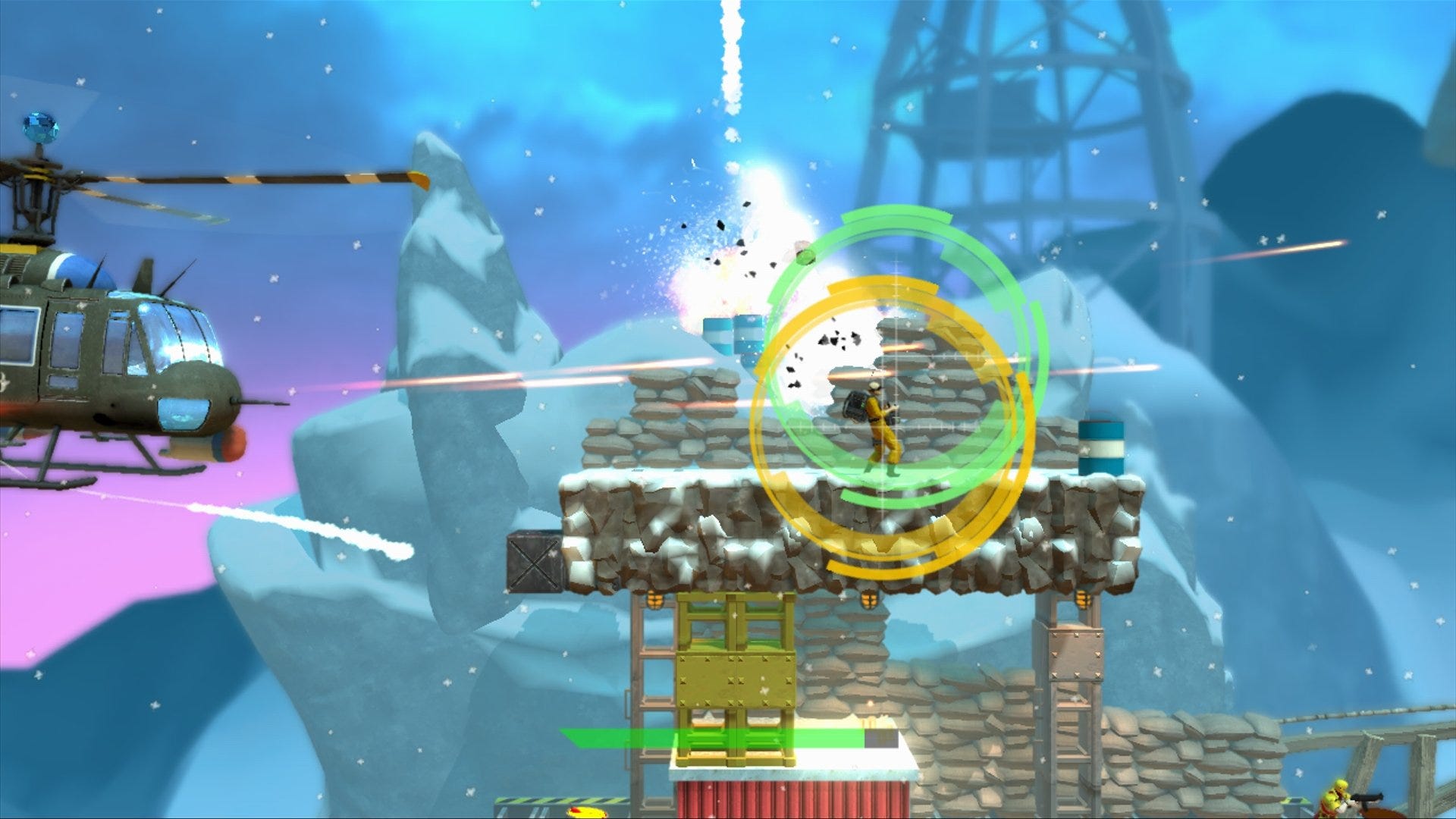
We have new things in their stead. Like PhysX support, a feature apparently so important it warrants a prominent position on the title screen. Aside from a couple of showboating sequences, this seems to equate to little more than realistic barrel movements and slain enemies slumping to the floor with disturbing authenticity. Slightly less authentic is the manner in which these corpses suddenly roll off the side of whichever surface they fell onto, like a continental footballer overreacting to an aggressive challenge. Such behaviour could be excused were it not for the fact that most leave it a good few seconds after their demise before hurling themselves off-screen.
Other changes may prove more divisive. In the interim, it seems Spencer has learned how to jump, though he's still not very good at it, his feeble hop hardly likely to trouble Mario any time soon. Stages are still designed to support non-jumpers, so purists can disable the new ability in the options menu, though the extra level furniture makes getting around feel more awkward. You're best leaving it on and just using it sparingly.
More controversially, the swing mechanics have changed. Previously, Spencer would automatically let go of a surface unless the analogue stick was held in a particular direction, but this time his claw grips tightly onto most surfaces, only relinquishing its grasp once the player presses a button. This allows you to change the direction of his swing, which is theoretically very useful as it potentially minimises backtracking after a mistimed swing or leap. In reality, however, it's rare you'll want to lose your rhythm or momentum, particularly when you're traversing a series of small swing points above a perilous drop.
All the extra button-pressing required to negotiate levels makes traversal feel far less fluid than in its predecessor, with the timing seemingly more capricious and unforgiving. If Rearmed's lack of a jump button meant exploration felt a little guileless in places, it at least had the excuse of being a faithful remake of a restrictive original. Levels here lack the simple elegance of the first game, meaning that the joy of free-flowing movement is all but lost.