It's a couple of hours after today's momentous PlayStation Meeting, the Tokyo event at which Sony unveiled its lavishly-specced successor to PSP, codenamed Next Generation Portable, or NGP.
A cab ride has taken me from the briefing to the imposing, minimalist Tokyo HQ of the entire Sony Corporation. I'm here to interview Andrew House, president and CEO of Sony Computer Entertainment Europe, about what I've just seen and heard.
At the conference, Sony also made the surprising announcement of PlayStation Suite, a PlayStation-branded platform bringing classic PSone games as well as new developments to Android-powered phones and tablets. The idea seems to be that PS Suite will fight a rearguard action against Apple and the iPhone, opening the smartphone market up for more traditional gaming, while NGP takes the fight to Nintendo's 3DS with an equally gimmicky gaming gadget – albeit one with much more horsepower and, it appears, superior online features.
But it's NGP that dominates the attention – not least here, in this blindingly white room. House has one sitting on the table in front of him. It's a glossy, gorgeous device; the resemblance to PSP is pronounced but it's a more confident, less fussy design. And, yes, it's big, but not overwhelmingly so. Up close, it doesn't look too dissimilar in size to PSP, while the benefits of its dimensions are obvious in the large screen and comfortably-placed twin analogue sticks. Lined up next to House's BlackBerry, it looks the same depth and about two and a half times as wide.
House, meanwhile, is friendly and polite, chooses his words with care, and possesses the ability – extremely unusual in videogames executives and, well, human beings in general – to speak grammatically correct English while actually answering your question (or appearing to, at any rate). I start with the softest of softballs to warm him up, but even this answer is quite interesting – so here it is in full.
Eurogamer: What's the key message that you want to communicate today?
Andrew House: I think we announced two very significant elements of strategy today, and I think both are important. One is in response to and recognition of how the portable landscape has shifted and changed in the last five years, since we launched PSP.
With PlayStation Suite, we've essentially taken a good look at the Android marketplace. I think you'll find that the volume of games is generally in the casual space and the free space, but where the value is being generated is around richer and deeper games. They're generally for the audience that is, you know, your audience, your core audience.
So we thought, based on that, and in discussion with publishers and especially conventional game publishers, that there's a really significant opportunity in what I would call a middle segment – for a consumer that wants the convenience of a smartphone, but wants something deeper and richer than perhaps they generally get right now, and is prepared to pay for that.
Andrew House in Tokyo. Every right to look pleased with himself.
The beauty of that strategy for publishers is that it allows them to leverage their existing content, and to find a new revenue stream. Several publishers have told me that they struggle, in the current Android marketplace, to find a home for their content and to find a new business model. We think we've gone a long way to address that.
Eurogamer: And where does this beautiful new device in front of you fit in?
Andrew House: This beautiful new device sits very much at the top end of that segmentation. I think it's a statement of leadership, that we think there is huge potential for dedicated portable game devices with the right set of cutting-edge features. And we've gone all out – in terms of a fantastic screen and viewing area which is core to any premium game experience.
One of the learnings that we took from PSP is that consumers are not satisfied with taking a conventional console experience and merely putting it onto a portable device. There has to be a range of features that fit that portable experience. Hence incorporating GPS for location-based services and game experiences. Connectivity is obviously crucial for a new and upcoming generation of gamers who want social connectivity as much as they want a dedicated game experience.
Eurogamer: As you say, it's clearly a very powerful device and it's got a lot of features. What does that mean for price? I know you're not announcing anything today, but can you put it in a ballpark? Are we talking iPad money?
Andrew House: I can't put a ballpark on it in terms of figures, but I think what I would say is that we will shoot for an affordable price that's appropriate for the handheld gaming space.
Eurogamer: Are you prepared to sell at a loss to do that?
Andrew House: I think ideally we would want to have our hardware be profitable, in addition to our software. We've experienced both sides and we know which one we like to be on!
Eurogamer: I'm sure. Do you know when you'll reveal the price?
Andrew House: I don't right now.
Eurogamer: The other main question from our readers, seeing how powerful the machine is and how many features it has, is about battery life. Do you know how long we can expect it to last – in gameplay?
Andrew House: I think we'll have a good, solid battery life because of two factors. It's influenced our choice of flash media, versus incorporating a disc drive; and number two, the screen is large and gorgeous – it's also OLED, which is fantastically good for low power consumption as well. So there's two, I think strong, features there that bode well for battery life.
Eurogamer: In terms of the media games will come on, will everything be available through the PlayStation Store? And will everything also be available on cart?
Andrew House: Yes, and no. So what we're intending to do is have everything available on PlayStation Store, and potentially be on physical media as well.
But I think an area that is exciting for us is, if you have games that are only available for digital download, you remove clearly a huge amount of risk for publishers. What that, we hope, trends to is more innovation, some greater risk-taking creatively, by that flexibility of being able to deliver only in the digital space.
NGP sounds like a quango or a parking lot. What was wrong with PSP2?
I wouldn't want to call too many things too early, but I think what you'll see in the physical space is the larger, and I mean in terms of data capacity but also in terms of bigger, blockbuster franchises that will probably lend themselves more to the physical medium – you know, big games that you don't necessarily want to spend an awful lot of time downloading.
Eurogamer: How will 3G work? Obviously that's a major and very interesting new feature for a handheld console. But you have to have network partners presumably, and there must be some cost for the user, at the end of the day?
Andrew House: I think the answer to both those questions is yes. You'll hear more from us around that aspect of the strategy as we get closer to launch. We are working very hard on partnerships in that area.
The first thing to clarify, which I'm not sure the presentation did a perfect job of doing today, is that all of the devices will have wi-fi capability; a separate SKU will have 3G.
Eurogamer: OK. Like the iPad.
Andrew House: So the user gets a choice. Wi-fi is available wherever, which clearly is the most important aspect of connectivity and that connected experience; 3G will be a subset of that.
Eurogamer: Will it support online gaming over 3G? Actual simultaneous gameplay?
Andrew House: I'm not sure. [He actually sounds unsure.] I think it would depend very much on the degree of data traffic that's being driven by that online game.
If PlayStation Suite is the gateway drug, NGP is the [censored by our lawyers]
Eurogamer: So it might depend on the game?
Andrew House: It might depend on the game. One area that I'm particularly excited about is the idea of asynchronous gaming, whereby the game experience is existing either on a PS3 or on your NGP, and then the 3G ability is the real-time, you know, "you're under attack, you've got to go do something"; messaging, just keeping that link with you, which clearly is not very heavy in terms of data traffic, but creates a whole different sense to the experience.
Eurogamer: Any plans for phone or web browsing features?
Andrew House: Web browsing features, yes; phone, deliberately no. We've avoided it.
Eurogamer: Why is that?
Andrew House: We think that voice capability carries with it a whole other set of expectations, and we want this to be first and foremost the ultimate gaming experience. We've elected not to complicate that proposition overly by trying to have it be all things to all people including voice and a conventional phone. Clearly [PlayStation Suite] addresses an already vibrant phone marketplace that serves that consumer very well.
Eurogamer: Who do you regard as your main competition? Is it 3DS or the iOS devices?
Andrew House: Clearly in the dedicated portable space, we will be in competition with 3DS.
I know you'll think me coy, but our wish when we enter markets is to grow the overall market and landscape, and find new audiences. So in that space, I think we're more or less generally competing for consumers' time, and that's where we place the highest premium. It's our job to deliver fantastic experiences that merit the consumers' investment of their time with our devices.
Eurogamer: But 3DS is, at the end of the day, a fairly high-spec, high-tech, second-generation handheld launching into the market at roughly the same time. It's got to be a close fight.
Andrew House: I think that we feel very confident that we have very sufficiently differentiated ourselves from the competition with spec, and in particular the connectivity and network features and interfaces that are all pretty revolutionary. That will set this device apart.
Eurogamer: Is the screen potentially capable of 3D, with glasses?
Andrew House: Um... I'm not sure, is the honest answer to that question. [Once again, it sounds like he really doesn't know.] But that does not sit within our plans right now.
Eurogamer: That seems interesting, given that 3D is such a big thing for Sony as a whole in terms of its TV business, and PS3...
Andrew House: It's a fair question. I think that we view 3D as having the greatest potential, in the near term, in what I would call a dedicated entertainment environment. And that's in the home, around the television, and where it's a shared experience. I think that's really important. We struggle a little bit to see how that 3D, shared experience translates to portable devices as they currently stand.
Eurogamer: This is the first, post-Ken Kutaragi, new PlayStation hardware. Will it be easier to develop for than previous PlayStation platforms? It's often been a criticism from developers.
Andrew House: I think what you heard today from a range of publishers and developers was, yes, that they're already finding... I would say to you, we're further along in the development curve in preparation for this device than we have been on previous devices.

If NGP is released wordwide in 2011, Apple, Sony and Nintendo will turn Christmas into a consumer electronics bloodbath.
The feedback that we're getting from our own studios as well as external studios is that it is very pleasantly surprisingly easier to develop for. And as you heard from some of the speakers today, the opportunity to take certain assets from an existing PS3 experience, and take them fairly seamlessly, then allows the developer to concentrate on the aspects that really do inform a portable experience.
Like, how do I use the interfaces? I think you saw that demonstrated well from Shuhei's demonstration of Uncharted: it's visibly and recognisably the same world and experience as the PS3, but the uncovering of the tablets, the interface to do climbing, just makes it then a completely new twist.
Eurogamer: That was my next question – what are you going to do to stop people simply porting games across to it? If it's that powerful that you could bring a PS3 game across quite easily...
Andrew House: To be honest, the publishers that I've spoken to have generally indicated that they don't think that that's satisfactory for the consumer. To try and ask the consumer just to re-purchase an existing console experience – I don't think we or they feel that is really going to be the correct strategy.
Where I think it does become really interesting is if publishers, including ourselves, start to think of franchises more holistically. So, here's Uncharted; here's the dedicated PS3 experience and that's what this needs to be; here's a network aspect to Uncharted and that's what that needs to be; and here's the portable offshoot or adjunct to that, and here's what that needs to be. But they're all working together to enhance a franchise.
We were delighted that Philip [Earl, Activision suit] was able to be with us today and to stake a commitment that they've already seen that opportunity for Call of Duty and taking an extension of the most powerful-selling franchise around right now.
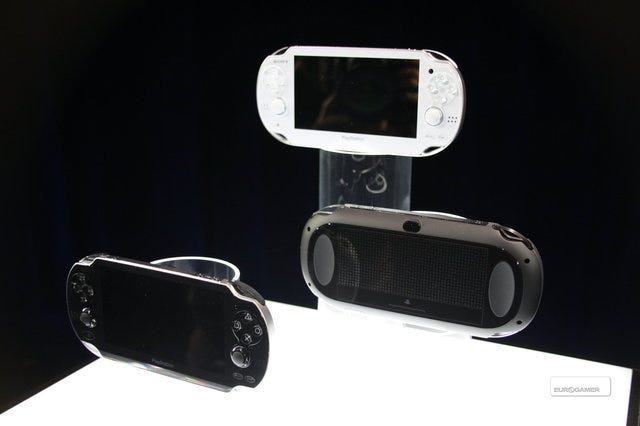
Another unanswered question is if the NGP will retain it's current codename upon release.
Eurogamer: Can I move the conversation onto PS3 briefly? The fact that PS3 has now been "cracked" by hackers – what does that mean for players, and can you realistically stop piracy now?
Andrew House: I think that we will work extremely hard and are already moving very fast to try and maintain the security of our device. It's the lifeblood of our industry – if you're going to continue to see innovative games, they have to be within a business model that allows publishers to justify and recoup the huge investments and creative talent they've put into those games.
I think the best thing that I can say on that is we will do our absolute utmost to address any and all security issues around PS3.
[A Sony rep informs me after the interview that PS3 received a firmware update today – 3.56 – which he characterised as the first, if definitely not the last, step in Sony's response to the hack.]
Eurogamer: Kaz Hirai said that NGP will be released "starting from the holiday season this year". Does that mean Japan? Are we looking at 2012 in the US and Europe?
Andrew House: I don't think we're in a position to have nailed down launches by geography. You'll hear more about that from us later on this year.
Eurogamer: But it will be available somewhere this year?
Andrew House: It will definitely be on the market within calendar year. That's the intention.
Eurogamer: Fine. And when's PS4 coming out?
Andrew House: [Laughs] PSwhat?
PR: Haven't you been invited to tomorrow's presentation?
Andrew House is president and CEO of Sony Computer Entertainment Europe.
