Nintendo's back catalogue is never-knowingly underexploited. In recent years the runaway success of DS and Wii has emboldened the company to keep remixing – or simply repackaging – classic titles in the confidence that there's no shortage of customers to hoover them up.
Take New Super Mario Bros. on DS. The game was released in 2006 as a reimagining of the 20 year-old NES classic for a new generation. Years later, it's still a big hit - in fact it was the second best-selling DS title in the UK in 2010.
But that was a new game. More brazen, and just as clever, was last autumn's marketing ploy to celebrate the 25th anniversary of "Super Mario". For the purposes of the headline-friendly "25" figure, Nintendo seemd to be ignoring the character's previous gaming roles.
The world's press (including us) duly reported on this grand occasion and Nintendo marked it by sticking the contents of 1993's Super Mario All Stars SNES cartridge on a disc and into a shiny new box.
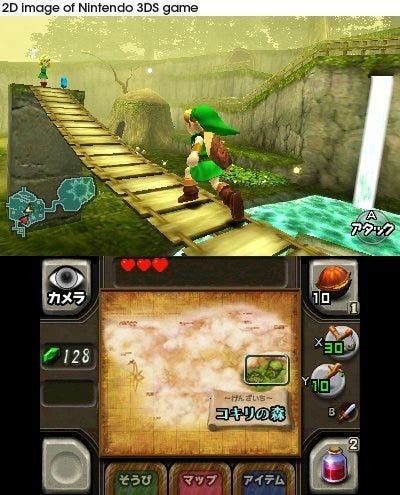
No more jumping in-and-out of pause menus with maps and item controls squeezed onto the bottom screen.
The reason why Nintendo succeeds here is simple: a disproportionate number of its headline releases from the 8-bit era onwards – compared with other contemporary tiles – retain a timeless quality to their core gameplay.
If that sounds hopelessly vague, let me put it another way: strip away everything else from a Mario game but the character and there is still pleasure to be had from the simple act of control itself.
What 2009's New Super Mario Bros. Wii tells us, as much as anything, is just how right Miyamoto and his team got it in the first place, a quarter of a century ago.
Nintendo is also one of the great innovators, of course, in the areas of hardware and software. But the enduring quality of its classic titles ensures the Mario Karts continue to sell alongside the Wii Fits.
So it should come as no surprise to find a similar blend of old and new across the launch line-up for 3DS: the revival of Kid Icarus and Pilotwings; the re-release of Super Mario Land and Zelda: Link's Awakening via Virtual Console.
But for fans of a certain vintage, an early highlight will be the chance to play The Legend of Zelda: Ocarina of Time on the move. This is for 3DS what Super Mario 64 was to the original DS – the rebirth of what is considered one of the greatest games of all time on handheld.
Its hold over gamers' imaginations was clear enough last week at Nintendo's Amsterdam event, with more people queuing to play Zelda than anything else.
There are three playable sections in the demo: Kokiri Forest, Inside The Deku Tree and Gohma. The former serves as an enemy-free playground to (re)familiarise oneself with the controls and get a handle on the 3DS-specific features.
The biggest change is the use of the lower touch screen for info and icons previously accessed via the Start menu. With a map display and icons for various gear, weapons and potions, it should streamline the experience.
And, as Nintendo itself has noted, this will be of particular significance in the dreaded Water Temple – which required endless switching in and out of iron boots via the pause screen. Now, we're assured, it can be done in a flash via the bottom screen.
The attract sequence alone is iconic fanboy porn.
Another notable change makes use of the system's gyroscope when using the first-person view to look or fire a catapult. For me, it feels too daft and unnecessary to be anything other than a gimmick players will quickly ditch in favour of using the analogue nub in the old-skool way.
Shifting the console around at dramatic angles to direct Link's field of vision may be a nifty demonstration of the tech (something newer iPhones and iPods are already capable of), but it's hardly practical. And when the 3D is turned on it becomes plain annoying, since the effect is only maintained while you're looking at the screen dead on.
The 3D effect is non-essential in general but does a satisfying job of drawing you deeper into the experience. More pleasing is the decision to give the original 1998 visuals a lick of paint, with better textures and more expressive character models.
With the latter two playable sections of the demo giving a taster of dungeon exploration and a boss battle – the overall style of which set the template for all subsequent Zeldas on home console – one hopes, as with all classic games, that the strong urge to relive the experience in no way tarnishes the memory of it. But I can't say I'm losing any sleep in this regard.
Ocarina of Time doesn't make the case for 3D gaming, but it doesn't need to. Given the original was one of this young medium's most revered experiences, I'm as excited about the chance to play the game again on a fancy new toy as I am about the idea there are people who will be taking their very first steps in this unforgettable adventure.
