Stacking
The pile-high club.

It was the best of times. It was the worst of times. Mid-morning – something like that. Poor little Charlie Blackmore and his family were sitting at home shivering in their Dickensian surroundings of bare, splintering floorboards, thin soup and Hounds of the Baskervilles, while their greased-up windows were busy framing bleak-looking chimneys. Outside, interminable Andrew Lloyd Webber musicals stalked the streets and factories. Then, all of a sudden, old man Blackmore burst into the kitchen-lounge-bedroom-refectory, and announced that he had secured gainful employment and the family was saved. There was much rejoicing.
Mere weeks later, however, daddy was nowhere to be seen, and the family was in disarray – possessions hawked to pay for soot, the same underpants worn on successive days, etc. – when even more of a sudden, a masked hoodlum arrived and pressed the Blackmore children into the service of renowned industrialist and evildoer The Baron, in order to pay off their father's debts. There was less rejoicing. Charlie, having been deemed too piddly for manual labour, was left behind to rue. But rue he would not. Though he may have been the smallest of the Blackmore children, he set out to rescue his siblings from a life of servitude and choreography the only way he knew how: stacking.
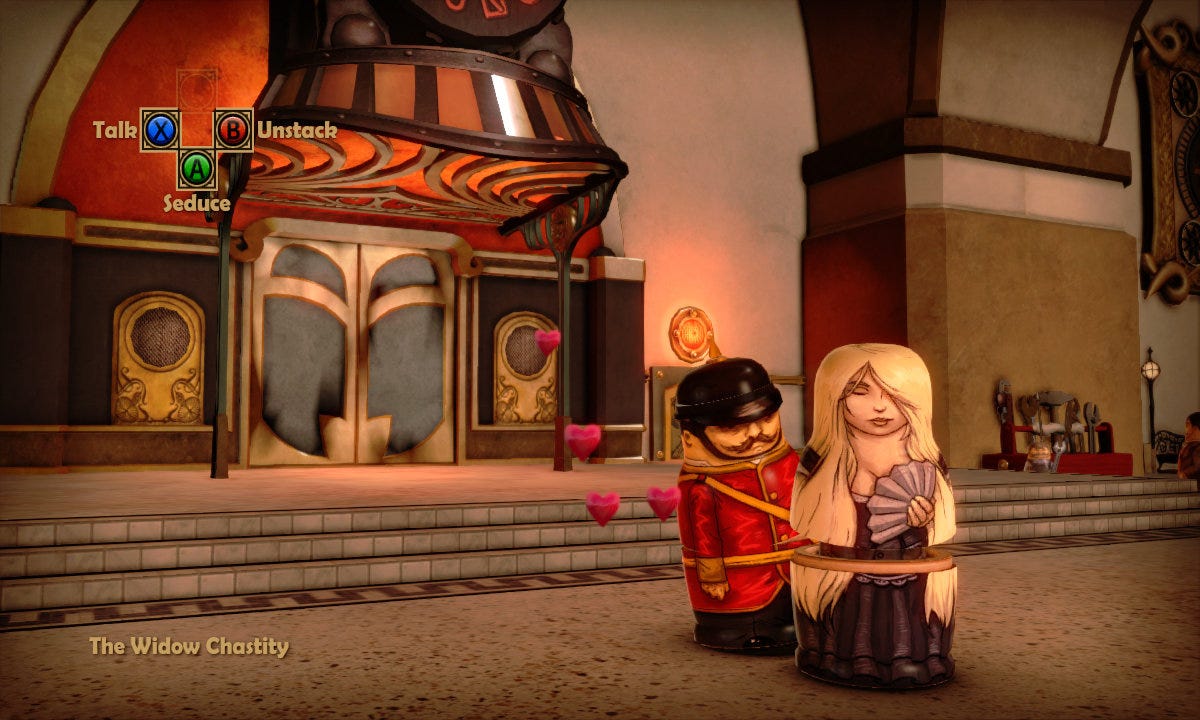
Tim Schafer's latest game – to be fair, he doesn't make them all, but we all wub him so much that we refuse not to invoke him when we mention anything with Double Fine written on the front – is a puzzle-driven adventure starring, of all things, Russian stacking dolls. Charlie is a tiny, cap-wearing little scamp, and by moving up behind other dolls he can hop inside them and take on their appearance and unique abilities. And they can hop inside other, larger dolls, and so on and so forth.
Charlie faces obstacles at every stage of his journey, but drawing upon the abilities of the local dolls he is able to turn the tide in his favour, and he can do so in several different ways for each scenario. One of the first things he has to do, faced with industrial action at the Royal Train Station, is locate and assemble guild bosses, who are attending an exclusive party in a swanky club and are needed in order to break the picket lines.
Having located the puzzle – the right bumper highlights the route to the next challenge – one solution is to distract the doorman using a nearby strumpet ("the Widow Chastity") whose special ability is "Seduce". As she leads him away, wiggling her wooden hips (similar to Traveller's Tales and its LEGO characters, Double Fine's animators extract a lot of physical comedy from their dolls' restrictive frames), Charlie can unstack himself, sneak behind the doorman and seize control of him, gaining access to the club. Alternatively, he can take over a nearby engineer and use his wrench to crack open a vent.