Kingdom Hearts Re:coded Review

The same old toon.

Version tested: DS

Let's be honest: the clamour for improved graphical fidelity plays a big part in driving the progress of new gaming technology. Pretty games sell. Not that all games are reliant on visual frippery, of course, but it's impossible to deny that much of Kingdom Hearts' appeal comes from its lush recreations of famous Disney worlds and the characters that reside therein.

This naturally presents Square Enix with a problem when it comes to the DS. Re:coded is among the better looking games on the system, but there's no doubt the old girl's starting to creak a bit as she prepares to make way for a shiny new model. The PSP's terrific (and technically impressive) Birth By Sleep offered a number of new locations to explore and smash monsters around in, but Re:coded is content to mostly retread old ground, as Sora revisits settings from the first PS2 game. Sadly, these worlds lose much of their impact in the downsizing process.

The plot contrives to find an excuse to return to the likes of Wonderland, Agrabah and the Olympus Coliseum. Jiminy Cricket's computerised journal of the first game's events has been corrupted, and so Mickey, Donald and Goofy decide to send a virtual Sora into the digital world to get rid of the bugs. But soon after you arrive on the Destiny Islands, it's clear these unsightly blocks of code are the least of your problems.
1

You'll sometimes be sucked into portals to another digital realm. Complete additional challenges here to earn more experience and item rewards.

I'm afraid that's your lot as far as story info goes, Square Enix's faintly silly review restrictions preventing me from elaborating much further. Suffice to say that while the plot is more straightforward than most Kingdom Hearts titles, there's a degree of assumed knowledge that means some scenes won't make a jot of sense to newcomers. Given that there's a strong sense of déjà vu to proceedings for those familiar with the series, you do begin to wonder just who the game is aimed at.

There's plenty of toing and froing as you're sent on simple fetch quests by a variety of well-known Disney characters, and along the way you'll spend a fair bit of time smashing the stacks of black blocks which represent the glitches in Jiminy's digital journal. Most hold either restorative items or experience orbs, though they can also be used as stepping stones to reach hidden areas or higher platforms.

Completing missions and defeating certain baddies earns you computer chips, which are placed within a matrix to enhance Sora's powers. It's not entirely dissimilar to Dead Space's weapon upgrades, though here you're levelling up your character more than his arsenal. The rather neat concept of 'dual processing' sees the effect of certain chips doubled if you use them to connect two circuits. This can allow for faster levelling, or hugely increased power in battle – useful during the handful of boss encounters.

There are even 'cheats' of a form, which you can use to tweak the combat mechanics, increasing the amount of experience or cash gained from defeating enemies, but at the cost of making them tougher to beat. The difficulty level can be adjusted at any stage, with rarer and more valuable item drops for those up for the challenge.

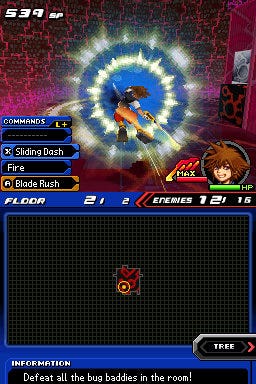
I'd have been more willing to do so had the fighting been more entertaining. Kingdom Hearts battles have always been reasonably straightforward, mostly reliant on rapid taps of the standard attack buttons, with combos emerging if you make enough consecutive connections without being whacked in return. You can assign special attacks to the Y button, and activate the more powerful deck commands by holding the L button and selecting them from a short menu. Once you've accumulated a few specials, you can choose which ones will appear in the list, though it's also worth assigning a potion or two here to quaff during the tougher scraps.

There are two main issues though. The first is repetition; the gloopy foes known as the Heartless come thick and fast and take a fair few blows before they fall, enough to make the frequency of the battles a chore. Quite a few quests take you through areas you've previously visited, and rather than being able to explore them at your leisure, you'll always have a handful of enemies to worry about. As the game wears on, their near-constant presence elicits more groans and sighs.

The second problem is the camera, which seems to take an active dislike to Sora, pointing at walls, floors, enemies – anything rather than centre on the spiky hero. It can be manoeuvred by squeezing the R button and moving the d-pad, but that leaves Sora open to attack. Use the stylus instead and you can at least guide him out of harm's way as you shift the perspective, but unless you've been blessed with several extra fingers on your right hand, you're not going to be able to attack at the same time.

2

The busyness of the HUD exacerbates the camera issue, while the constant cascade of orbs can easily obscure enemies.

Mindful of the slightly monotonous rhythm of the early stages, Square Enix does at least attempt to mix things up as the hours tick by. Hollow Bastion hosts a 2D platformer sequence, which is entertaining in a fairly rudimentary, old-school kind of way. A Sin and Punishment-esque rail shooter interlude is good fun, too. And for the entirety of the Coliseum world, the game decides it's going to be a turn-based JRPG for a bit – and not a bad one at that. It's certainly more enjoyable to defeat the Heartless this way rather than mindlessly jabbing at the A button over and over.

But outside these moments and the admittedly interesting Matrix system, there's precious little invention here, and the anaemic story fails to pick up the slack. While the graphics are decent enough, the presentation is otherwise a little flat, with lengthy conversations presented in a very static and half-hearted way. The game's obviously been buffed up a bit from its mobile phone debut, but it's lacking the polish you'd expect from a Square Enix game.

Camera and pacing issues aside, there are few real flaws, but equally there's very little you'll remember once the credits have rolled on the 15-hour campaign. While Birth By Sleep pointed a potential way forward for the series, Re:coded is a disappointing step back. The unshakeable sense of overfamiliarity won't trouble newcomers, but anyone who witnessed that first glorious collision of the worlds of Disney and Square will surely think that Re:hash is a more appropriate title.

5 / 10

Read the Eurogamer.net scoring policy

Comments (33)

Comments for this article are now closed, but please feel free to continue chatting on the forum!

  • Loading...hold tight!