Version tested: DS
It's been a while since there's been a portable Harvest Moon to rival Friends of Mineral Town, which was lodged in my GBA's cartridge slot for the whole of 2004. The series has ambled off in several different directions since, turning your farmer into a robot boy or or an island castaway or a spiky-haired amnesiac youth to spice up the process of building and tending to an agricultural empire, but it always loses something in translation. Every exciting new addition is tempered by some unnecessary annoyance, and they usually end up balancing each other out.
In this context, Grand Bazaar looks promising. You're simply a farmer, girl or boy, with a spot of land next to a small town – no caves with monsters in, no magic gems or impending disasters. You start out with a hoe, a watering can and a pack of turnip seeds, and off you scamper to tend to them until your first harvest.
But there's a huge change to this familiar scene – instead of popping your crops and produce into a box that mysteriously turns them into money, you have to sell them yourself at weekend market days, setting out a stall and ringing a bell to attract customers.
This greatly changes the rhythm of play, turning all of your attention towards the end of the week. Instead of growing as much produce as you possibly can, you have to think about how much of it you can store so that it won't go bad before the next bazaar. Instead of collecting and selling any plant or piece of twig lying around town, you have to prioritise. Cooking suddenly becomes much more important, turning two or three basic items into one valuable dish. It's just what the series has needed: a neat twist that breathes new life into familiar gameplay.
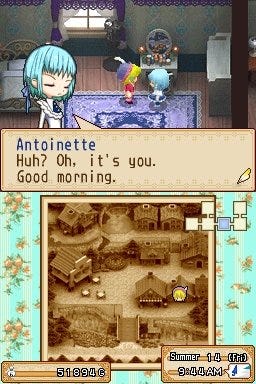
Grand Bazaar's visual style isn't the series' best; it's halfway between lovely sprites and shonky semi-3D.
The town's prosperity is tied directly to the market's. Everybody participates in the bazaar, from the inexplicably Mexican seed-seller and his poncho-wearing brothers to the café owner who sets out cakes and coffees or the top-hatted mayor who sells chocolate. At the start, there are just a few stalls, selling essentials like seeds, cows and the occasional tool; after a few months have passed, it expands, offering more and more customers and items for sale.
Instead of staring longingly at a mayonnaise maker in the window of the local shop for months, saving up your turnip-pennies to buy it, every weekend brings a new selection of equipment, produce, seeds and cooking ingredients. It makes life a lot less predictable.
Before we throw our hats in the air and sign away our free time, though, there's a caveat. As if specifically designed to balance out the hugely positive influence of the bazaar, there's another, annoying novelty factor in the form of windmills. They're the new way of processing items, and they replace shops and expensive equipment.
Instead of buying a cheese or mayonnaise machine, for instance, you chuck milk or eggs and oil into one of the three windmills around town, and it spits out the finished article after a couple of in-game hours. Instead of visiting the blacksmith, you place your tools into the mills with valuable ores, and a few days later you've got a slightly better version.
There are over a hundred different windmill recipes, and there's a certain alchemical thrill to turning objects into other, more valuable ones, but the windmills are incredibly fiddly to use. Rather than just throwing ingredients in from your inventory, you have to scroll through every single recipe to find the one you want, and when you have to do that several times a day it becomes a ritual irritation.
Grand Bazaar generally doesn't explain itself very well, leaving you to turn to internet message boards for advice on the arcane mathematics behind windmilling, dating, tree growth and other such everyday farm concerns. The process of improving tools is baffling; after months of play I still don't understand how it works, and there's no in-game help to advise me. I miss being able to exchange money and some gold ore for a better hoe in the local smithy. Life was simpler then.
The windmills are indicative of a wider trend in Grand Bazaar: it takes progress out of your hands. Things happen at a predetermined pace, with scripted events at certain times that give you new items or open up a new windmill for you to use; no matter how hard you work or how well you do, you can't hurry them up. Your farmer will be going to bed at 10AM all the way through the first Spring; it's months before there's enough going on to keep you busy.
Because of the way the game's clock works and the limited field size, all your normal farm business – taking care of cows, sheep and chickens and watering plants – is almost always over by 11AM. Theoretically this should leave the rest of the day for enjoying yourself, but there's nothing to do. After the middle of the first summer you can at least go fishing, but after one afternoon you'll have caught enough fish to fill your entire inventory, and they don't sell for much at market.
A large part of this problem is that the town is too small, with too few inhabitants. The bazaar and the windmills eliminate the need for shops, and without shops, there's not much for Zephyr Town's denizens to do with themselves. Magical Melody – which remains, in my opinion, the peak of the Harvest Moon series – had a bustling, busy town, full of potential friends with busy lives. In Grand Bazaar, meanwhile, there's nobody to hang out with.
Cats and dogs help out, taking care of the cows and chickens. I wouldn't have thought cats and chickens would be a smart combination.
Townspeople spout the same two lines of dialogue every damned day of the year, and the bachelors and bachelorettes are universally insipid. It's not like they were ever exactly brimming with personality, admittedly, but they did at least have something to say for themselves beyond "Today is a nice day! Let's work hard!"
The boredom can be temporarily alleviated by Grand Bazaar's Animal Crossing-style multiplayer. Friends can visit your farm, and you can frolic off to the river to go fishing or water plants in communion. Immediately you wonder why Harvest Moon has never done co-op farming before. It's an excellent way to take the edge off the grind.
But unlike Animal Crossing, every person's farm is the same, and so the motivation to visit others' dwindles fast. You end up acting as hired help, teaming up to pull off a big harvest. The only thing you can customise is a sign above your field – although I suppose you could plant your crops in the shape of a swastika if you really wanted.
In both single- and multiplayer, the problem is the same: there's just not enough to do. Even when there's a whole field bursting with ripe crops and a barn full of animals to tend to, you'll still be running in circles for hours to pass the time. After your first game-year, there's even less novelty to look forward to between bazaars. You're living for the weekend, not because it promises respite but because you'll finally have something to keep you occupied.
Harvest Moon: Grand Bazaar is a game that I've played daily for more than two months, but I can't honestly recommend that you do the same. Not unless you're a Harvest Moon fanatic, in which case Grand Bazaar offers just enough of a twist on the well-worn, comforting old formula to ingratiate itself into your daily routine. It's the best portable Harvest Moon in quite some time, and the multiplayer is a promising development, but we're still waiting for another Friends of Mineral Town.
6 / 10
Harvest Moon: Grand Bazaar is available now in North America. It's not released in Europe.
