Like a cheap sausage roll, any game with an average score of 65 per cent should be approached with caution. There may be a score somewhere in the eighties at the range-apex, but you know it'll exist in elastic tension with a 45 per cent.
With such a broad spectrum of personal opinions about a single game the purchase decision is a difficult one. There's a high probability the game will cause some measure of buyer's regret, and possibly a dicky tum.
Fortunately I wasn't forced to make that choice with Two Worlds. I was handed my PC copy of Reality Pump's 2007 open-world RPG by a friend. When I asked him what he thought of it, he stoically replied, "Utter balls."
However, he added, slapping the box into my hand, "You might get something out of it. You like RPGs."
At the time I'd just finished my third replay of Oblivion. I'd modded the socks off it and milked it for every experience it could offer. I was hungry for another huge world to get lost in, but those are some big boots to fill. I held out no hopes of salvation from this oddity but decided to give it a crack.
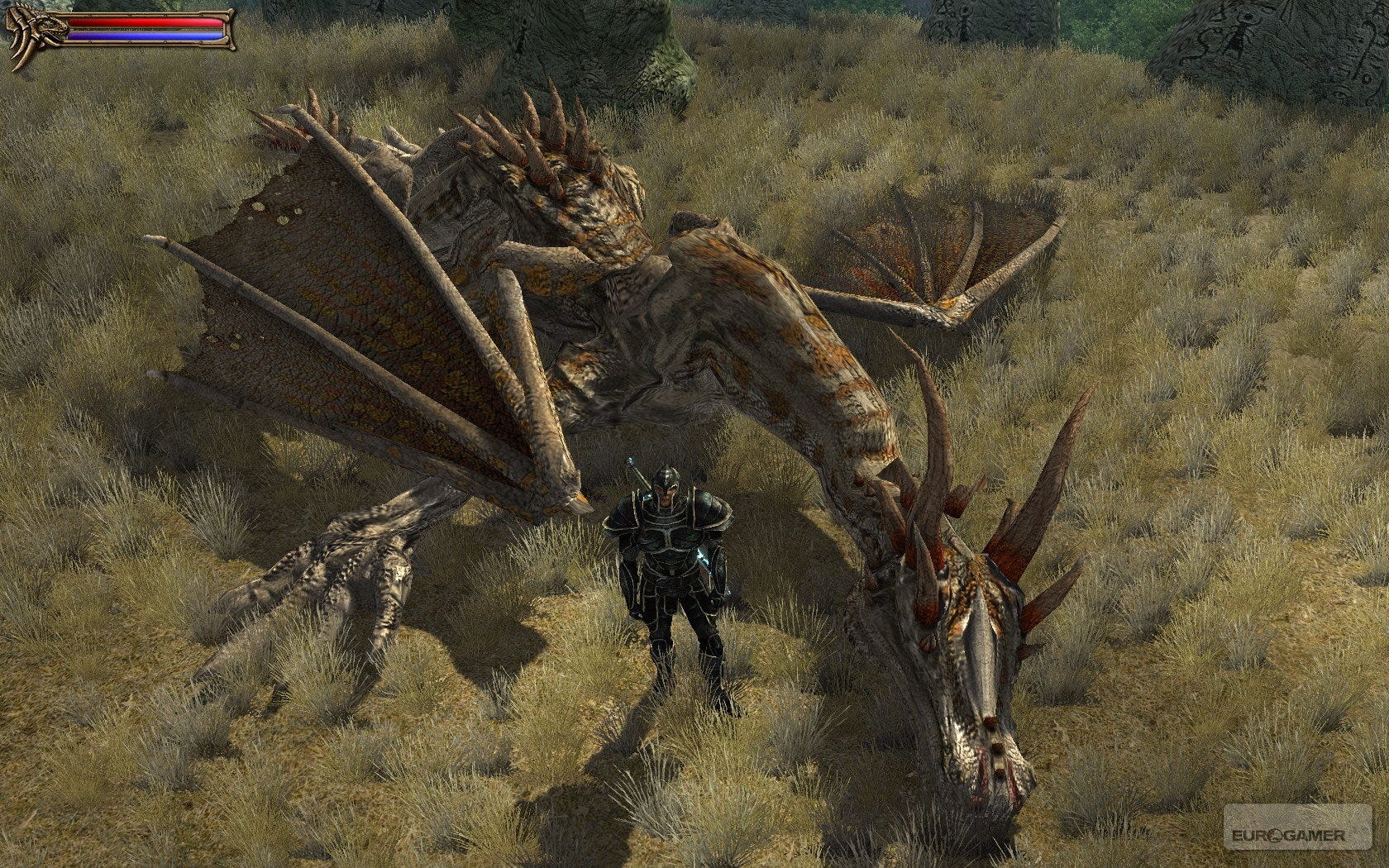
"Stack your gear carefully kids, and you too can net yourself one of these".
Since then I've completed Two Worlds twice. I have some really fond memories of it, hence the title of this article. I'm also prepared to admit it's a bit of a stinker. For the sake of balance, here are the reasons why, along with an explanation of why I'm able to overlook them...
Two Worlds is slow-moving, buggy, and rough around the edges. There are numerous broken quests and some poor UI decisions. Sometimes you fail to strike enemies in combat for no apparent reason. While its open-world couldn't be described as empty, it's a bit barren compared to the cranny-packed landscape of Elder Scrolls IV.
The game is painful to listen to; the cast of Widow Twankies and Pulchinellos is enough to drive anyone to distraction. I have one overriding audio memory of the game branded into my brain-stem, taking up precious meaty megabytes I'll never recover. Whenever the protagonist casts a heal spell, he bellows the words "HEALING POWER!" without a hint of irony. He sounds like a total donger.
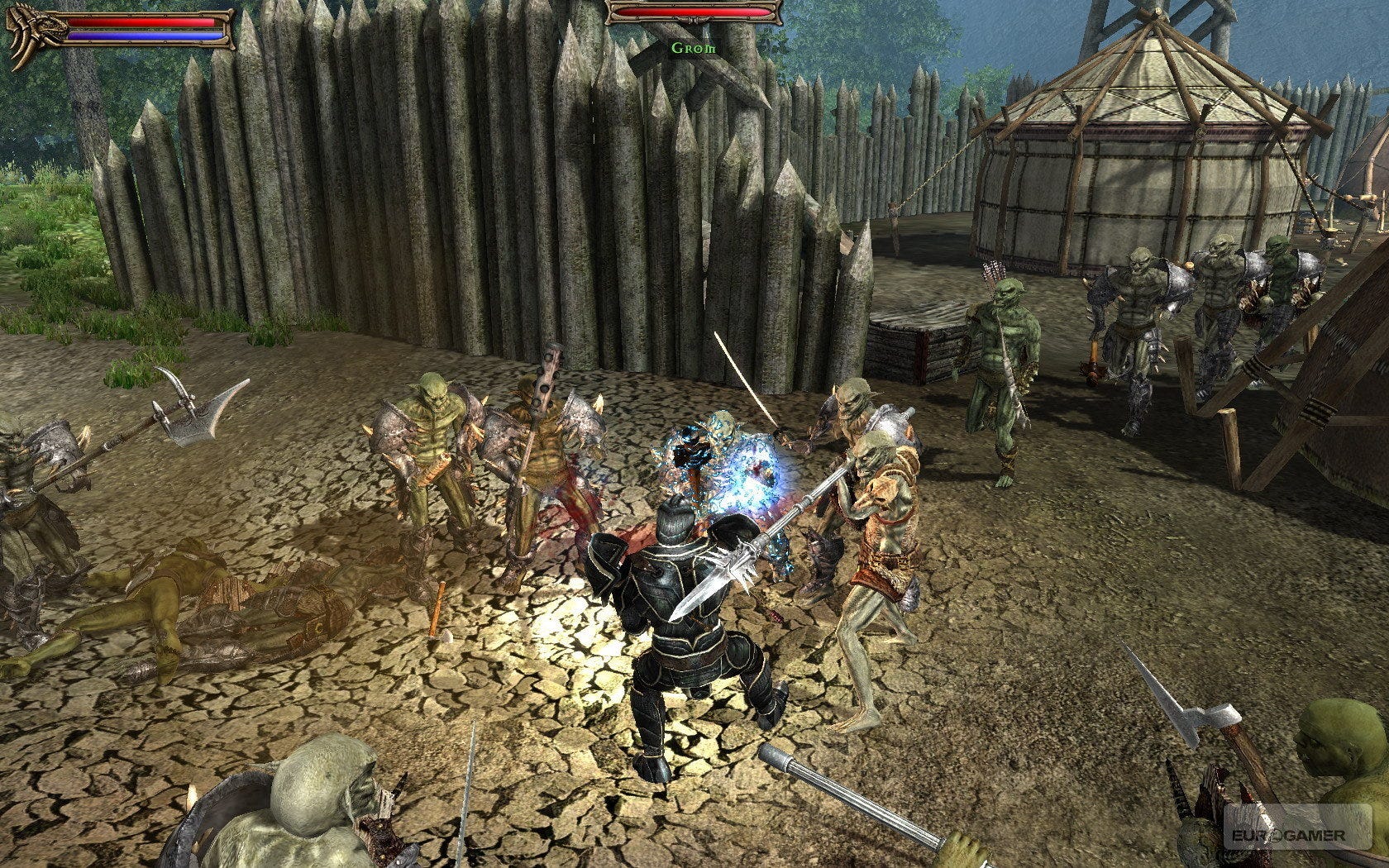
Massed multiple combat was a hallmark of the game. Happy orc-bashing memories.
But there's something affable and lovably amateurish about Two Worlds. It held my attention and offered greater rewards than a number of more accomplished games.
There's a real sense of adventure; you can plod off into the wilderness to explore a landscape-feature viewed from afar, such as the game's Mage Towers. You might find an area ripe for your level and abilities, or you might find a situation in which you're hopelessly outclassed. It's risky, and that's kind of fun.
Like most RPGs, Two Worlds sees you looting shedloads of gear and hauling it off to traders. But because of a single mechanic, it's all worth it. That mechanic is item-stacking.
As per usual, whenever you find a juicy new rare weapon or suit of armour you tend to stick with it for a few levels until the basic stuff dropped by mobs renders it obsolete. At this stage you're keenly hunting for an upgrade, something that will help you feel just a little overpowered for your level again.
Two Worlds features a marvellous mechanic which means that if you find a duplicate of an item, you can combine it with the original to create an enhanced version with beefier characteristics.
Any single item can be stacked 20 times. At this point you've got something which is more effective than the original blueprint by an impressive order of magnitude.
It feels strange to say a game feels worthy because of a single element like this but it turns loot-hunting into an overriding obsession. It becomes a kind of cat-and-mouse game which has you constantly foraging for new and better gear but, perversely, almost hoping you don't find it, because you've spent several levels powering up a single item via the stacking process.
If you had leaves for a hat, you'd be this unhappy too.
This leads to some really tough decisions, and that's a good thing. A new, rare sword drops that's just a wee bit better than the one you're wielding. But the one you're wielding is the empowered result of numerous re-stacks. Is it worth starting from scratch again?
As you grow into your constantly-improving gear you'll find base versions of it appearing more frequently in traders' inventories. The more you stack an item, the more likely you are to find duplicates of it and stack further.
I recall one suit of Black Necromancer plate armour I'd stacked 18 times. I then came across a new kind of suit that was, in its base state, marginally better, but with the promise of fresh enhancement. Knowing that it might be a while before duplicates started appearing, it was enormously hard to part with my pet project.
The Reality Pump designers obviously knew they were onto a neat thing with this concept as they supported it by cramming the game's towns with vendors. Most RPG population-centres give you a blacksmith, a food vendor, a general-supplies trader and so forth. The cities of Two Worlds boast crowds of traders. I swear I spent half my time in the game just sorting through their wares with a fine tooth comb.
Two World's cities boasted pleasing architecture, which you'd notice if you weren't shopping 24-7.
I found myself putting quests on hold just to head back to the nearest town, in the hope that someone was stocking another copy of my sword or shield. Or finding that they did have one in stock but I didn't have the readies, and needed to farm some trash to make up the fee. Would it still be on sale when I got back? So exciting. The fate of the world be damned... I'm shopping!
For this reason, I'm pretty excited about Two Worlds II. Reality Pump have admitted in no uncertain terms that the original was lacking in a number of fundamental ways, and are promising to do things better in the sequel.
Don't get me wrong, I'll be the first to lay out the bunting if they fix what was wrong with Two Worlds. But in the urge to tear down and rebuild, I sincerely hope they don't do away with the stacking element. It was the thing above all others which kept me coming back for more, and it helped the game's various inadequacies pale into insignificance.
