Publishers can wheel out as many fitness experts or frightful ex-popstars as they like – that alone cannot disguise the fact that building fitness requires weeks and months of serious effort and determination.
The original EA Sports Active understood this implicitly, mixing an impressive range of exercise techniques within a structure cleverly designed to keep you motivated when every fibre of your being was screaming "TAKEAWAY ON THE SOFA".
The 30-Day Challenge was the jewel in its crown: a month-long, varied, total body workout programme with clearly defined goals and a fantastic reason to pursue them: a measurable improvement in fitness at the end of it.
For those whose principal goal was to start taking their fitness seriously, both Active and its sequel, More Workouts, were in a class of their own. So the expectations for a full sequel have been understandably high. Not least because Active 2 marks the series' long-awaited arrival on PS3 and 360.
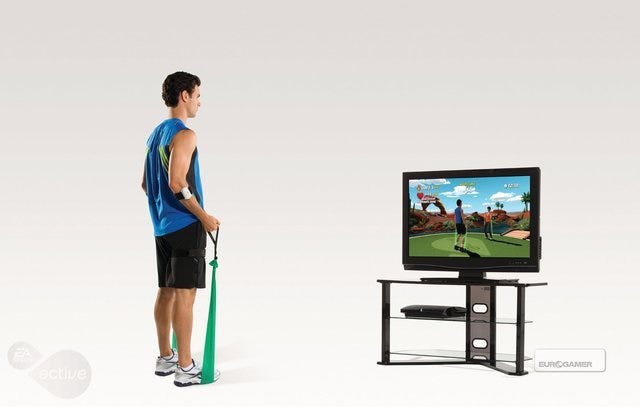
First let's look at what you get in the box. Each comes with a resistance band (which needs assembling – not necessarily easy for knot noobs). And each packs in a heart-rate monitor (360's is bulkiest in size and takes two AA batteries, the others a pair of AAAs).
That's it for 360 (assuming you already own Kinect). With Wii there's an additional leg sensor and USB dongle (to sync devices to the console), while PS3 has a leg sensor, dongle and a separate right arm sensor – Move isn't supported.
The big, unifying feature across all platforms is the heart-rate monitor. Strapped to your left arm, just below the elbow, this records pulse and beams the info to the console, which shows you on-screen how quickly your heart is beating – and, therefore, how hard you're working.
Eurogamer vs. The Olympian
It's the game's major new feature and an important one. You might think you've been pushing yourself: now you know, in real-time, if you are. If you cheat a bit on an exercise, the movement sensors may not realise, but the pulse doesn't lie. You are cheating yourself and it's right there in your face.
The game explains clearly why this matters, splitting BPM into five 'zones' of effort from Rest (93 and under, for recovery and rejuvenation) all the way up to Full Throttle (168 and over, for maximising results in short, unsustainable bursts).
In between, there's good info on where you should be aiming to burn calories, improve fitness or strengthen the heart. As a motivating concept designed to help you muster an extra five per cent of effort, it's a terrific addition – when it works.
I've had problems on all three platforms with the heart meter periodically losing track of my BPM or displaying a resting pulse level while I'm almost passing out from exhaustion.

The heart-monitor sometimes struggles to read BPM accurately - as this graph shows.
EA says clothing, tattoos and scarring can prevent the device from working properly. Without any of those obstacles I've still yet to find a consistent sweet spot where it works solidly without the need for readjustment.
It's by no means a deal-breaker and has certainly worked for me much more often than not. But it's frustrating when the game fails to register a massive effort.
Set-up in general can be a bit of a faff. Neither Wii's nor PS3's gadgets worked at first, so I had to go through the 'rebinding' process to reset them all before they would start flirting with the dongle. And since the Wii's USB slot is on the rear of the console, you may need to move it before a connection is established. Fortunately this should just be a one-off hassle.
Out of the box, the 360 version is the easiest to get going. The heart monitor, though a chunky brute, syncs in exactly the same way as other Xbox peripherals. And, unlike PS3 where they're strapped every-flippin'-where, if you get caught playing in your pants, it looks less like you're embroiled in a weird sex game.
Basic game structure is the same across the board. There's now a nine-week total body programme or a three-week cardio-focused course to choose from as a starting point.
Beyond that there's a large number of individual routines to choose from, and the facility to customise your own workouts from the 60-odd exercises featured.
Whatever your needs, there's probably an exercise for it, from straightforward cardio workouts, to strength routines for legs, arms, chest, back and so on.

No clumsy nunchuk stuffed away in a pocket on Wii this time. Instead, there's a separate sensor you strap to the right thigh.
Unlike the wafer-thin structure of Ubisoft's recent YourShape, everything you do in Active 2 feels as if it makes a meaningful contribution towards your individual goals.
Whether it's a scheduled workout or a random exercise squeezed in during some spare time, it's all tracked and added to your profile, with pages of graphs highlighting your progress in detail.
As with previous Active titles, there's an option to fill in dietary details and list activities completed outside of the game – hardly vital additions, but features that can still help simply by making you more conscious of your general lifestyle.
Set-up and online profile and stats are shared automatically with EASportsActive.com, where you can track progress and plan workouts wherever you have Internet access. Assuming EA's servers are actually working, that is. Over the past week across all versions, making a connection has been a roulette wheel of uncertainty. Last night I spent longer watching "Obtaining data from EA servers" messages going nowhere than I did actually working out.
The site's still officially in beta, so I'll give them the benefit of the doubt and assume this will be fixed, but it's clearly frustrating for a new user.
Feature-wise, it's the most comprehensive fitness game ever released. At the highest settings workouts can be brutal and exhausting – even causing mega-fit Olympic gold medal-winning cyclist Victoria Pendleton to work up a sweat during a recent press event. No mean feat.
But, in taking itself out of the Wii comfort zone and onto three platforms simultaneously, EA has over-exerted itself and the resulting performances are inconsistent to say the least. Here's a format-by-format breakdown.
Wii
This is solid, familiar territory for EA. You can import profiles from both previous Active titles and, though pretty limited, it's possible to compare basic stats in Active 2 against previous regimes.
Heart monitor aside, the big change is the reduced role of the Wiimote, presumably to make it easier to adapt the game on other platforms.
You will use Wiimote as before, just not as much. But you won't necessarily miss it and the addition of the heart monitor is a more than reasonable trade-off. Meanwhile, few will mourn the loss of the giant thigh-band with the nunchuk pocket, replaced by the neater leg strap, which is much less prone to sweat-slippage.
A Balance Board can be used in various activities such as step aerobics, but you can still exercise hard without it. And while the Wii version doesn't support DLC, the new online functionality – once it's working properly – has the potential to deepen your commitment to a workout plan.
Body-tracking can still be a woolly, imprecise affair at times, but never so much that it ruins a workout – and thanks to the heart monitor, cheating is effectively punished with the knowledge that a great big graph is waiting to mock you for wimping out.
Active 2 on Wii is a confident addition to the best fitness series on any platform, and the new features strengthen the offering - if not revolutionising it as EA would have us believe.
Current niggles with the online service and the inconsistent performance of the heart monitor create a level of frustration not present in earlier versions – and, at £70, you really shouldn't be paying extra for that.
But if you lack the means or motivation to join a gym and want to improve your fitness, EA Sports Active remains the best there is.
8/10
PS3
Active 2 on PS3 is, to all intents and purposes, an HD update of the Wii game. An extra arm sensor is included instead of Move support and works just as effectively as the Wiimote where relevant.
On PS3, meanwhile, you get a special bonus right arm sensor. Because it doesn't support Move.
Commercially, I can see why EA has avoided building a bespoke Move-enabled version as it's early days for the peripheral. But while the combination of devices does the job, it's hard to ignore the potential for a fitness title that makes use of Move and PS Eye's one-to-one tracking. Maybe next time.
The feature set is essentially the same as on Wii, although PS3 owners will be able to expand the portfolio of exercises over time via DLC. As such, the smartly structured approach and range of content makes this the leading PS3 fitness title at the first attempt.
EA's solution to multi-platform development here is a neat and largely successful one (despite the occasional waywardness of the heart monitor). But that means Active 2 on PS3 feels more like a polished upgrade to a Wii franchise than a title that genuinely takes full advantage of the platform.
You won't find a game on PS3 right now that will work you harder than Active 2 – but I want to see EA Canada working up more of a sweat next time.
7/10
Xbox 360
Oh dear. On paper, Kinect could have been designed for the fitness genre. A full-body, motion-tracking 3D camera sat in front of your telly? What could possibly go wrong? A lot, it turns out.
And the reason it goes wrong isn't all Kinect's fault. After all, Ubisoft's YourShape is a stunning technical achievement and a striking example of how Kinect revolutionises active gaming. Sadly, in that case the game around it falls well short of the standard set by the technology – and by EA's previous efforts.
Active 2 for Kinect is in many ways the exact opposite of Your Shape: superb game design undermined by a baffling series of technical failings that, at best, suggest the game was rushed to release without proper testing.
Let me be clear: it's far from a total disaster. And when it works it can stand shoulder to shoulder with the other versions – and in some cases, thanks to the body tracking, surpass them. But there are so many glitches and frustrations caused by poor Kinect implementation that it can just as easily ruin a workout.
Having played all three versions extensively, the problem now seems obvious enough. It's a design and resource issue: rather than create three bespoke fitness games, the team has created a single core experience that is tailored to fit each platform.
That process may have worked on Wii and PS3. Not here. Take menu navigation. It turns out that a game designed for use with controllers – amazingly – doesn't work very well with hand gestures.
In five seconds the game will pause itself and he'll put his foot through the screen.
To work around this EA has made the whole game navigable via voice commands. But thanks to Kinect's tin-ear it won't be long before you're barking impotently at the stupid camera before reaching for the controller.
If that were the extent of the problems, it could be forgiven. Sadly, I can't be as charitable about the game itself. For instance, during exercises the jukebox menu has a bizarre habit of appearing at random. Which pauses the game. As do tutorial videos which start playing for no apparent reason.
At other times the game brings up the pause menu – and I'm presuming this is what's happening – because Kinect thinks my arm is making the pause gesture, even though the game is TELLING ME TO HOLD IT LIKE THAT.
It's not consistent, either. Some workouts, I only have problems a couple of times; others it's literally every activity. And yes, I've tried recalibration. And considered throwing it out of the window.
I also noticed that there are fewer events here than in other versions – perhaps because they couldn't be made to work? That said, there are activities designed specifically for Kinect, such as Dodge Ball (the reverse of Kinect Adventures' Rally Ball), which works rather well, and target-based football.
The supplied resistance band is too weak for blokes - you're better off using separate weights.
Space is a general issue with Kinect and Active 2 certainly demands more space than most. In my flat I have just about enough space to play pretty much everything I've tried. Here the camera tracks me fine when upright, but can lose me during floor-based exercises like pushups and crunches. No doubt if you have one of those football-field-sized living rooms 'as seen' in the Kinect ads you'll be fine.
The most damning thing to say about Active 2 on Kinect is not that's it's outright bad – as noted, when it works, it works very well and at times you really can see the difference one-to-one tracking makes, though YourShape does it much better.
It's that EA would have been better off not bothering with Kinect at all and simply packaging the game with the same devices as the PS3 version. That's right, Kinect actually makes Active 2 worse. Amazing.
There's a solid, clever, comprehensive fitness game buried away in here that's fighting to get out. And I hope EA can at least issue a patch that resolves some of these problems.
And then the team needs to take several steps back – a Microsoft-recommended six-to-eight feet ought to do it – and have a long think about how it can deliver a game that does justice to Active's peerless content and Kinect's game-changing technology.
5/10
