Version tested: Xbox 360
Two years ago I saw the Wu Tang Clan's Ghostface Killah perform at the UK music festival, All Tomorrow's Parties. There, in a sorry venue at the heart of Minehead's Butlins, carpet sticky with beer from so many bleak cabaret nights, Ghostface performed to a packed room of largely white, middle-class music buffs and scenesters.
When the rapper invited girls in the audience to the stage to dance behind him, he was joined by a group of bookish hipsters wearing plaid skirts and tortoiseshell-rimmed glasses, bumping and grinding with Ghostface's entourage in a scene of palpable awkwardness, one it seemed that nobody involved had quite thought through.
It's not that Ghostface's audience was being ironic. Quite the opposite: at least half the room was mouthing along with his rhymes, hi-fiving after each chorus and blap blapping after each song climax. But even so, there was a collective gasp of horror when the rapper politely asked if there was anyone in the audience who wanted to join him on stage for an impromptu rap battle. Oh bollocks, we thought. We are about to be found out.
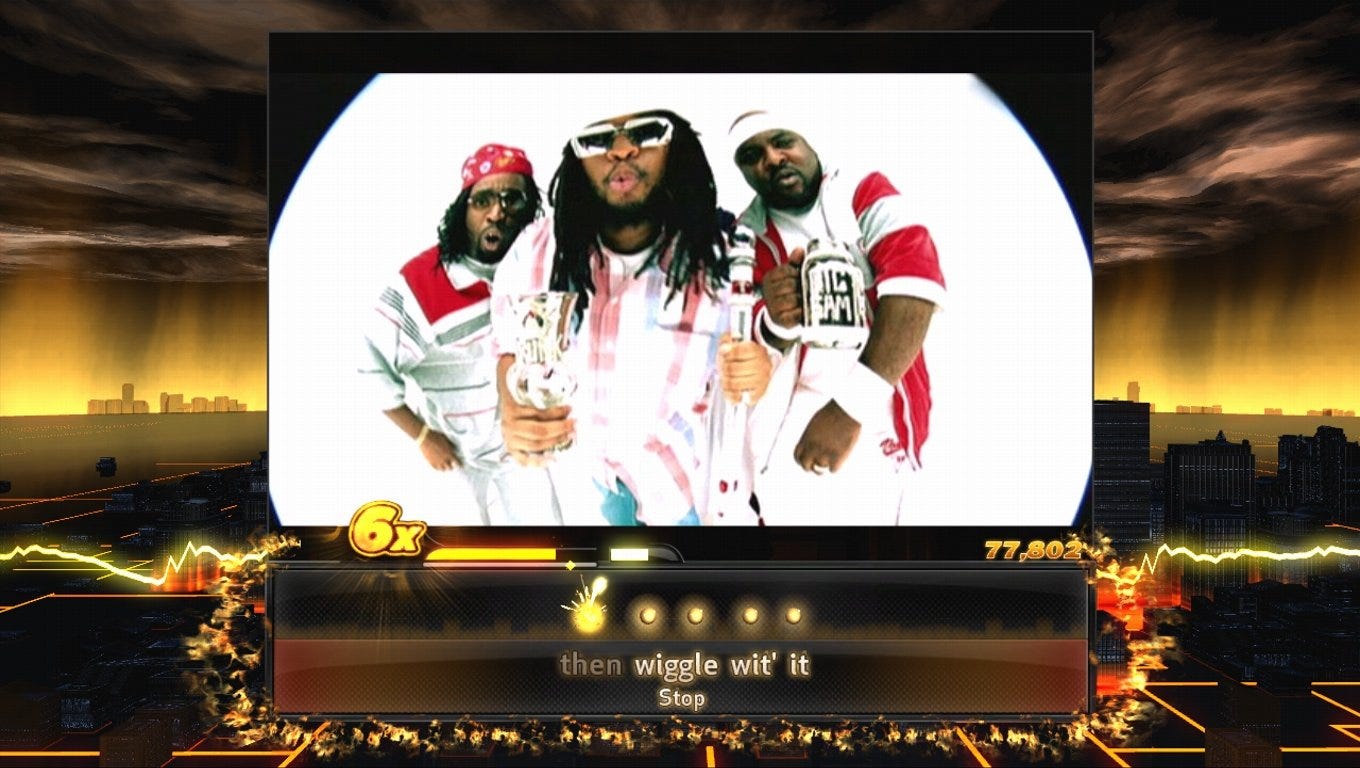
As you progress through the career mode you unlock further backing tracks for freestyling over.
After what seemed like a lifetime of silence, a gangly kid in skinny jeans tentatively raised his hand. A faintly concerned smile broke out across Ghostface's, er, face as the crowd hustled the young man forwards toward the stage. We were caught somewhere between relief that someone had answered the rapper's call and keen terror that this young man was fronting and about to embarrass everyone.
Boom, clack. Buh-boom-boom, clack. The room holds its breath. The boy, well aware of the pantomime scene he is now a key player in, lets out a Disney villain laugh and, bar four, launches into a majestic pitter-patter rhyme, all London twang and lithe eloquence. Like a featherweight boxer he bounces around Ghostface, whose smile is now as broad as his shoulders in the face of this unexpected talent.
It was a magical moment. And it's one that, in part, you can now recreate in the comfort of your own living room, courtesy of Def Jam Rapstar.
There's no denying that Konami and 4mm Games' latest entry in the rhythm action movement benefits from its uniqueness. PaRappa the Rapper aside, rap games are hardly the commodity that rock games have become, so even if the execution of this title were poor, it would still have value as the only destination for amateur rappers to ape the hip hop greats.
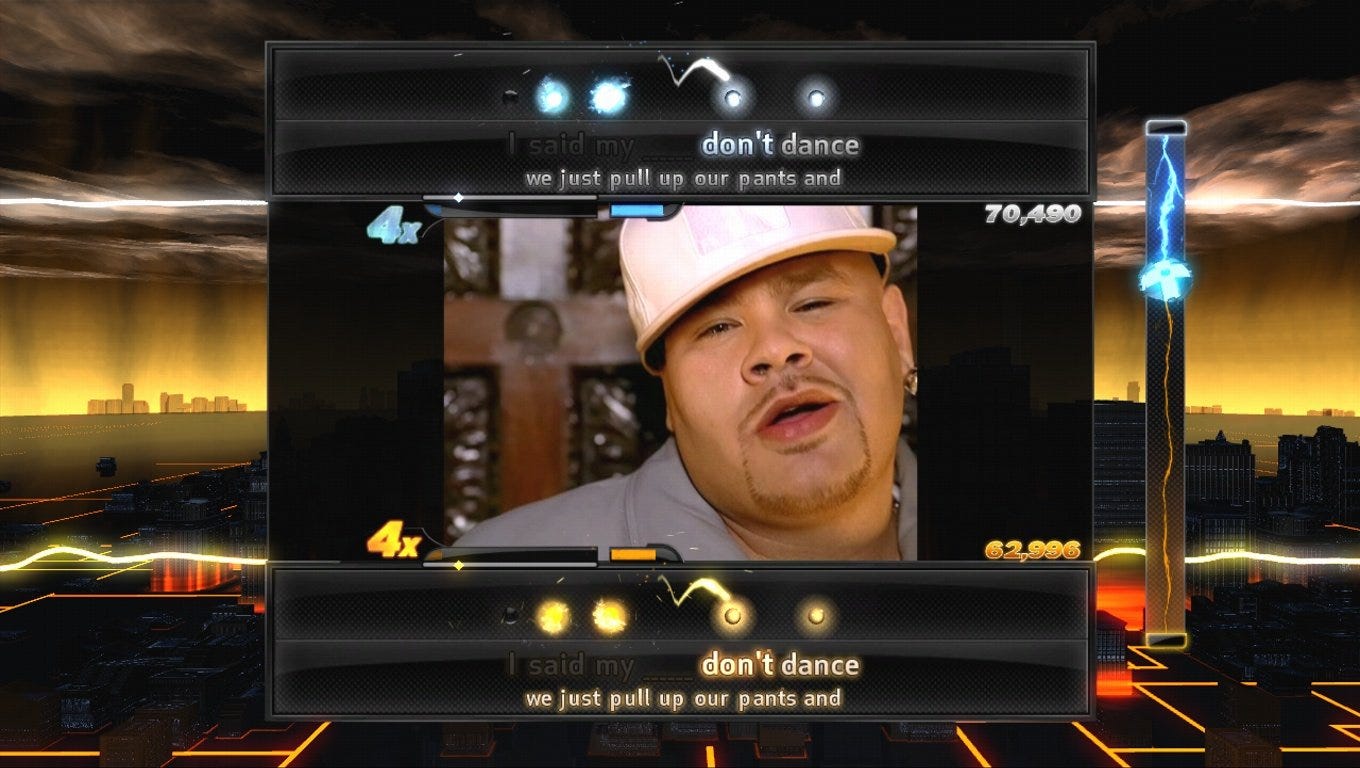
The lack of an option to turn expletives on is a shame, although creatively filling in the blanked-out lyrics is ******** excellent fun.
Mercifully, while the game has issues, 4mm doesn't merely rely on its scarcity to provide value. We're a long way from the spit and polish of Harmonix's latest titles here, but it enjoys a workmanlike competence, fills a niche and, thanks to some smart community features, may even help launch a career or two.
As in any music game, much of the heavy lifting is done by the song list, and here Def Jam's deep pockets and contacts yield a bumper harvest. Particularly impressive is the gamut of UK artists featured, with tracks from London grimesters Devlin, Wiley and Chipmunk, not to mention classics from older UK rap artists, such as Root Manuva's classic Witness the Fitness, So Solid Crew's 21 Seconds To Go and Dizzee Rascal's Mercury Music Prize-winning Fix Up, Look Sharp.
For players who prefer their hip hop US-flavoured, tracks include the mainstream hits of Kanye West and Nelly as well as vintage cuts such as Public Enemy's Fight the Power, Run DMC's Run's House, Beastie Boys' Brass Monkey, Dr. Dre's Nuthin' But a "G" Thang and Salt-N-Pepa's Push It. It's a varied and impressive soundtrack, and with a slew of desirable tracks already on the Rapstar store for purchasing (including Flo Rider's Low), there's a baseline clutch of music here to justify the entry fee.
All songs in the game are backed by their original videos, but these play out in a 4:3 ratio box in the centre of the game screen, a presentation that immediately makes the game look like a cheap karaoke knock-off by comparison to SingStar's slick full-screen approach. This effect isn't helped by the menu design, which features jagged, oversized lettering overlaid on a rudimentary 3D model of a gold city under a blackened sky – a far, clichéd cry from the slick creativity of some of the artists the game features.
The game itself works in much the same way as SingStar. Any sung parts in a song are judged on tuning and rhythm, with a scrolling line moving up and down in step with the changing pitch of the note. Rap notes are marked in much the same way, but here pitch is far less important than rhythm. Dots show the rhythm of each phrase, while the next lyric is shown on screen below the one you are currently singing, enabling you to keep up with sections that you don't know by heart.
Nevertheless, the game is most playable when performing songs with which you are intimately familiar. Attempt an unfamiliar track and following the rhythm of the dots with any sort of accuracy is almost impossible: the notation is simply too crude to act as anything other than a gentle guide. In raps you are scored on rhythm and, allegedly, on lyrics, although the extent to which the game manages to distinguish the words you're using is debatable. Correctly completing lyrics fills a multiplier meter and chaining together lines is the key to high scores.
Recorded videos can be edited and customised with stickers, animations and Geocities-era Internet video effects.
The structure sits somewhere between that of the plain karaoke simplicity of SingStar and the structured play arc of Guitar Hero. Career mode is segmented into five discrete stages. You earn microphones for performances (these work in exactly the same way as Rock Band's star ratings) and in order to access later stages you must pass a set threshold of mics. Training modes allow you to break songs down and, undoubtedly, as you learn the tracks and practice, improvement is discernible.
Party mode, by contrast, opens up most of the game's track list (bar those few that you unlock in the career), allowing you to cue up medleys and perform with friends either in a co-operative duet or a competitive 'rap battle' for the highest score. Finally, a freestyle mode provides a slew of backing tracks for you to rap over, with the option of filming the results and uploading them to Rapstar's community.
This section of the game is surprisingly well-featured, co-ordinating performances in the game with the official site. You can upload 30-second raps as well as rate and vote for other performances around the world. The videos currently featured on the service are serious, with few comedic ones, 4mm perhaps pre-loading its servers with solemn entries in order to discourage messing about. The option to challenge another rapper to a battle and have the community vote for their favourite of the two performances is smart, and for those players who fully engage with this portion of the game, there's some scope to become known amongst the community and perhaps beyond.
There's an option to turn off the original vocals in a track, for those players confident enough to tackle a performance without backing.
Indeed, 4mm's investment in the community portion of Def Jam Rapstar makes its ambition clear. For some, the game will be a chance to get a bit drunk and mess about singing Gold Digger while pretending to be the wiry-haired teacher off of Glee. And to that end, the game satisfies rather than dazzles.
But for others, Rapstar represents a bona fide opportunity to show their skills to a wider audience. Arguably, with its 30-second limit, these players would be better off uploading their rhymes to YouTube. But if enough people engage with the framework 4mm has erected, this could prove a breeding ground for new talent the likes of which the other rhythm action games can't provide.
Meanwhile, for me, it's a chance to rap alongside Ghostface Killer in the comfortable privacy of a suburban living room. You can't put a score on that.
7 / 10
