Drawn: Dark Flight Review

Decorated.

Version tested: PC

Sometimes, a game gets by on its character alone. That was the case with last year's Drawn: The Painted Tower, an unassuming little point-and-click adventure which might have passed you by. It was hampered by some unfortunate puzzles, a dreadful hints system and a slight lack of variety, but it exuded something special.

The same is true of its follow-up, Dark Flight. But in the year since the first game, something remarkable has happened. Drawn's developers have not just maintained the spectacular, magical ambiance of their low-key original, but expanded upon it to a truly wondrous degree. And, most impressively, they've also fixed just about every problem I had with The Painted Tower. The result is that I've spent the past week giddily pestering everyone to play it. Seriously, oh my goodness, play it.

Dark Flight isn't perfect, by any means. Like its predecessor, it's very short (I clocked around five hours), some might say it's too easy, and the ending arrives with an awkward abruptness and, frustratingly, a "To be continued..." message. But it's telling that my reaction was to become excited about the inevitable sequel rather than scream unpleasantries at the monitor.

Drawn's world is the Kingdom of Stonebriar, and your quest - whoever you are - is to save a young queen-to-be from evil forces looking to harness her power. The queen, Iris, is gifted with the ability to paint pictures which come to life, and that in turn grants you the ability to delve into them, making the real fictional and the fictional real, in order to solve a variety of generally straightforward puzzles.
2

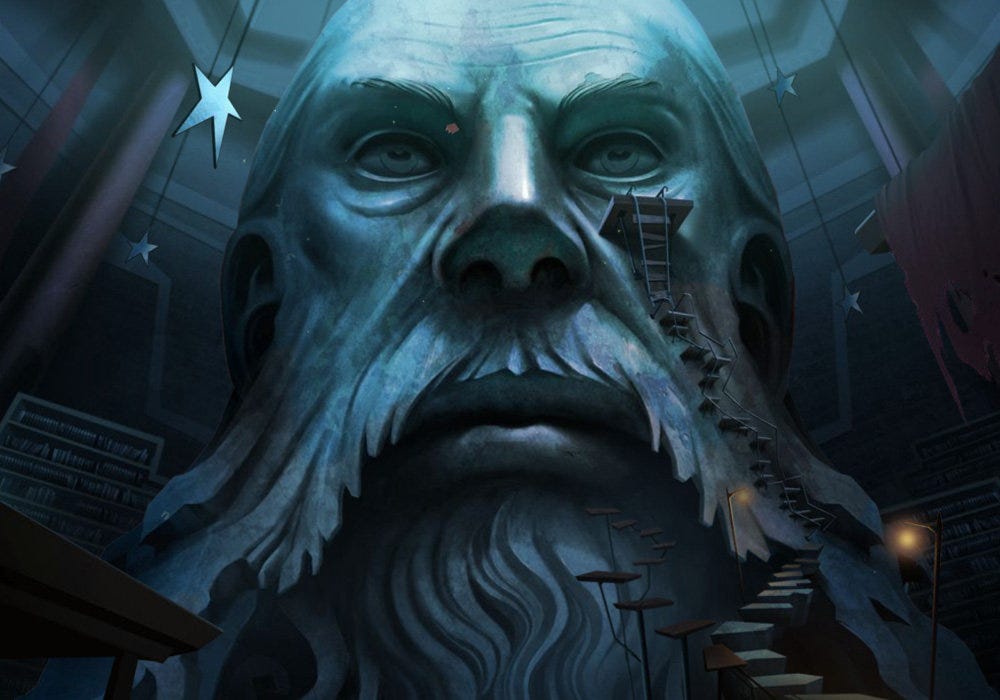
I dunno, man. You just seem a tad big-headed these days.

It's certainly been built with accessibility in mind, released as it is by Big Fish Games, one of the leading casual game publishers online. But the level of challenge isn't the point here. It's a rare adventure game in which the puzzles simply make sense, and never feel convoluted despite several intertwining layers within the fiction.

With the exception of a few mini-game puzzles, most of Dark Flight's challenges amount to simple inventory work. However, in an ingenious move, real items function within paintings, while drawings become their concrete counterparts in the real world. A sketch of a spade torn out of a scrapbook might well dig a hole in Stonebriar proper. Or a fan positioned next to a painting might blow away the clouds depicted within it. Dark Flight cements a perfect internal logic that's entirely fantastical, but brilliantly consistent.

It's unlikely that a seasoned player would end up baffled by most of these conundrums, but Big Fish has nevertheless tidied up the hints system which plagued The Painted Tower. Before, it never quite seemed to grasp context very well, pointing you in directions you'd already taken ages ago and, infuriatingly, requiring a sizeable 'recharge' period between each clue. Now, a simple click on the disembodied head of your guide (a petrified butler named Franklin) triggers a series of increasingly explicit context-sensitive pointers – no caveats to be found.

I'm sure it will come under criticism for turning an already easy game into a breeze. But you don't have to use the hints, and there's nothing worse than getting so head-poundingly stuck in an adventure game that you've no choice but to give up. Drawn: Dark Flight ensures that this would never be the case.

It means that Dark Flight feels like a neater, more carefully designed game than its predecessor. Simply placing these tightened mechanics into Drawn's world would have left us with a perfectly charming adventure. It's all that would really have been required to turn an atmospheric but clunky game into a properly good one. Which is why it's so astonishing to see what Big Fish has done with its world since the last visit.

Stonebriar is truly spellbinding. Drawn: The Painted Tower was restricted to a plod to the top of an enormous skyscraper, but Dark Flight sees us wandering out into the town beyond it. And what a place it is; I can't think of a time I've struggled quite so much to select just a handful of screenshots.

Its architecture is angular and wobbly, like a German expressionist film coloured in by hand. It's empty, cracked and broken. Shadowy figures block your passage, clenched fists outstretched from a cloud of darkness. Barely anyone seems to live here. That the only tangible character you meet in Stonebriar for the majority of the game is a wooden boy with dud batteries for a heart... well, it says something about the atmosphere of this town.

It's constantly, extraordinarily beautiful, even in its desolation. The technology powering this world is as simple as it gets, but so much care has gone into the art design. The music, too, swells and softens majestically, melding with the view on-screen. It's the sort of aesthetic that gives you shivers. With variety provided by the range of paintings, sketches, pop-up books and posters that you find yourself within at numerous points in the game, you're left with a truly remarkable picture.

Then, just as you think you've got Dark Flight's mood clocked, it begins to change. Your overriding goal is to light three beacons, warding off darkness and allowing Iris to be crowned queen. And as you begin to do so, a triumphant orange glow begins to emerge in the sky, life starting to return to Stonebriar.

3

Music is a key theme throughout.

This is what I love most about Drawn: Dark Flight. There's a visually eminent sense of doing good that flows through it. Most strikingly, its themes are all tied closely to the arts. You overcome challenges not through violence, or through deviousness, but through painting, and music, and craftsmanship. This isn't just a remarkably creative game, but a game whose entire fiction is rooted in the magic of creativity.

The ending is a problem. It arrives out of nowhere, almost immediately following a delightful exposition sequence. You can't help but feel the story had so many interesting places still to go, and it's massively frustrating that these have been saved for a third Drawn game. Should you opt for the Collector's Edition, there's an additional couple of hours of playable epilogue, which manages to round off one side-plot rather nicely. But it ends too abruptly. Some games are short for a good creative reason. Dark Flight aches to be a little longer.

Also, it's unfortunately guilty of assuming you've played the first game. That's a real shame, since I expect quite a few people will arrive at the series with this second instalment. It's by no means unplayable without knowledge of prior events, but some of the fiction is left a little hazy until right near the end. Why are you trapped in the crumbled ruins of the tower at the start of the game? It's only explained in the most perfunctory manner.

Nevertheless, I don't think an adventure game has captivated me this much all year. The first Drawn's problems have been fixed so solidly, and Stonebriar overflows with character. Initially haunting and lonely, then blossoming into something joyous, Drawn: Dark Flight is a triumph of creativity and imagination.

8 / 10

Read the Eurogamer.net scoring policy

Comments (26)

Comments for this article are now closed, but please feel free to continue chatting on the forum!

  • Loading...hold tight!