Retrospective: All hail the BBC Micro

Do pay attention. This is very BASIC.

There's a subset of thirty-something males who rarely get coverage on nostalgia TV, or even get a word in at pub table reminiscences that are routinely hijacked by the Sinclair Spectrum mafia. As such I think it's high time the nice, polite and extremely middle-class boys whose parents bought them a BBC Micro for unspecified educational purposes took a stand.

As a first step, I've taken over the Eurogamer Sunday Retro section for a brief moment of glory. Next steps in (shift) breaking the system include: putting in a copyright claim against popular sofa-provenors DFS for the unsolicited use of our favoured Disc Filing System acronym and starting a campaign demanding that the next role-play sequel Obsidian Entertainment takes under its wing is Granny's Garden II: Nana's Revenge.

As of tomorrow, we will then take over the world in a violent and bloody revolution in order to politely indicate that the BBC was a credible gaming platform. Then, next month, those who stayed loyal to the cause through the Archimedes era will gather in Trafalgar Square with a lifesize replica of Mad Professor Moriarty and throw spanners at political prisoners.
1

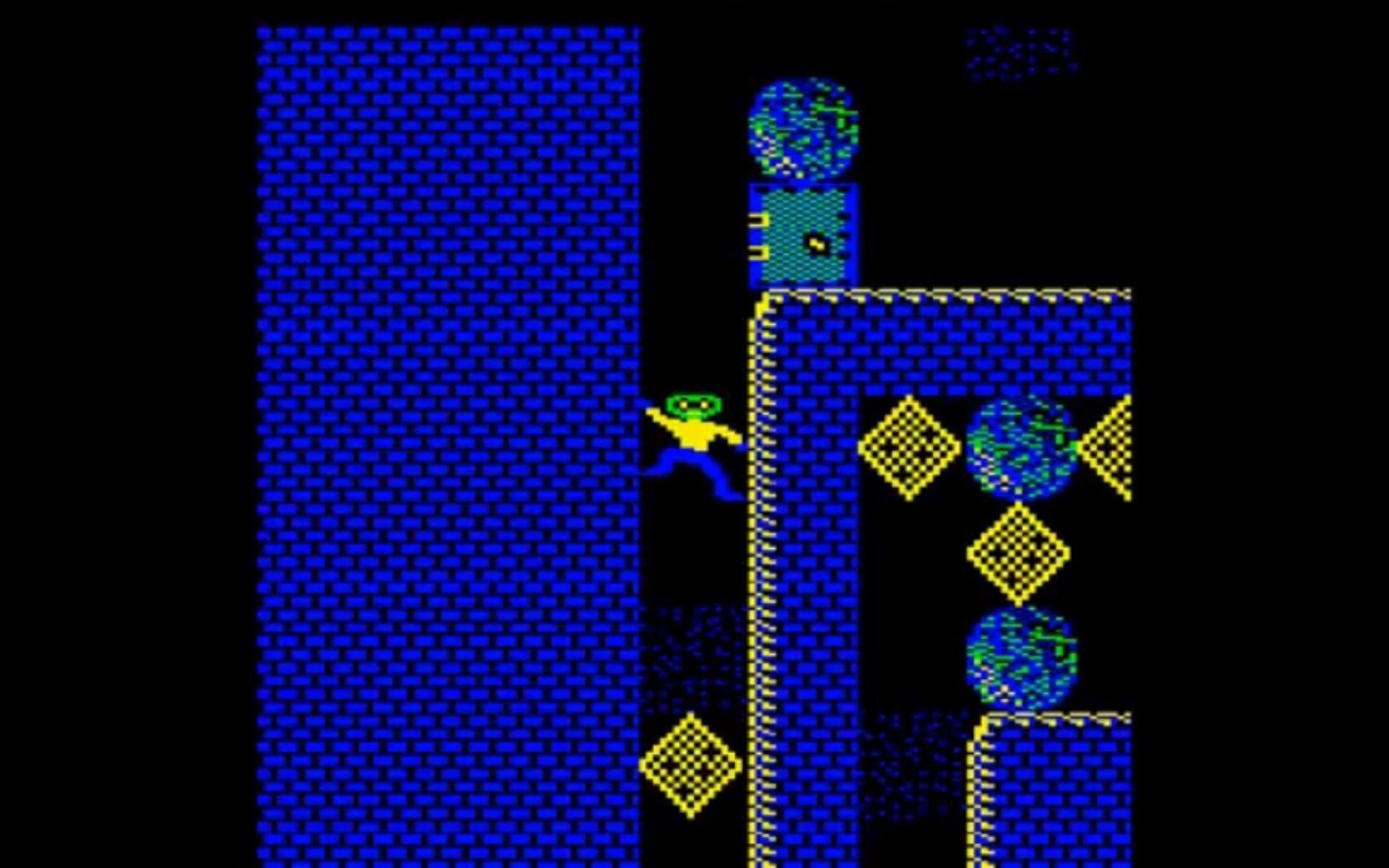
Quite why Repton the lizard wears trousers has never been explained.

Acorn was a wonderful company- and worth a little fuss. This eulogy will be a personal one alighting on three subjects: the Repton series, Exile and Imogen - three games I knew and loved on my BBC Master Compact.

And yes, I'm going to highlight the split in our burgeoning movement - I just said BBC Master Compact! With a three-and-a-half-inch disc! None of your BBC Micro Model B, Master and Electron 5.25-inch floppy trash! So after our revolution we can have a lengthy civil war based around this sole issue - perhaps having stormed EA's Winter Palace and murdered their UK boardroom by stopping their train as they attempt to escape Guildford. Anyway, I digress...

Repton

He's got a green face! He looks left and right! The music goes like this! The basics of Repton involved the collection of diamonds - a quest hindered by cascading falling boulders, monsters that hatch out of eggs that had to be crushed by said boulders and (come later Repton iterations) hovering sprite things that track around the edges of your 2D confines and must be directed into traps. If, on paper, it sounds a little Boulder Dash-y that's because that's exactly how it was born: its 15-year-old creator Tim Tyler read a review of BoulderDash in a magazine, and didn't actually play it, but was inspired nonetheless.

Repton, however, is far more of a puzzle game that Boulder Dash. It's the pursuit of various objects around a map through pushing boulders off ledges, finding the level's key to turn all the nearby safes into diamonds or simply choosing which patches of 'grass' (well, that's what I called it when I was eight anyway) to move over so that boulders, monsters and sprites can move freely through them. And, dear sweet Lord, when you were a primary schooler in the 1980s you found those six-legged two-frames-of-animation green-bastard monsters pretty damn scary...
2

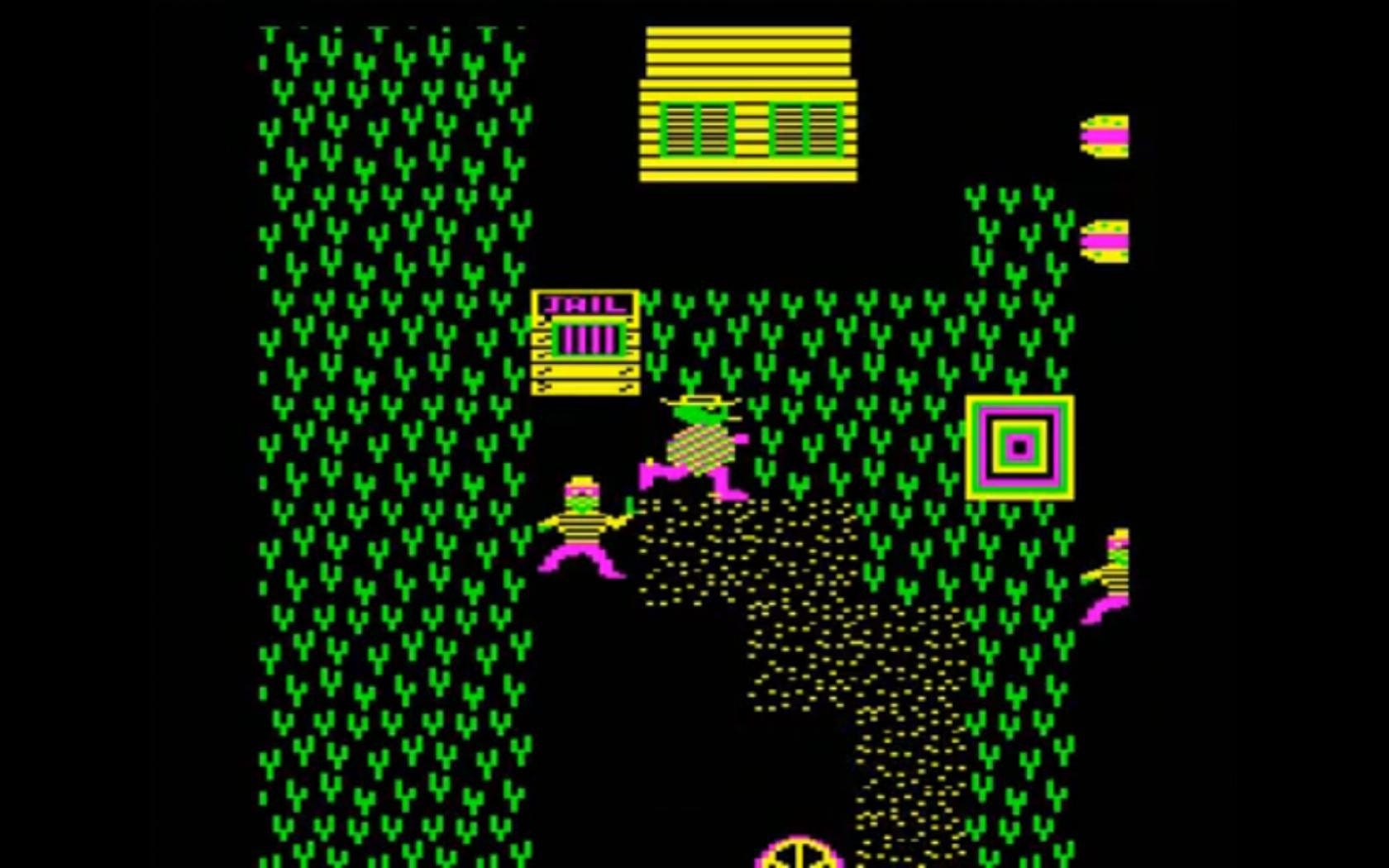
Wild West Repton. That bandit is going to jail, and simultaneously becoming a diamond.

Even more excitingly, by the time Repton 3 rolled around, publisher Superior Software (blessed be its name) pioneered a rather modern trait, by pumping out standalone expansions that took Repton away from his familiar blue walls and blue trousers. Around the World in 40 Screens, for example, took the green-faced diamond obsessive to places like the Wild West (where Sheriff Repton collected burgers, got crushed by Wagon Wheels and was chased by Indians when their wigwams got busted) alongside Africa, the Arctic and Asia - where angry samurai-types would do karate-chops at you should their rickshaw-egg get smashed.

Other re-skins were also available in the forms of Repton Thru Time and The Life of Repton, both of which were sadly better than Repton Infinity, which transported all the action to a floating city and representation of turn-of-the-century American imperialism. No hang on, that's a mix-up. Repton Infinity was just a bit soulless really, and had a rubbish game attached to it where you were a bulldozer who liked fruit.

If you've read all this and still don't get the love for Repton, I will simply direct you to the following YouTube video. This is Repton creator Tim Tyler, and he is about to show you his keyboard. Legend.

Imogen

Imogen is a game in which a wizard can turn into a lovely cat or a lovely monkey. The lovely monkey can climb ropes. The lovely cat can jump quite far. Meanwhile, the wizard carries objects and kills babies. Sometimes he shoots them with a bow and arrow. If there aren't any innocents around to massacre he'll whip dogs and grow tulips out of the freshly harvested guts of crushed hamsters. He is, in short, a monster.

As well as realising the comic potential of a baby falling from a balloon with an arrow lodged in its pudgy belly, Imogen was a masterpiece of puzzle-platforming. Every level was fairly sparse, and entirely coloured in a regimentary light blue, yet every single prop and creature overflowed with character - from simple tables and ledges all the way through to characters like the bulldog you made hungry through ringing a Pavlovian bell having stuck poison in his dogfood.

Each bad-pun level ('Tulips from Hamster-Jam', 'Babboonacy', 'Gnu Problem' etc.) ended in finding a teleport crystal to escape to the next, yet every one contained different animals to torment, different reasons to climb ropes and the very occasional toddler to shoot with a handgun. The lovely cat and the lovely monkey, meanwhile, were so beautifully animated that as a kid I'd occasionally waste one of my strictly limited 150 transforms per game just to see their lovely wavey tails and lovely happy faces.

3

A hamster getting squashed by a monkey. Move along. Nothing to see here.

If you weren't a baby blocking a wizard's way, Imogen was pretty great. In fact you can play a PC version of it online, although the graphics aren't half as nice when they're in colour.

Exile

This is it. This is the big one. This is where the humble BBC Micro takes your Super Metroid, rips it to pieces and forces you to painstakingly reconstruct it over the course of the next 15 hours. As with its BBC familiar Elite, Exile came with its own accompanying novel (because proper games used to come with novels) but it also shared that incredible sensation of exploring a strange and dangerous new worlds - albeit this time in the parameters of a jetpack platformer.

It was huge, it was tough, it was filled with rocket launcher-toting Daleks and it had these green bird things that went 'cheep, cheep, cheep' and followed you around the place. In this day and age it might not sound much, but there's a strong argument for Exile being one of the most pioneering games of all time.

5

"May I use your sideways RAM? y/n"

The game opened on the surface of the planet to which the evil Triax had been exiled - your mission being to retrieve a spaceship-doofer the nasty chap had purloined. Despite not being old enough to know what physics were, what I loved back in the day were the physics. You dropped out of the opening ship and started falling - experimenting with bursts from your jetpack as you did so. You could fly for ages either left our right (the play area was huge) yet incredibly for a computer so creaky the game conjured up a real feeling of being buffeted by intensely strong alien winds - cartwheeling your spaceman back every time he made some ground into what felt like the infinite bounds of this planet's surface.

What I know now (well, what Wikipedia informs me) is that the remarkable movement of your character in Exile was down to a chap called Jeremy Smith, who is sadly no longer with us, yet first programmed the amazing feat of gravity-awareness that was Superior Software's Thrust. What a guy - turns out he pretty much defined my childhood.

Exile's caves were packed full of rarely repeated enemies - often owing more than a little artistic inspiration to the planet Skaro. Insanely tough to kill, even with lob of the game's ultra-rare grenades, most of the early-game involved running away and trying not to disturb the game's rolling (and flying) menagerie. With no on-screen tips, dialogue or anything handholdy of any description, meanwhile, it was up to you to work out just which of the main chamber's many, many passages you should be going down - and just what items might help you.

6

Okay, so some of the enemy robots were a little Star Wars droidy too...

It was a colourful place, garish even, and it was routinely full of sprays of exploding bullets and terrifying homing missiles that would thunder after you through the planet's red tunnels while you tried to shake them off.

Above all games from this era, Exile deserves more recognition. It seems such a shame that the magnificent Elite seems to draw all the BBC plaudits, while all your bloody Manic Miners and Jet Set Willys on those damned silly Sinclair machines eat up the majority of the retro love. Well, no more. Not today. Today is the day that the silent BBC Micro faction rise again! Just has been foreseen, in manuals! I've even made a flag with an owl on it! Those ZX Spectrum scum won't know what hit them! Join me, brother! For we march at dawn!

Author's Note: The Glorious BBC Micro Revolution will be starting early, so it might be a bit cold - our advice would be to wrap up warm. We'll be meeting outside the Houses of Parliament where the basic plan is to replace the statue of Churchill with one of Chris Curry. From then on, it's essentially a riot. If people could avoid ransacking and looting the nearby branch of Simply Food then we thought we'd get lunch there, as there's always something for everyone. Anyway, good luck! First one to murder five Sinclair users gets a limited edition ARM processor!

Comments (124)

Comments for this article are now closed, but please feel free to continue chatting on the forum!

  • Loading...hold tight!