Can Rock Band Save Music Games? • Page 2

Harmonix on making keyboards sexy and crafting its defining statement.

It's fair to say that it's not the best of times to be putting out a music game. With Guitar Hero: Warriors of Rock posting dismal first week sales and DJ Hero 2 failing to break into the UK top 20, there's a consensus that the music genre might be all played out.

Enter Harmonix with its phenomenal Rock Band 3 – a genre-defining experience and one of the finest titles you'll play this year. Eurogamer sat down with project director Daniel Sussman to find out whether creating a near-perfect game will be enough to lift the genre out of the doldrums and where the franchise can possibly go next.

Eurogamer: The game is finally done and it's been picking up some great scores. Are you happy with the finished product?

Daniel Sussman: We're very proud of the work that we did over the last couple of years. One of the things that's interesting about the way we work is that we're very secretive and protective of our products when they're in development so it's always a mystery as to how people are going to receive them.

We have a good track record and we know there is a lot of anticipation for the work that we do but we're very much in the bubble during development so it's nice to see people understanding the motivation behind the decisions we made.

Eurogamer: Were you worried it might have gone the other way; that people wouldn't get it?

Daniel Sussman: The big fear was that nobody would care. A lot of the work we put into the game was to reinvigorate the category and remind people that there are ways to innovate in the music game space.

Coming into this holiday there were a lot of sceptics looking at music games as a trend that was on the decline. We really wanted to remind people that all it takes is an innovative title to re-spark interest.

5

Eurogamer: Guitar Hero: Warriors of Rock and DJ Hero 2 have both really struggled at retail. Are you fearful of a similar fate?

Daniel Sussman: Who knows how the public at large will feel about the game? The early read is that a lot of people are waiting for our game and I hope that turns out to be true.

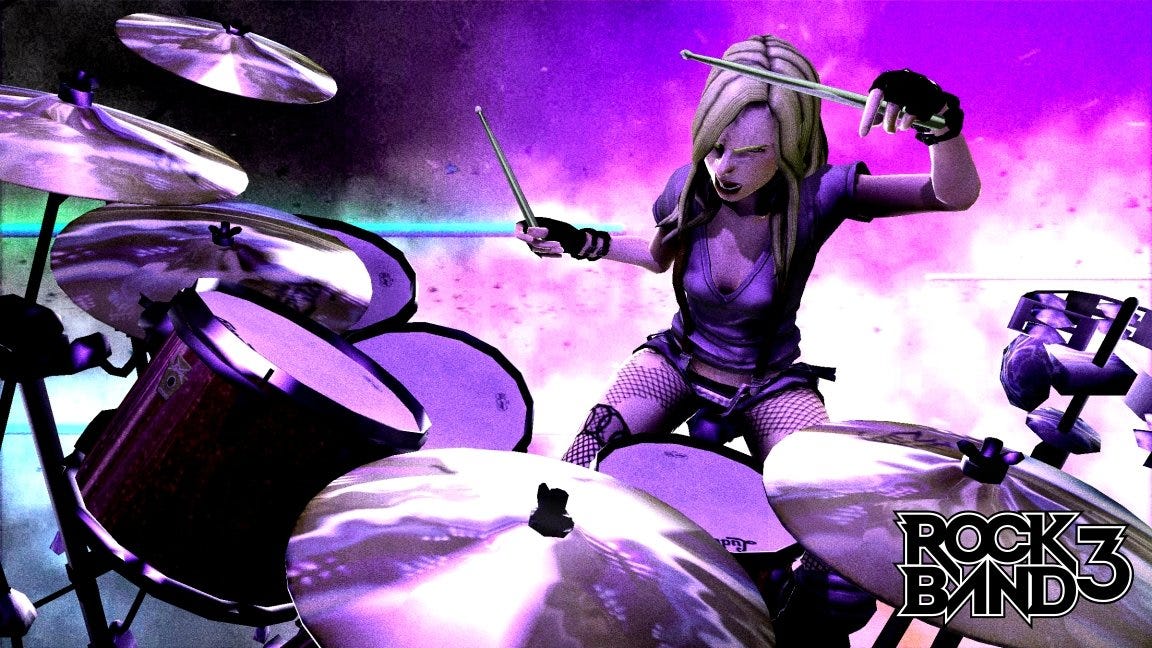
Our studio is all about accessibility and from game to game we've put a lot of emphasis on respecting the casual player. We've played very close attention to that in respect to the keyboard and making sure that, whether you're playing on regular five lane keys or Pro Keys, it's accessible to people who don't have any Rock Band experience. The same with the Pro Guitar.

Eurogamer: Why do you think that Guitar Hero and DJ Hero are struggling this year?

Daniel Sussman: I'm not an analyst. I know that as a game player I'm the type of gamer that would wait and spend my money on Rock Band 3. It's possible that sales of other games in the category are down because people are waiting to spend their money on Rock Band 3. That's what I hope anyway!

Eurogamer: With the keyboard and Pro Guitar, there is clearly a lot of new content for the seasoned Rock Band player. But is there any innovation for the casual player who might not be interested in those bells and whistles?

Daniel Sussman: Absolutely. We re-engineered the entire front end interface so that a player who is looking for a casual experience doesn't have to spend a lot of time configuring band sessions. The time spent in the shell is really minimal, even compared to Rock Band 2. We put a lot of effort into getting people into the game quickly.

I can be playing a song and if you come into the room and want to join in on drums, you can just press a button and join without having me quit out first. It's a lot more modular and streamlined.

6

We've also done a lot of work with respect to the way we track your progress. We are trying to emphasise the 'gameyness' of the experience. Not in a hardcore, 'play on expert and get five stars' kind of way, but in a way that just encourages people to care about their score and rewarding them for beating songs on whatever difficulty.

In Rock Band 2, players had to make a decision as to whether they wanted to play Quick Play, which was super-casual, or play the World Tour, which was considered more hardcore. That choice was polarising for a lot of users.

In Rock Band 3 – whether it's Quick Play or the Road Challenges – everything you're doing is contributing to your progression through the game. You can play however you want to play and you'll still progress and unlock items.

Eurogamer: Why have you only included a freestyle mode for Pro Drums? It seems a missed opportunity now that the other instruments are so versatile.

Daniel Sussman: Drums are really easy because the mapping of pads to sounds is very direct and you can do a lot with samples. Once you get into making actual music with controllers, latency becomes a humongous issue and it's technically very challenging.

To be frank, we had our hands full with the Pro gameplay and the keyboard. Everybody is wondering, 'What could they possibly do next with the franchise?' These things you're talking about here are the things that we've thought about and we're just waiting for the right product to realise it.

Eurogamer: Is that why there are no studio features that allow you to record and edit your own songs?

Daniel Sussman: Absolutely. That's difficult. There are games out there that have put their toe into the water with respect to that. It's difficult to get it right and it's the kind of thing that would require a lot of focus from a very talented team.

If it was to come from Harmonix we'd want to make sure it was done the right way and we didn't have time to do that with Rock Band 3.

Eurogamer: The 102-button Mustang guitar is available from launch and then you're coming out with the stringed Squire later on. Why not settle on just one or the other?

Daniel Sussman: We did a lot of testing and we found that there were a lot of players that were intimidated by the Squire design and the maintenance that comes with owning a guitar.

We see the Mustang as this really great introduction to the world of the guitar for a gamer. It's for someone who doesn't want to worry about callouses, or breaking strings or being out of tune - all that stuff which is very real for anybody who buys a guitar.

That said, the Squire is absolutely the flagship of the Pro Guitar experience. There's something incredibly powerful about being able to play a game and then being able to take the gameplay that you've developed and apply that to an actual guitar.
2

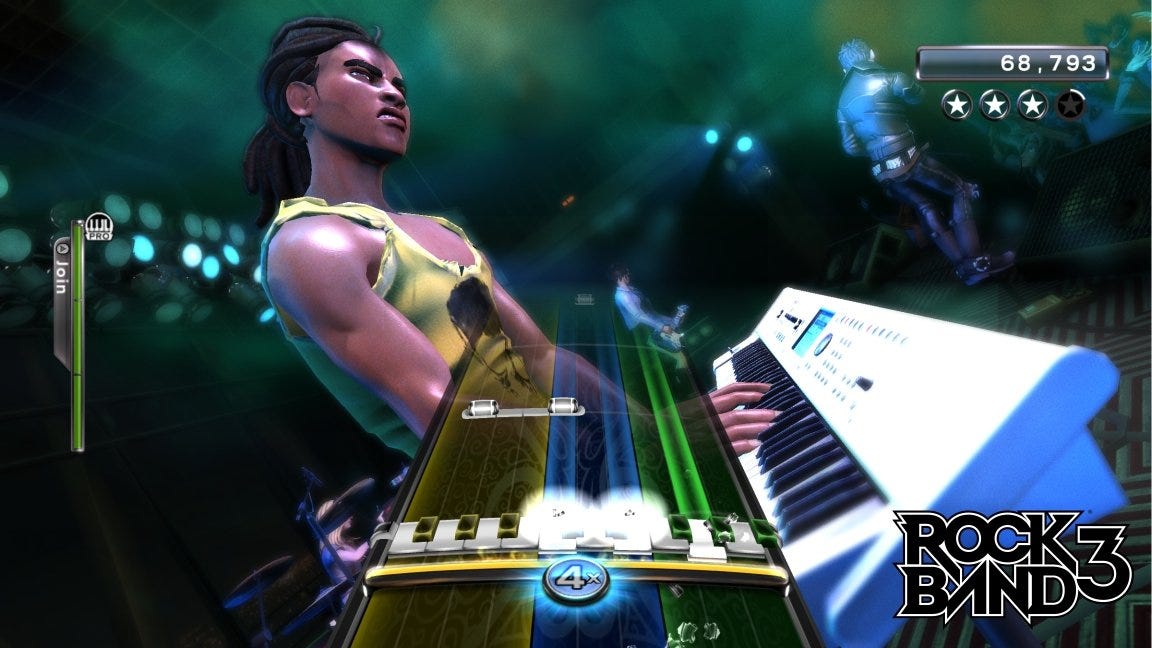
Eurogamer: If you're starting a band for real, who wants to play keyboard? It's just not that sexy, right? What inspired you to include it in the game?

Daniel Sussman: You think about that a lot. Like, who has a fantasy to be a bass player? Who has a fantasy to be a drummer? I think the guitar game is really successful because people do have that fantasy. For us though, it really comes down to gameplay. The fun thing about the keyboard is that it's new.

From a song selection standpoint, it opens things up a lot. I don't think we would have done "Bohemian Rhapsody" without the keyboard as part of the experience, or The Doors or Elton John. It complements the Rock Band library really well. There's a lot of stuff in the back catalogue that we'll be able to go back and apply keyboard parts to that will be really fun to play.

Eurogamer: Was it tough to design? Was there a lot of prototyping?

Daniel Sussman: We understood pretty early on that we wanted as many keys on there as possible and a good entry level keyboard size and shape. The hardware design went pretty smoothly. We spent a lot of time trying to get the software design right.

We were helped by the fact that the interface didn't need to be that abstract. We were very careful about how many lanes we could show at a time and at what point we introduced the rotating track mechanic and how to ramp from easy all the way up to expert. That took some time.
3

Eurogamer: What's your response to the viewpoint that there's too much plastic cluttering up the living room these days. Are you worried about peripheral overkill?

Daniel Sussman: A lot of that comes down to the quality of the peripheral and respect for the fact that people don't have a lot of space. We put a lot of thought into how we could be compatible with what people already have.

We're pretty conscientious about supporting all controllers, whether they're from Rock Band 1, or Band Hero, or whatever. We really focused on a software sale that works with what you already have. If you want to augment that with some of the new things then that's great.

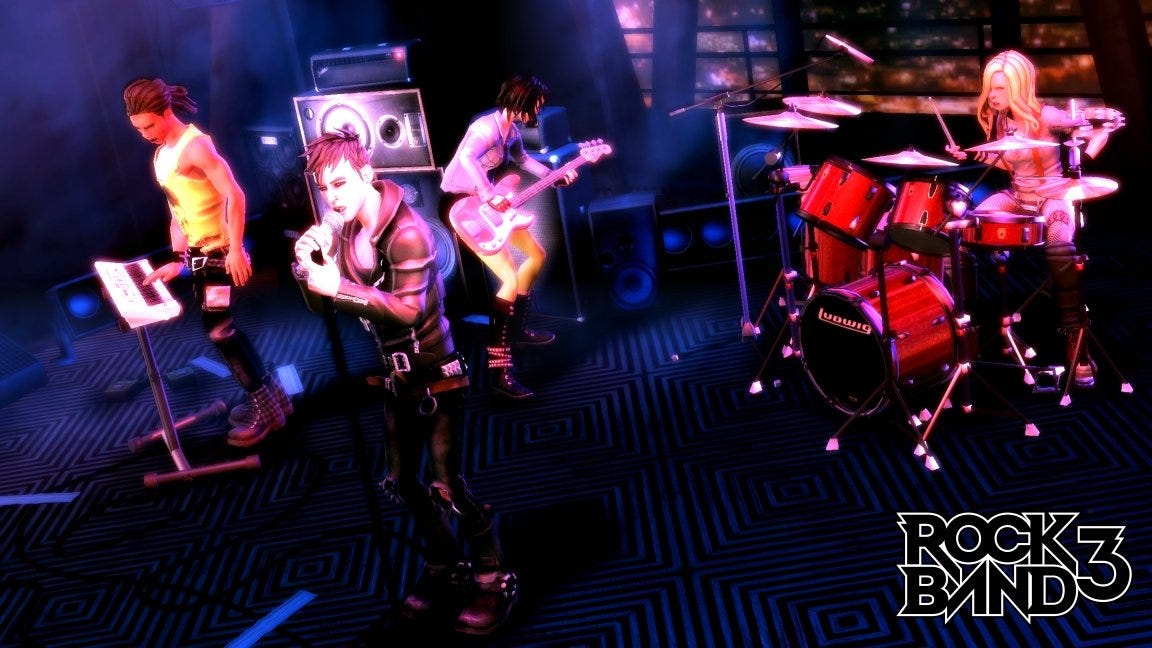
We also put a lot of effort into making sure our controllers look good. They're very close to full scale and they're pretty realistic. I think the Mustang looks really cool. We want to make stuff that people aren't ashamed to have in the living room. We're proud of the way they look, and of course for the first time they're actually real, usable musical instruments too.

Eurogamer: Is this the 'end game' as far as peripherals are concerned? Will any future Rock Band sequel be focused on expanding the gameplay and adding content rather than introducing new instruments?

Daniel Sussman: I don't know. We have very creative people on staff and we have a great relationship with MadCatz and with Fender. Again, we want to be particular when we build in a dependency for players. We don't want anybody to have to buy a new big box and we want to make sure people are getting a return on their investment. If you buy the keyboard we want to make sure that you have a lot of gameplay to access.

I don't want to speak to the future because we are creative people and we are working on very interesting things, I want to leave the door open.
4

Eurogamer: Do you have plans to retro-fit Pro instrument compatibility to old Rock Band tracks?

Daniel Sussman: Yes. What we're messaging is for Rock Band fans to post on RockBand.com and tells us what songs they'd like to see. We're in a position where we can be pretty reactive to that. We can't afford to do everything so we want to see what the community at large wants most.

Eurogamer: Rock Band 3 is obviously a really ambitious title and Harmonix also has Dance Central coming out any day now for Kinect. What's left to achieve in the music genre?

Daniel Sussman: The important thing is just because there's been a game that has worked over the past couple of years doesn't mean that there isn't some mind-blowing new idea out there. I may not have thought of that idea yet but the music game category is not just about a particular game or brand of gameplay.

There are ways to interact with music through videogames that have not been realised yet. Harmonix is pleased to be on the bleeding edge on innovation in that regard – there's all kinds of opportunities out there, and not just for Harmonix but other studios too.

Daniel Sussman is project director for Rock Band at Harmonix. Rock Band 3 is out now on DS, PS3, Wii and Xbox 360.

Comments (33)

Comments for this article are now closed, but please feel free to continue chatting on the forum!

  • Loading...hold tight!