Pokémon Black & White

You know, for kids.

Imagine a world where Pokémon isn't a success. No animé spin-offs, no cuddly plush toys or plastic figurines and most importantly no stigma attached. Instead this niche little RPG is revered among gaming connoisseurs, its players free of the apparent social embarrassment that such associations currently bring.

In its own way, Pokémon is as masterful an example of its art as Advance Wars. Like that series, its biggest problem is that Nintendo – or, if we're being pedantic, Game Freak - got it so gloriously right first time that it's been a struggle to develop beyond cosmetic improvements and negligible additions.

The core gameplay in both franchises is so finely tuned that any significant adjustments would risk upsetting that immaculate balance. Major changes would undoubtedly provoke anger among the established fanbase, minor ones sighs of disappointment. It's no surprise that the latter option is preferred.

Yet Black and White represents the series' biggest evolutionary leap for quite some time – probably since the original Gold and Silver. This is perhaps the closest it has ever come to a reboot: there are 156 new Pokémon, three-on-three battles and completely reworked graphics.

The online aspect is more comprehensive than any other Nintendo game and will likely remain that way until the inevitable Pokémon Grey. For the first time in a long while, Pokémon feels thrillingly different.

Up to a point anyway, because there remains a comforting familiarity about the setup. There's still a kindly Pokémon professor who provides you with a choice of Grass, Fire or Water starters at the outset. You still fight eight gym leaders and collect badges from them before facing an elite group of trainers to become Pokémon champion.

You still have HM moves like Cut and Surf and Fly, and one Pokémon who you burden with as many of them as possible. And in the early hours of the game, there's still one Pokémon who you get sick of the sight of because they're always hanging around in the wild grass waiting for a scrap. Sorry Minezumi, you're the new Rattata.
1

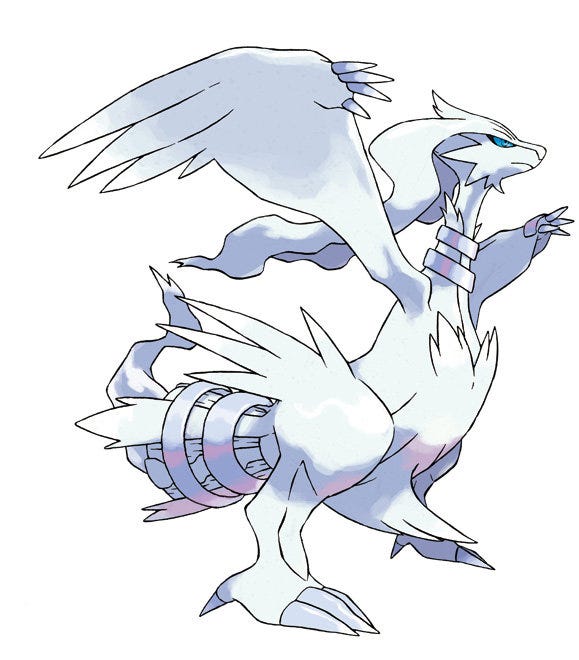
Each version has a handful of exclusive Pokémon – curiously enough Reshiram here is the legendary for Black...

The regularity of such encounters is less of a problem than it was because everything's much quicker than before. Battles have been impressively streamlined so energy bars rapidly deplete rather than slowly crawling backwards. An icon quickly flashes up whenever a Pokémon is afflicted by status effects or boosted by its special ability, rather than another pile of text to slow things down.

Those aren't the only features that make combat feel slicker and more intense. The camera zooms and pans to better show off the moves and the Pokémon themselves, who are more animated than ever before, hopping from foot to foot impatiently as they wait their turn.

The sprite-scaling effects are similar to Square-Enix's The World Ends With You, and so those nearest to you look a little blocky, but the hypnotically looping movements of your monsters and the restless camera make it far more interesting to watch so you'll forgive the chunkier pixels.

You could even argue that it's a deliberate stylistic choice, triggering fond memories for those old enough to remember the low-res characters in the original Red and Blue versions. You'd probably be wrong, but if it is an accident then it's a happy one.

Outside battle you'll notice a number of graphical changes. The first major city you come to is reached via a gigantic suspension bridge, with the camera steadily rising as you cross until you're barely a dot, dwarfed by the trucks passing by the side of you and the freighters sailing underneath.

Pokémon worlds have always been pretty large, but they've never made you feel quite so small. It heightens the sense of being on an epic journey, something the earlier games managed to capture but rarely as impressively as this one.

Cherry blossoms gently float across the screen as you enter the first town while another area sees sand and dust is violently blown by powerful desert winds. A big wheel whirls in 3D in one city, its gym seeing you travel to its leader by space pods doing loop-de-loops on electronic rails.

There are seasonal changes, too, which in the accelerated timescale of the Isshu region come around once a month. It might be nothing more than an environmental reskin but it adds to the sense of place.

The new menagerie is, as ever, a bit of a mixed bag. Some of the designs are terrific, others are awful and a few are so bizarre they almost defy description. As if pre-empting internet criticism, Game Freak has included a Pokémon which is literally a pile of rubbish.

The final evolution of the grass snake starter is at once elegant and imposing while the fire pig's evo looks a bit like Brian Blessed. There's a fluffy puppy which evolves into a Yorkshire terrier, which in turn transforms into a morbidly obese Yorkshire terrier.

Another looks like the love child of a poodle and a grumpy clown and wields a large metal girder; its evolution tightly grips two large cylindrical stones, as if it was trying to mend the Acropolis but went overboard on the superglue. One Pokémon is – yes, really – an ice cream. With twin and triple-cone forms when you level up.

But then you try drawing 649 monsters and not come up with a few duffers. For the most part, they're interesting, likeable and well-animated, and there are some delightful creative touches - like a snail inside a knight's helmet transforming into a surly slug when its metallic shell is stolen by a bug Pokémon mid- trade.

And their battle cries don't sound so much like broken fax machines any more, which is a definite bonus. Musharna in particular sounds like something from Brian Eno's sample bank.

Outside battles the touch screen is used to access the C-Gear. This device constantly searches for infra-red, local wireless or online wi-fi connections, allowing you to instantly battle or trade with friends.

The process of trading via infra-red in particular is noticeably less laborious than before. Via the wireless feature you can access a place called the Dream World where you're able to sync your game up to a Pokémon Global Link account on your PC.

2

...While Zekrom features in White. Each game has an exclusive area – Black City and White Forest.

The intricacies of this will only become clear with an English-language copy of the game, but it seems you'll be able to encounter Pokémon from other regions which can then be discovered within certain areas of Isshu.

There's also an option for local video chat with friends, though given that all players need to be within range of the wireless signal it'd surely just be quicker to actually talk to them face to face.

Perhaps it's helpful if someone needs the toilet mid-conversation, though I imagine it's a fairly small percentage of gamers who like to chat about Pokémon in groups while one drops the kids off at the pool.

Anyway, with Nintendo vigorously promoting the idea of 3DS as an always-on wireless communication device, the C-Gear effectively acts as its precursor: an ingenious way of using a hugely popular title to get players accustomed to the concept.

A 'pass by' mode which exchanges player data from chance encounters between those who keep their consoles on standby – as in Dragon Quest IX - seals the deal. The saturation of the DS and both games in Japan may mean it's East rather than West which benefits most from these features, but what better game than Pokémon to see such a phenomenon take off on these shores?

Elsewhere, the new Battle Subway – apparently inspired by a Game Freak employee travelling on the Tube after a Millwall game – replaces the Battle Towers of old, offering the option to team up with a friend over wi-fi to take down AI trainers or simply to fight some of the game's toughest encounters alone.

There are plenty of other asides besides, like the thoroughly silly Pokémon musicals, where you can kit out your favourite monster in a top hat and grass skirt before sending it out to wow the audience with its skills at bouncing up and down and rotating on the spot.

The story remains impenetrable in Japanese and it'll take more time before all the hidden complexities become apparent. But the beauty of Pokémon is that it's as simple or as deep as you make it. All I know is, 30 hours in and six gym badges won, I'm still discovering new stuff and having a ball doing so. If Pokémon really is a kids' game, growing up seems hugely overrated.

Pokémon Black & White is slated for a spring 2011 release in Europe.

Comments (31)

Comments for this article are now closed, but please feel free to continue chatting on the forum!

  • Loading...hold tight!