Okamiden
Wolf parade.

Okami is, in my estimation, the only challenger ever to have beaten Zelda at its own game. It shared Zelda's themes and its structure – exploration and discovery, gentle but absorbing puzzling, an unobtrusive but captivating narrative gently ushering you through a sequence of towns and dungeons whilst leaving you free to distract yourself.
However, its personality was stronger. It had irrepressible wit and breathtaking artistic direction, and an entirely unique, game-changing idea in the Celestial Brush; it remains one of the most beautiful and memorable games you could ever play.
No one bought it, depressingly. But it was just too beautiful to be allowed to fade away. After Clover Studios dissolved, two senior members of staff at Capcom took Okami on. Both are huge admirers of the original game and both are committed to taking it further.
They are Motohide Eshiro and Kuniomi Matsushita, producer and director. They showed me a translated section of Okamiden at the Tokyo Game Show this year, a few weeks before its Japanese release.
"By the time Okami came out at the end of the PS2 lifecycle it was overshadowed by other news," says Eshiro, on being asked whether he felt the game met its full potential. "The timing for it just wasn't there. But it did reach a good amount of people, enough that it started to get known, and every time we released a new version of the game – the PS2 original, the Best Price version, then the Wii version – we saw sales going up.
"We wanted to make a game for that fanbase, but not just for them – it needed to be put into new people's hands as well, and the way we wanted to do that was by bringing it to the DS. It has such a huge install base, and you can make a game that's more affordable to a larger group of people."
"There are a lot of people who did hear about Okami, but who didn't play it; they kind of know what it is, but it doesn't have the name recognition," adds Matsushita. "So now we hope that people who have been aware of Okami in the back of their mind will pick up Okamiden to see what it's about."
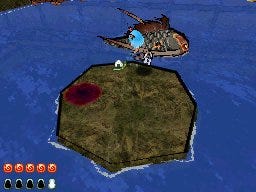
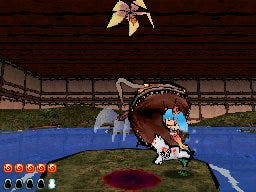
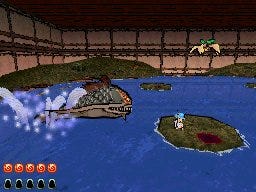
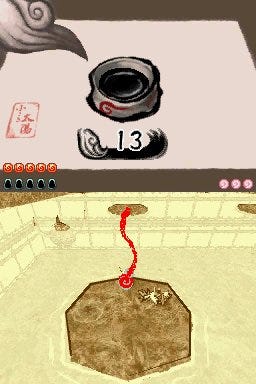
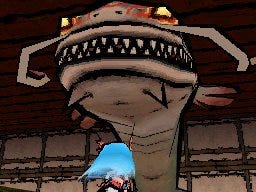
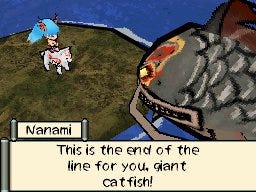
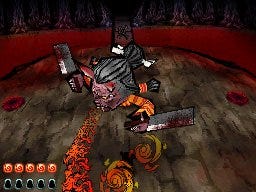
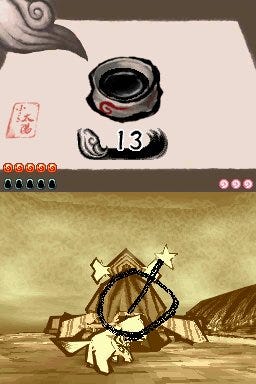
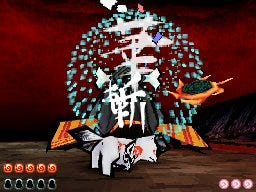
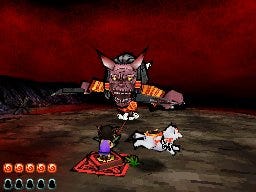
Okamiden stars Chibiterasu, an adorable white wolf-pup, and his mates - among them Kuni the miniature warrior and Namami the mermaid - who ride around on his back. The demo opens in a surreal, otherworldly market, run by Spirited Away-like apparitions.
The demons' stalls with their weird, unidentifiable wares are lit up against the dark forest like the lantern-adorned stands at a matsuri festival. Before they enter, young Kuni gets Chibiterasu to draw him a mask to wear as a disguise. It's the first of many touch screen-inspired vignettes to make me smile.
"When we thought about making a new Okami, we thought, what can we do what's new and different?" Eshiro says. "The celestial brush was the key thing – we wanted to bring that to life, fully realise it, and for us it was a no-brainer because the DS has the stylus and the touch-screen, so you can directly interact with the world. If there had been no DS, I don't know what we would have done."
Familiar Celestial Brush powers are there, too – you can still investigate cracks in walls with hastily-drawn cherry bombs, still slash enemies in mid-air, still fill in broken bridges and dot incomplete constellations with missing stars.
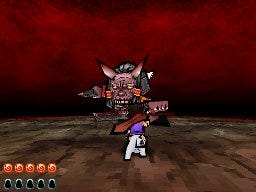
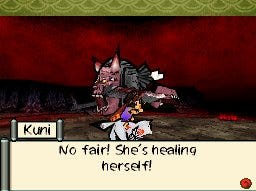
The translation is witty and conversational; on-screen text is accompanied by lively nonsensical jabbering. After exploring the market for bizarre items – Fire Eyes, Ice Mouths, Thunder Ears – and chattering to the demons, we skip ahead to the Witch Queen, a monstrous, giant-headed hag who brandishes two meat cleavers, like a murderous Yubaba.
As in the original Okami boss fights aren't three-hits-and-they're-down pushovers, but much more Capcom-esque battles of will and attrition. The Witch Queen defends herself with the cleavers, forcing you get around behind her; once you've got enough damage in, she starts healing herself with altars that pop out of the ground. You have to leave cowering Kuni stood on a switch to get rid of them whilst you continue the fight.