WWE Smackdown vs Raw 2011
Mustn't rumble?

When the WWE took over most of LA last weekend for the Summer Slam pay-per-view, modern day California got a taste of something 19th Century America would have been intimately familiar with: the circus had come to town. The contemporary circus may have huge, HD displays, licensing deals with SlimJim and circling clusters of TV helicopters, but it's retained quite a bit of the older feel too. There's the same friendly opportunism, gaudiness and contradictory blend of cynicism and uplift that only arises when the audience is in on the joke.
Many of the wrestlers stayed at the Sheraton Downtown. Padding through the squeaky-floored lobby or bunching together in bulky groups in the restaurant, they made for an odd sight. They kept in character for the kids and grimaced for photographs when necessary, but they also hung out like old colleagues shooting the breeze at a two-day printer toner seminar. There was plenty of shop talk and plenty of catching up on family life. Current stars like Seamus wandered around cheerily with those fake-but-real championship belts slung over their shoulders (accompanied by fake-but-real pride on their faces), while Bret Hart - smart, self-deprecating, and only mildly haunted - sat with a few friends in a corner of the hotel bar, gently turning a wine glass filled with mineral water around in his huge hands.
There was someone else in the Sheraton lobby, too: a lanky boy in his late teens, who didn't appear to be staying at the hotel. He was positioned all day, every day, over by the gift store, however, leaning awkwardly against a wall, wearing a faded John Cena cap and a variety of ill-fitting shirts and hoping to shake hands with a few of his heroes. He had thickish glasses and patches of whispy stubble that spoke of great, unfulfilled beard ambitions, and he knew so much about wrestling that he almost certainly could have held a Ph.D in it. Possibly from Bolton University. How far had he travelled to be there? Where were his parents? He looked happy enough, even if he was generally too shy to speak to the superstars when they did pass nearby.
With its latest Smackdown vs Raw instalment, THQ has to please people such as him and that might not be so easy. Because, to people such as him, wrestling is complex and mysterious, like some manner of early religion. It's a sport, sure - a series of bluntly sculpted finishers which shake canvas and send sweat flying into the crowd - but it's something deeper, too: a fable, powered by twin engines of hick morality and a dark, capitalist sense of humour - a brutally twisty soap opera concerned with the garish lives of a handful of grumpy superheroes.
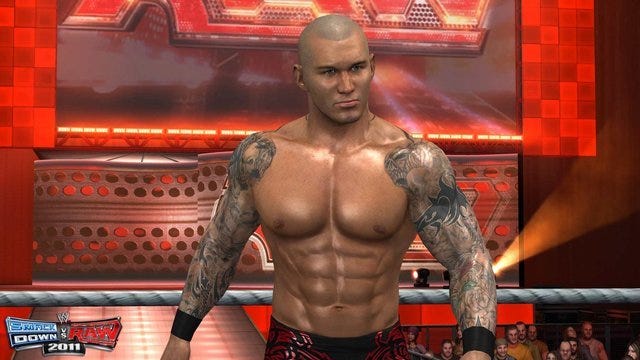
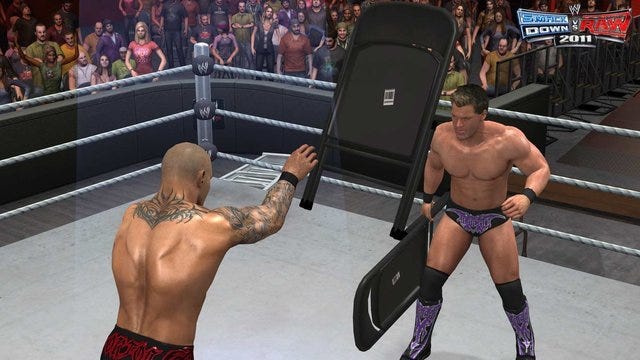
This year, the publisher is making a pretty good run at capturing both sides of the WWE universe, by the looks of it. As a simulation of wrestling - or a simulation of the fantasy of wrestling, in which punches really collide and the ringside stretchers are genuinely there to take people to hospitals - Smackdown vs Raw 2011 is a familiar mix of the carefully-crafted and the ever-so-faintly ropey. Character models are fantastic, for the most part: skin is wet with sweat but not plasticy, while facial detailing perfectly captures The Miz's sneer and The Undertaker's otherworldly grimace.
The animations, on the other hand, can seem a little too stilted as they jump between one move and the next, and the more elaborate connections often lack weight - at least in the current build. There are plenty of moves available and once again, players can create their own finishers by stitching together individual grabs, pummels, throws and flips, chaining together up to 10 separate pieces. But the system of counters is a little too forgiving in the preview code, meaning that grapples can be cancelled out fairly easily and matches can descend into hilariously lengthy stalemates.