Videogames often mirror the values of the culture they emerge from. Tetris' Eastern blocks must be stacked and tidied with Soviet efficiency, the endgame payoff a rocket ship - that highest of all Russian technological ambitions – finally setting off for the moon.
Lara Croft embodies the imagined adventuring spirit of the British aristocracy: old money funding trinket tourism, the pilfering of foreign tombs to bring back Elgin treasures with which to furnish our great nation's stately home museums. Master Chief, meanwhile, is the all American hero, riding a warthog through the apocalypse to bring about the universe's salvation, planting flags to mark the occasion with imperialistic glee to the applause of his square-jaw, five-starred general superiors.
So too does the Japanese RPG reflect the cultural values of its nation, with endless tales of adolescents charged with saving the world via a strong work ethic. If there were any doubt as to the message to young Japanese players that glory is born of industry, in Atelier Rorona, the metaphor is made explicit.
Rorona, the girl who you play as, is charged with reversing the fortunes of a failed village chemist. She is given 12 assignments to complete over a three-year period, at which point the council will decide whether the shop should keep its premises and continue its work, or be closed down, its staff deported from the land. It may not be the most scintillating premise, but Atelier Rorona may be closest a videogame has ever come to articulating The Japanese Dream.
Before synthesising any item Rorona will comment on the proposed recipe, giving a hint as to how likely it is that she will successfully complete the order.
As is right and proper for any young Japanese female, Rorona does not seek such responsibility but rather has it thrust upon her. A nervous and somewhat panicky girl, voiced by the sort of helium-voiced, simpering American actress who routinely gives voice to this anime archetype, she works for Astrid, the owner of the chemist.
Astrid, who wears a clutch of test tubes on her utility belt like some sort of Chemistry-themed action hero, is a lazy and disliked public figure in the community. At the start of the game, following the council's pronouncement, she hands the business over to Rorona - who, despite having worked there for some time, appears to know nothing about how it all works.
Her lack of experience and knowledge is, of course, a device to allow Gust to explain the game's systems to new players. The core objective of the game is to increase Rorona's alchemy proficiency by harvesting ingredients from the local fields and woods and making recipes, or 'synthesising', in a giant cauldron.
Rorona earns experience for every recipe successfully completed and when she levels up new recipes become available. The system is an expanded, more convoluted version of that found in many JRPGs, from Star Ocean to Dragon Quest. But here cooking up items is the primary focus of the game instead of a sideshow event.
Harvesting ingredients requires Rorona and up to two hired accomplices to leave the safety of the town and head out into the wild, where they must do battle with the local wildlife. The battle system appears simple and somewhat antiquated, a turn-based affair without much flair or ambition, at least in the game's early stages we had access to.
Ingredients must be gathered from the field environment, harvest points marked with exclamation points attached to landmarks. Rorona can carry up to 60 items in her basket so it's possible to spend a decent amount of time exploring before you need to return back to the shop in order to unload and recuperate health points by sleeping on the couch there. That said, perishable items found in the wild deteriorate with time; you need to either rush back to the workshop or put them in a container to extend their life.
The council issues Rorona with a new assignment every three months of in-game time, up to a total of 12 assignments for the three-year duration of the experience. Each assignment must be successfully completed or you'll need to return to an old save and restart it, despite the fact that game has multiple branch points in terms of its core storyline.
The quality of the translation is of the usual Nippon Ichi standard, generally robust but lacking in the flair seen in Atlus or current Square-Enix titles.
As well as making the shop a financial success, Rorona is charged with improving its general reputation, which has been tarnished in the community by Astrid's behaviour. This is accomplished by taking on 'Front Tasks', side quests issued by the townsfolk in between the main business concerns.
Considering this is the first Atelier game to be rendered in 3D, and that it doesn't feature the hand-drawn 2D aesthetic of the previous games in the series, the visuals are something of a disappointment. Game areas are small and the uninspired lighting does no favours for the rudimentary 3D environments.
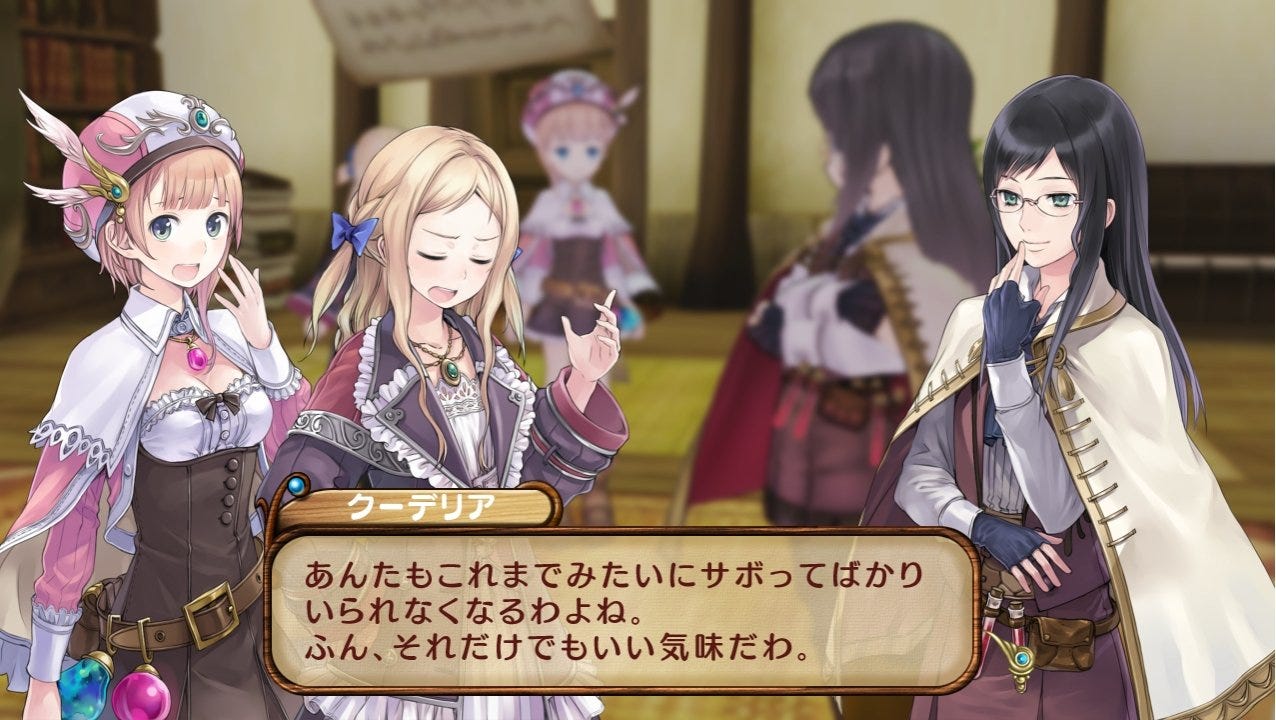
Nevertheless the cel-shade effect applied to the characters works well; these models are comparable to Level 5's earlier work in terms of detail and design. The world is navigated via 2D, watercolour maps, menu lists highlighting what enemies can be expected in each gathering location, as well as the primary items you can expect to harvest there. By contrast, the game's copious cut scenes play out with highly detailed but unanimated 2D sprites conversing in text boxes, a hotchpotch of art-styles as diverse as the ingredients in one of the game's recipes.
While Japanese players are familiar with both alchemy titles and cutesy but asinine shop-running sims, these curios are rarely translated into English. With a sequel already out in Japan, Atelier Rorona's success over there is already proven. While it seems unlikely the game will break out from the smallest of niche audiences in Europe, its release here in September is nevertheless welcome, providing some much needed spice and diversity to autumn release schedule.
